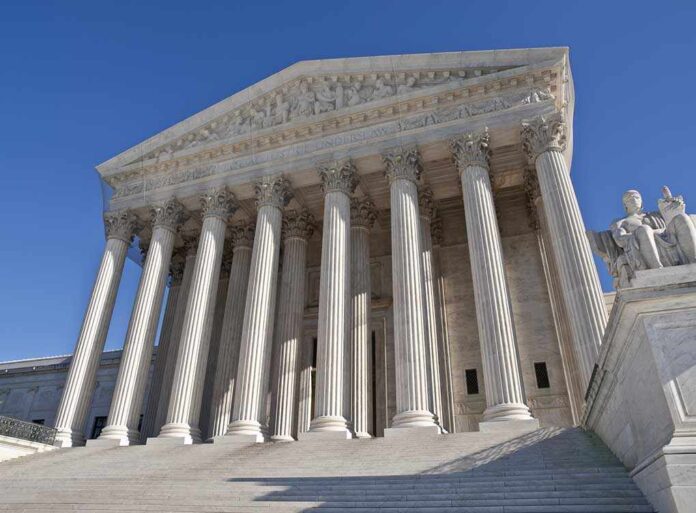
Justice Clarence Thomas’s blunt dismissal of legal precedent as “not the gospel” has thrown the Supreme Court—and the nation—into a state of suspense, as Americans now wait to see which bedrock rights may be pried loose from their constitutional foundations.
Story Highlights
- Thomas questions the sanctity of Supreme Court precedents, likening blind adherence to riding a train with no idea who’s at the controls.
- The Court faces a pivotal term, with cases challenging foundational rulings on presidential powers, voting rights, and same-sex marriage.
- The principle of stare decisis—long a stabilizing force in American law—is under intensified scrutiny.
- Legal scholars warn of instability; conservative voices tout fidelity to original constitutional meanings.
Clarence Thomas’s Precedent Critique Unsettles Legal Consensus
Justice Clarence Thomas stood before law students at Catholic University’s Columbus School of Law and delivered an assertion that sent a tremor through America’s legal community. “Precedent is not the gospel,” he declared, urging the Supreme Court to treat its settled decisions with skepticism rather than reverence. Thomas’s analogy—comparing adherence to precedent to riding a train not knowing whether a conductor or an orangutan is at the helm—was as provocative as it was direct. This speech landed days before a Supreme Court term set to reconsider major decisions, making his words both a warning and a challenge to the legal status quo.
Thomas’s remarks come at a moment of rare volatility for the high court. The conservative majority, emboldened by recent victories, is poised to hear cases that could overturn long-standing rulings on agency independence, voting rights, and LGBTQ+ protections. His skepticism toward stare decisis—the doctrine that courts should respect precedent—signals a willingness to upend not just specific decisions but the very architecture of American legal continuity.
Clarence Thomas Gives Bonkers Reason for SCOTUS to Tear Up Settled Laws https://t.co/zttsJRgkqM via @@YahooNews
— Pamela Dubsky #BoycottNRA (@pameladubsky49) September 28, 2025
The History and Stakes Behind Stare Decisis
The principle of stare decisis has anchored the U.S. legal system for centuries, ensuring that yesterday’s decisions inform tomorrow’s outcomes and providing stability for citizens, businesses, and government alike. Yet the Supreme Court has reversed precedent in landmark moments, such as Brown v. Board of Education and, more recently, Dobbs v. Jackson Women’s Health Organization. Thomas has long argued that many substantive due process cases—from contraception access to same-sex marriage—rest on shaky constitutional ground. His call for scrutiny is not theoretical; his 2022 Dobbs concurrence explicitly urged a reconsideration of Griswold, Lawrence, and Obergefell, inviting the Court to dismantle rights many assumed were secure.
With several cases on this term’s docket challenging foundational precedents, Thomas’s vision is no longer a fringe perspective. The conservative bloc, with Thomas and Justice Alito most closely aligned, can now overturn precedent on a 5-4 or 6-3 split. Liberal justices, advocacy groups, and much of the legal academy warn that such moves threaten legal stability and minority protections, while conservative thinkers argue that fidelity to the Constitution sometimes demands tearing up flawed past decisions.
Inside the Supreme Court: Alignments and Power Plays
Power on the Supreme Court now pivots on ideological alliances and individual philosophies. Thomas and Alito agree in nearly all cases, forming the core of the conservative majority. Justices Barrett, Gorsuch, and Chief Justice Roberts, while not as outspoken, have signaled openness to revisiting precedent under the right circumstances. On the other side, Justices Kagan and Jackson frame precedent as a bulwark against judicial caprice and a safeguard for vulnerable populations. The dynamics within the Court ensure that every term is a battleground, with the potential for seismic shifts in American law emerging from a single vote.
The effects of this new judicial philosophy ripple far beyond the courtroom. Federal agencies like the FTC could lose longstanding protections, exposing them to political interference and undermining regulatory stability. Minority communities—LGBTQ+, racial, and religious—face renewed threats to rights secured over decades of legal struggle. Even the legal profession itself must now advise clients in an environment where yesterday’s settled law may disappear tomorrow, fueling uncertainty and raising the stakes for every Supreme Court case.
Legal Experts React: Stability Versus Constitutional Fidelity
Legal scholars and practitioners are divided. Some warn that undermining stare decisis erodes public trust in the judiciary, making rights contingent on the politics of the moment. Others point to history, noting that some reversals—like Brown v. Board—were necessary corrections. Conservative commentators defend Thomas, arguing that constitutional fidelity requires an honest reckoning with errors, no matter how longstanding. The debate is no longer academic. The Court’s willingness to break with precedent has already upended abortion rights and now threatens further changes to marriage, voting, and agency law.
Thomas’s vision—rooted in originalism and skepticism toward the accumulated weight of precedent—has become a driving force, shaping the questions justices will ask and the answers they may deliver. Whether this heralds a renaissance of constitutional interpretation or a period of legal instability remains the open question at the heart of America’s judicial future.