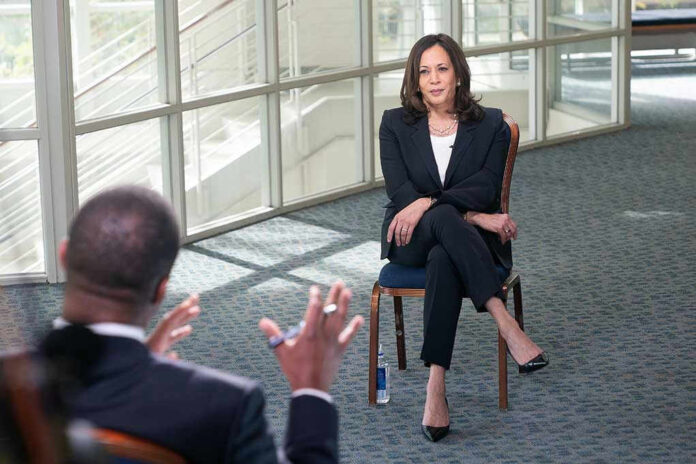
Kamala Harris delivers a wake-up call to the Democratic Party, accusing them of being entrenched in outdated strategies and misreading the public mood.
Story Snapshot
- Harris critiques the Democratic Party’s outdated voter assumptions.
- Her memoir and public remarks highlight internal party tensions.
- Way to Win report challenges the narrative of leftist blame for losses.
- Harris pushes for a future-oriented Democratic vision.
Harris’s Critique of Democratic Strategies
Kamala Harris, in a candid assessment, has accused the Democratic Party of being “stuck in the past” following their defeat in the 2024 elections. Her critique centers on the party’s failure to adapt to the evolving electorate and their reliance on outdated strategies. Harris’s comments, part of her post-election reflections and memoir, reveal deep-seated frustrations with the party’s leadership, particularly in their handling of key issues like economic discontent and foreign policy.
Way to Win, a Democratic-aligned strategy network, supports Harris’s assertions, highlighting that the party’s leadership misjudged voter priorities. Their analysis disputes the common narrative that leftist demands were to blame for the losses, instead pointing to economic frustrations and a fragmented coalition as primary factors. This data-driven perspective challenges the traditional establishment’s view, calling for a reevaluation of how the party engages with its base.
Impact of Harris’s Memoir and Public Commentary
Harris’s memoir pulls no punches, offering a critical view of Joe Biden’s decision to run for re-election in 2024, which she describes as “reckless.” Her book and subsequent public appearances have sparked controversy within the Democratic ranks, as she openly challenges the decision-making processes of her peers. Her critiques extend to notable figures like Pete Buttigieg, Josh Shapiro, and Mark Kelly, reflecting her dissatisfaction with the party’s current trajectory.
The memoir has been a catalyst for broader intra-party debates about the Democratic Party’s future. Harris’s call for a forward-looking vision resonates with reform-minded activists and donors, but it also risks alienating establishment figures whose support could be crucial for her potential 2028 presidential bid. Her insistence on addressing the party’s strategic stagnation underscores her commitment to driving change from within.
The Role of Way to Win in Shaping the Narrative
The Way to Win report serves as a pivotal element in the ongoing discourse about the Democratic Party’s failures in 2024. By emphasizing economic grievances and the fractured nature of the Democratic coalition, the report challenges the simplistic blame placed on progressive activists. It calls for a shift in focus toward long-term organizing and narrative development to counter the right-wing media’s influence.
Kamala Harris Gives Blunt Review of 'Stuck in the Past' Democratic Party https://t.co/itD2TsRqPf
— Mediaite (@Mediaite) December 17, 2025
This perspective aligns with Harris’s criticism of the party’s outdated strategies and highlights the need for a more nuanced approach to addressing voter concerns. The report’s conclusions advocate for a comprehensive reevaluation of the party’s strategies, urging leaders to embrace new methods of engagement and messaging that resonate with the electorate’s evolving priorities.
Looking Ahead: The Democratic Party’s Path Forward
As the Democratic Party grapples with the fallout from the 2024 elections, Harris’s call for a future-oriented vision remains a focal point of internal discussions. Her critiques, combined with the Way to Win report, have amplified the need for a strategic realignment that addresses the root causes of voter disaffection. The party’s ability to adapt and evolve will be crucial in shaping its trajectory ahead of the 2028 elections.
Harris’s role as both a participant and critic within the Democratic establishment positions her uniquely in the ongoing debate about the party’s direction. Her willingness to challenge entrenched assumptions and advocate for change reflects a broader movement within the party to redefine its identity and priorities. As the Democratic Party navigates these turbulent waters, the insights offered by Harris and Way to Win will continue to shape the conversation about its future.