
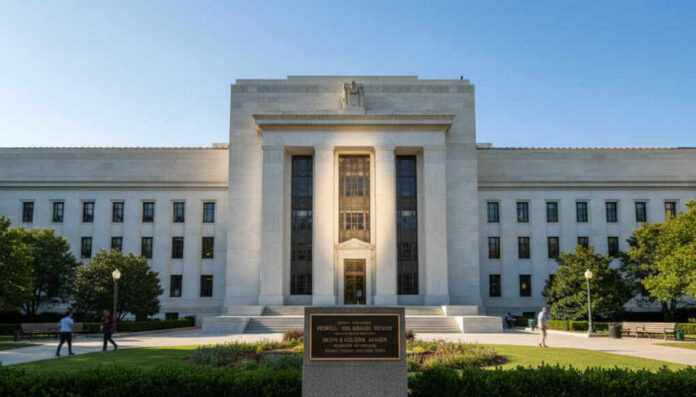
President Trump’s nomination of Kevin Warsh to replace Jerome Powell as Federal Reserve Chair signals a seismic shift toward reining in the unelected bureaucrats who have long operated beyond accountability, potentially ending the era of an overreaching central bank that has devastated American families with inflation and economic mismanagement.
Story Snapshot
- Trump announced Kevin Warsh as his nominee for Federal Reserve Chair on January 30, 2026, to replace Jerome Powell when his term expires in May
- Warsh, 55, served as the youngest Fed governor from 2006-2011 and is known for opposing quantitative easing, Fed overreach, and mission creep
- The nomination comes amid a Justice Department criminal probe into Powell and a Supreme Court review of Fed independence
- Warsh’s appointment could reshape monetary policy with a focus on curbing inflation, shrinking the Fed’s balance sheet, and reducing government overreach
Trump’s Bold Move Against Fed Dysfunction
President Donald Trump declared his intention to nominate Kevin Warsh as the next Federal Reserve Chair on January 30, 2026, praising him as potentially “one of the GREAT Fed Chairmen, maybe the best.” The announcement, made via Truth Social, directly challenges the status quo of a Federal Reserve that has kept interest rates stubbornly high at 4.25%-4.5%, crushing everyday Americans with unaffordable mortgages and car loans. Trump’s frustration with current Chair Jerome Powell’s refusal to cut rates aggressively has been well-documented, and this nomination represents a decisive break from an institution that has lost its way under Powell’s leadership.
Warsh’s Record of Fighting Fed Overreach
Kevin Warsh brings credentials that should reassure conservatives worried about unchecked government power. He served as a Federal Reserve governor from 2006 to 2011 after advising President George W. Bush’s White House and working at Morgan Stanley following his education at Stanford and Harvard Law. During his Fed tenure, Warsh acted as Wall Street liaison during the 2008 financial crisis but resigned in 2011 over fundamental disagreements with quantitative easing policies that ballooned the Fed’s balance sheet. His consistent opposition to QE, regulatory mission creep, and excessive Fed communication demonstrates a principled stance against the kind of institutional overreach that has characterized Powell’s tenure.
A Vision to Restore Sound Money and Limited Government
Warsh’s philosophy aligns with core conservative principles of limited government and fiscal responsibility. Now advising investor Stan Druckenmiller at Duquesne Capital and lecturing at Stanford’s Hoover Institution, Warsh has advocated for major structural reforms including a smaller Fed balance sheet, reduced banking regulations, and potentially greater Treasury coordination. His hawkish stance on inflation protection resonates with families devastated by the price increases that followed years of reckless money printing. Unlike Powell, who has defended Fed independence while facing criminal probes, Warsh represents accountability and a willingness to fundamentally restructure an institution that has accumulated dangerous levels of unelected power over the American economy.
What This Means for American Families
The nomination carries profound implications for ordinary Americans struggling under Biden-era economic policies. Warsh has signaled openness to rate cuts based on productivity gains from artificial intelligence and other innovations, which could finally provide relief on mortgage and auto loan costs that have squeezed family budgets. His commitment to fighting inflation addresses the root cause of affordability crises rather than perpetuating the failed Powell approach. The Senate confirmation process will test whether Republicans stand with Trump’s vision of Fed reform or cave to establishment pressures to maintain the dysfunctional status quo that has served Wall Street elites while devastating Main Street.
Trump’s selection of Warsh represents more than a personnel change—it signals a long-overdue reckoning with an institution that has operated with minimal oversight while its policies contributed to inflation, economic instability, and the erosion of American prosperity. With Powell facing Justice Department scrutiny and the Supreme Court examining Fed independence, the timing couldn’t be more critical for conservatives who understand that unaccountable bureaucratic power threatens the constitutional order and individual liberty that made America exceptional.
Sources:
Trump nominates Kevin Warsh to succeed Jerome Powell as Federal Reserve chair – Fox Business
Trump taps Kevin Warsh to lead Federal Reserve – Politico