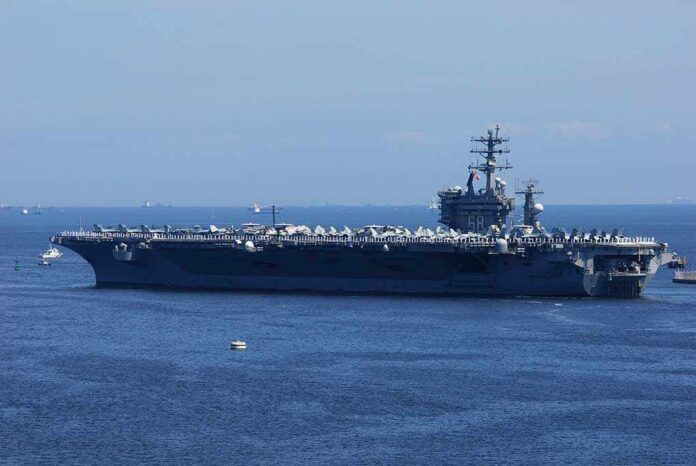
A $13 billion supercarrier built to dominate the seas can’t launch America’s premier stealth fighter due to a scorching physics flaw that risks melting its deck—exposing deep flaws in elite defense spending.
Story Highlights
- USS Gerald R. Ford (CVN-78) completes near-record deployment without F-35C capability, relying on older Super Hornets amid rising tensions.
- F-35C engine exhaust hits 3,600°F, threatening to warp or melt the flight deck designed in 2005 before final jet specs emerged.
- Costly retrofits now underway for deck hardening, jet blast deflectors, and data systems, burdening taxpayers further.
- Congress criticized the program in 2019; issues persist into 2026 despite billions spent.
Design Mismatch Leaves Flagship Vulnerable
The USS Gerald R. Ford’s hull design locked in 2005, well before the F-35C’s specifications finalized around 2025. This synchronization gap means the carrier’s flight deck cannot withstand the stealth fighter’s 3,600°F engine exhaust, which risks permanent warping under the jet’s 30-ton weight during launches. Noise at 150 decibels and massive data processing demands add further complications. Navy leaders now plan extensive shipyard repairs post-deployment.
The F-35C’s Engine Exhaust Hits 3,600°F — The USS Gerald R. Ford’s Aircraft Carrier Flight Deck Wasn’t Built to Handle Ithttps://t.co/DIAoHY5Ltn
— 19FortyFive (@19_forty_five) April 3, 2026
Deployment Exposes Operational Gaps
Ford completed a near-record deployment from Venezuela to the Middle East in 2026, extended amid U.S.-Iran tensions, yet operated only F/A-18E/F Super Hornets and EA-18G Growlers. Unlike four Nimitz-class carriers upgraded by 2025 with jet blast deflectors, Ford lacks F-35C bulletins due to persistent EMALS and AAG reliability issues. Weapons elevators remain problematic, with only two of eleven functional as of 2019 projections.
Congressional Scrutiny and Navy Challenges
In June 2019, Congress threatened to block USS John F. Kennedy’s delivery until Ford-class F-35C compatibility improved. Navy acquisition chief James Geurts admitted elevator shortfalls. Capt. David Skarosi, Ford’s commanding officer, defended crew resilience during maintenance clogs. GAO reports highlighted funding shortfalls and spare parts gaps, delaying full readiness and amplifying taxpayer costs for the $13 billion vessel.
Retrofit Path to Stealth Integration
Current sustainment includes deck hardening, jet blast deflectors, secure maintenance areas, and computer upgrades for F-35C’s data-heavy operations. Navy officials express optimism about EMALS long-term benefits over Nimitz steam catapults, framing issues as resolvable engineering hurdles. Critics view it as a damning sign of acquisition mismanagement, underscoring risks to naval dominance in crises.
Implications for Taxpayers and Readiness
Short-term, Ford’s limitations force reliance on non-stealth aircraft during potential conflicts, eroding edge against adversaries. Long-term retrofits promise blue-water dominance but at billions in overruns, fueling frustration across political lines over elite mismanagement. Sailors face morale strains from endless fixes, while everyday Americans question if Washington prioritizes reelection over secure defenses rooted in American ingenuity.
Sources:
Navy’s F-35C Stealth Fighters Won’t Fly From Troubled New Ford-Class Carriers for Years
The U.S. Navy’s Largest Supercarrier Can’t Launch the F-35C Stealth Fighters
Congress Unhappy With Ford-Class Inability to Deploy With F-35 Fighters