

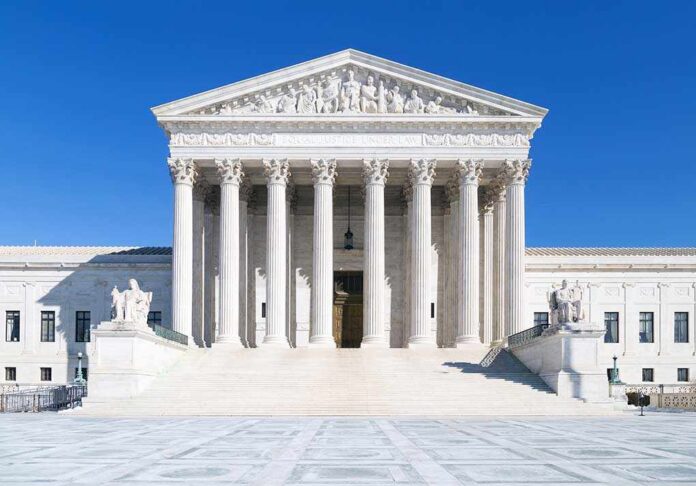
A renewed fight over birthright citizenship is putting the Constitution’s plain text—and the Supreme Court precedent built on it—back in the political crosshairs.
At a Glance
- The Supreme Court’s 1898 decision in United States v. Wong Kim Ark held that the 14th Amendment grants citizenship to most people born on U.S. soil, regardless of parents’ citizenship.
- The key constitutional phrase is “subject to the jurisdiction thereof,” which historically excluded narrow categories like children of diplomats, not broad groups of U.S.-born children.
- Executive Order 14160 (issued in 2025) asserts a narrower reading that would deny citizenship to certain U.S.-born children based on parents’ status, and it is being challenged in court.
- Legal analysts note that changing birthright citizenship nationwide generally requires a constitutional amendment or a major Supreme Court reversal.
Why Wong Kim Ark Still Controls the Birthright Citizenship Debate
The modern dispute traces straight back to Wong Kim Ark, born in San Francisco in 1873 to Chinese immigrant parents who were legal residents but not U.S. citizens. After traveling abroad, federal officials denied his re-entry on the theory that his parents’ status prevented him from being a citizen. In 1898, the Supreme Court rejected that view in a 6–2 decision, reading the 14th Amendment to grant citizenship to those born on U.S. soil who are subject to U.S. jurisdiction.
The majority opinion, written by Justice Horace Gray, leaned heavily on the English common-law tradition of territorial birthright (jus soli) and treated the Citizenship Clause as broad by default, with narrow, recognized exceptions. That matters now because many current arguments try to make “jurisdiction” do far more work than it historically did. Under the Court’s framework, parents’ lack of citizenship did not, by itself, remove a U.S.-born child from American jurisdiction.
What “Subject to the Jurisdiction” Meant in the Reconstruction Era
Birthright citizenship did not appear out of thin air in 1898. Congress debated citizenship explicitly after the Civil War, responding to Dred Scott, which had denied citizenship to Black Americans. The Civil Rights Act of 1866 established birthright citizenship in statutory form, and the 14th Amendment constitutionalized the principle soon after. In congressional debates, sponsors described the clause as consistent with existing law and understood it to cover children born in the United States to immigrant parents.
The historical record also shows that “jurisdiction” was not treated as a political loyalty test applied to every family line. Instead, the clause was understood to exclude limited categories: children of diplomats and certain sovereignty-related cases. An often-cited 19th-century example is Elk v. Wilkins (1884), which turned on the unique legal status of tribal affiliation and reservation birth at the time, not on a general rule that parents’ citizenship controls a U.S.-born child’s status.
Executive Order 14160 and the Limits of Executive Power
Executive Order 14160, issued in 2025, claims the 14th Amendment “has always excluded” people who are not fully subject to U.S. jurisdiction and frames that claim as support for denying citizenship to some U.S.-born children based on parents’ immigration status. The order has drawn immediate pushback from legal organizations and scholars who argue the order conflicts with long-settled readings of the Citizenship Clause and the Supreme Court’s interpretation in Wong Kim Ark.
That legal reality creates a major constraint: a president can direct executive-branch enforcement priorities, but an executive order cannot rewrite constitutional meaning that the Supreme Court has already declared. Analysts cited in the research emphasize that overturning nationwide birthright citizenship would typically require either a constitutional amendment or a direct Supreme Court reversal of Wong Kim Ark. As of the research provided, lawsuits are ongoing and no final judicial resolution is reflected here.
What’s at Stake: Stability, Litigation, and the Citizenship Standard
Policy debates about immigration often get heated, especially after years of public frustration over border disorder, strained local services, and a sense that Washington ignored basic enforcement. But the constitutional question here is narrower: whether citizenship can be denied to U.S.-born children by redefining “jurisdiction” to exclude broad classes that prior practice treated as covered. The research also flags potential consequences such as legal uncertainty for children, heavier litigation burdens, and long-term instability around a core constitutional guarantee.
@kewhittington on birthright citizenship:
"The conventional wisdom is right, and the Executive Order is wrong. Children born within the territory of the United States are natural-born citizens except under very narrow exceptions." https://t.co/OLhZFK5u17
— Scott Greenfield (@ScottGreenfield) February 11, 2026
The available sources also underscore a practical point for voters who want durable policy: if the goal is to change birthright citizenship rules, the Constitution’s structure channels that fight toward Congress and the amendment process, not unilateral decrees. Absent a constitutional amendment or a Supreme Court decision that narrows the Citizenship Clause, Wong Kim Ark remains the central precedent. For Americans demanding immigration sanity and rule of law, the bigger challenge is separating enforceable border policy from constitutional shortcuts.
Sources:
A brief history of citizenship and the 14th Amendment of the U.S. Constitution
Birthright Citizenship Under the U.S. Constitution
The Origins of Birthright Citizenship in the United States, Explained
14th Amendment to the U.S. Constitution: Civil Rights (1868)
A history of birthright citizenship at the Supreme Court
Can birthright citizenship be changed?
Protecting the Meaning and Value of American Citizenship
Amdt14.S1.1.2 Citizenship Clause: Doctrine and Practice