
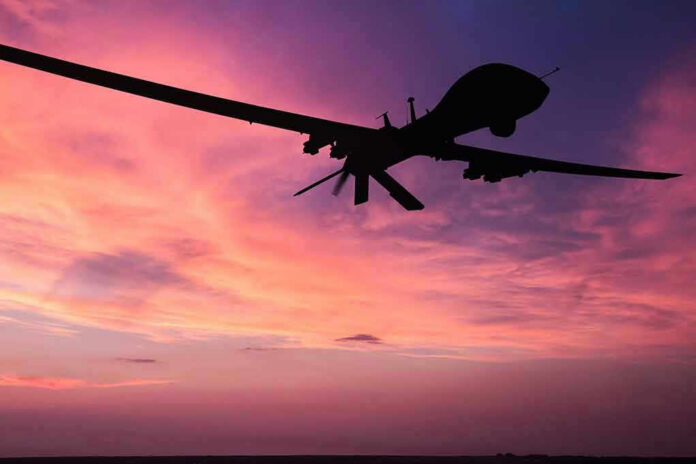
An FBI bulletin warning of a possible Iranian drone attack on California shows how fast foreign threats can move from overseas battlefields to America’s own coastline.
Quick Take
- The FBI circulated an end-of-February bulletin to California law enforcement about Iran allegedly aspiring to launch a surprise drone attack from an unidentified vessel off the West Coast.
- Authorities said the intelligence was cautionary and lacked specifics on targets, timing, method, or perpetrators, with no evidence of an imminent threat.
- Bay Area departments confirmed receipt of the warning and said they are monitoring conditions and adjusting posture as needed.
- The report surfaced as the Trump administration’s campaign against Iran continued, raising concerns about retaliation and the wider spread of drone tactics.
What the FBI Alert Said—and What It Did Not
Federal authorities warned California police departments about intelligence indicating Iran allegedly aspired to conduct a surprise drone attack on U.S. soil, potentially launched from an unidentified vessel off the West Coast. The bulletin, distributed at the end of February after intelligence emerged earlier in the month, offered few operational details. Agencies were not given specific sites, timing, attack methods, or named perpetrators, and the information was described as uncorroborated.
That lack of specificity matters for the public. A bulletin can be both serious and limited: serious because it reflects a potential hostile intent tied to a real-world conflict, and limited because it does not establish an active, imminent plot. The FBI’s Los Angeles office declined to comment publicly, leaving local departments to balance transparency with operational security while still reassuring residents that normal policing and readiness measures are in place.
How California Agencies Responded on the Ground
Local law enforcement across Northern and Southern California acknowledged receiving the FBI warning and said it triggered heightened awareness rather than panic. Bay Area departments, including San Jose, Oakland, and San Francisco, confirmed the advisory and emphasized that they had not seen evidence of an imminent threat. Oakland police said they were monitoring developments and assessing whether conditions require additional presence or adjustments in patrol patterns.
Los Angeles County’s sheriff’s department said it reviewed response plans and increased resources in light of global events and religious observances. State-level coordination also came into view. California Gov. Gavin Newsom’s Office of Emergency Services indicated it was working with federal, state, and local partners to protect communities. San Francisco’s mayor expressed confidence in readiness, pointing to existing coordination and planning meant to keep residents safe.
Why Drones, Why the Pacific, and Why Now
The reported scenario—drones launched from a vessel—reflects the uncomfortable reality that modern threats do not always require a conventional military footprint. Drones are cheaper, harder to detect than traditional platforms, and can be adapted quickly. The bulletin’s West Coast vessel detail is also a reminder that national security isn’t only a border issue at land crossings; maritime approaches and major coastal metros can be attractive targets for adversaries seeking surprise and headlines.
What the Warning Suggests About Spillover From Overseas Conflict
The alert surfaced publicly as U.S. operations against Iran continued, while Iran has used drones in retaliatory actions in the Middle East. A former DHS intelligence official interviewed in coverage argued that the FBI warning helps agencies prepare and that Iran has incentive to consider asymmetric responses when under military pressure. At the same time, officials noted U.S. and Israeli strikes reportedly degraded Iranian capabilities, adding uncertainty about what Iran can execute.
America’s Security Tradeoffs: Vigilance Without Overreach
For Americans already frustrated by years of instability and policy drift, the practical question is how government responds without trampling everyday freedoms. The strongest, most constitutionally aligned posture is targeted vigilance: hardening likely targets, improving detection and interagency coordination, and protecting public gatherings while avoiding broad, open-ended domestic crackdowns. The FBI bulletin, as reported, points toward preparedness rather than sweeping new authorities—because the intelligence itself was limited.
🚨 BREAKING: FBI warns CA police of possible Iranian attack, Iranians living under this regime live in constant fear. The mullahs must fall. #DownWithTheocracy #FreeIranhttps://t.co/H3DrIHi1jk
— Masked Node (@MaskedNode) March 12, 2026
Residents should also recognize the limits of what has been disclosed. Officials said there is no evidence of an imminent attack, and the bulletin did not name specific targets. That means the public should treat this as a situational awareness update, not a call to alarm. The story’s bottom line is straightforward: hostile regimes abroad can inspire plots that reach toward the U.S. homeland, and local agencies are being told to stay ready.