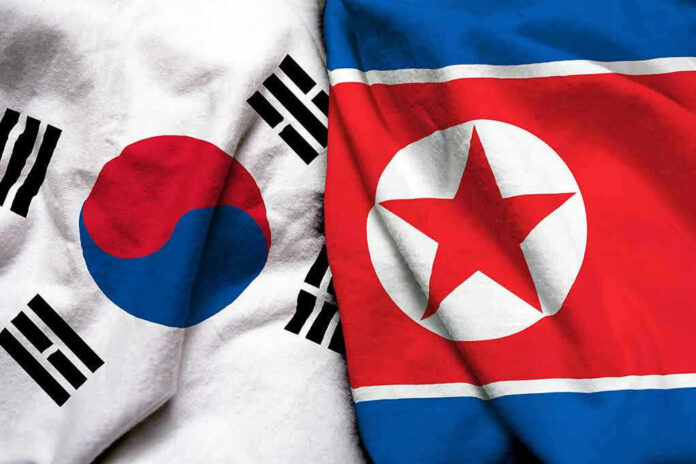
Kim Jong Un’s sister just slammed the door on South Korea’s latest “peace” offer—and left the world to wonder if the Korean Peninsula will ever see real dialogue, or if we’re doomed to yet another round of North Korean stonewalling and saber-rattling.
At a Glance
- Kim Yo Jong, sister of North Korea’s leader, utterly rejected South Korea’s bid for talks.
- South Korea’s new president, Lee Jae Myung, hoped to thaw tensions with a softer approach.
- North Korea’s leadership calls Seoul’s proposals naive and says there’s “no interest” in talks.
- The diplomatic freeze signals a new low in North-South relations, with no end in sight.
North Korea Snubs South Korea’s “Peace” Gambit—Again
North Korea’s ruling clique, led by Kim Jong Un and his formidable sister Kim Yo Jong, has once again dismissed South Korea’s overture for dialogue. On July 28, Kim Yo Jong issued a scathing statement via the Korean Central News Agency, making it plain: “No matter what policy is adopted and whatever proposal is made in Seoul, we have no interest in it and there is neither a reason to meet nor an issue to be discussed with the ROK.” That’s about as close to a diplomatic slap in the face as it gets. South Korea’s new left-leaning president, Lee Jae Myung, had just taken office with high hopes that a softer tone, a halt to anti-North broadcasts, and a clampdown on activist balloon launches would reset the relationship. Instead, he got the cold shoulder, with Pyongyang mocking Seoul’s “blind trust” in the U.S. alliance and brushing off its latest gestures as “reversible” and meaningless.
Kim Jong Un’s powerful sister rejects appeasement overture by South’s new president https://t.co/ta3mtVhl1j pic.twitter.com/W0Nnf1CgaT
— New York Post (@nypost) July 28, 2025
Kim Yo Jong’s words carry real weight. She’s not just a regime mouthpiece—she’s the regime’s power broker, echoing her brother’s hardline stance. Her statement reaffirms what anyone paying attention has already suspected: North Korea isn’t interested in talks, reconciliation, or any kind of compromise unless it gets exactly what it wants. For years, South Korea has tried every trick in the diplomatic playbook, from the “Sunshine Policy” to offering economic aid, and all it’s gotten in return is more provocations, more threats, and more disappointment. The Lee administration’s attempt at a reset was met with derision, not dialogue.
Years of Failed Engagement and Rising Tensions
The rift on the Korean Peninsula isn’t new. Since World War II, the North and South have been locked in an endless cycle of hope and heartbreak. The Korean War may have ended with an armistice, but the two sides remain technically at war. Every few years, a new South Korean president comes along promising peace, and every time, North Korea strings them along before slamming the door shut again. Under former President Yoon Suk Yeol, tensions flared with propaganda broadcasts and tit-for-tat balloon launches, culminating in North Korea sending refuse-filled balloons over the border. Lee’s election was supposed to signal a fresh start. Instead, Pyongyang’s answer was a categorical “no.”
North Korea’s leadership has done this dance before. When it doesn’t get sanctions relief or security guarantees, it escalates. When it senses weakness, it exploits it. Kim Yo Jong’s latest statement signals a deliberate hardening of the North’s position. She paints the South as a hostile puppet of Washington and dismisses every peace overture as a naive fantasy. President Lee’s administration is left looking feckless—and the South Korean public, desperate for real security, grows more frustrated by the day. The pattern is as predictable as it is exhausting.
Implications: A Freeze with No Thaw in Sight
The consequences of this latest rejection are grim. In the short term, all dialogue channels remain closed. The psychological warfare may be on pause, but neither side is backing down from military preparedness or alliance drills. The Lee administration’s engagement policy is under fire at home for producing zero results, emboldening hardliners who argue that appeasing Pyongyang is a fool’s errand. Families split by the border watch their hopes for reunification vanish with every hardline statement from the North. Border communities brace for the next round of provocations, knowing that even a minor incident could spiral into something far worse.
In the long term, North Korea’s new “two hostile states” doctrine all but guarantees that meaningful engagement will remain out of reach. The North’s rulers see no incentive to talk unless they get everything on their wish list, and with the U.S. and its allies holding firm on sanctions and military deterrence, there’s no reason to believe Pyongyang will suddenly have a change of heart. Meanwhile, the region’s major players—China, Japan, and the U.S.—watch nervously, knowing that miscalculation or escalation could have catastrophic consequences.
No Surprises, No Solutions—Just More Stonewalling
Analysts across the board agree: Kim Yo Jong’s statement is both a negotiating tactic and a genuine reflection of North Korea’s deep-seated mistrust. The regime is facing real internal challenges, from economic hardship to pandemic fallout, but none of that has softened its stance. Scholars note that every cycle of hope in inter-Korean relations ends the same way: with the North slamming the door and the South left empty-handed. Some optimists argue that the door isn’t completely shut, but the facts suggest otherwise. Until the underlying security dilemmas and power dynamics shift, don’t expect anything but more of the same from Pyongyang.
What does this mean for Americans? It’s a stark reminder that appeasement doesn’t work with bullies—whether on the Korean Peninsula or closer to home. Real peace requires strength, not wishful thinking. And as long as the world’s worst regimes see weakness, they’ll keep playing the same old games, leaving ordinary people—on both sides of the border—to suffer the consequences.