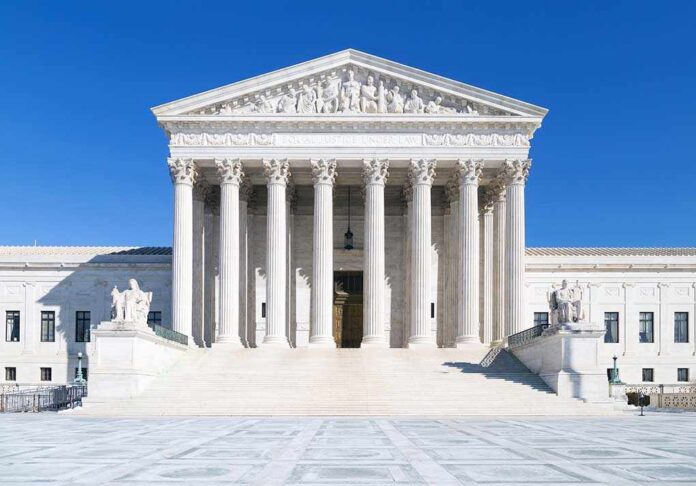
Supreme Court justices are openly clashing over the handling of Trump administration immigration cases, exposing deep fractures on the high court that threaten the principle of judicial independence while revealing how activist judges continue attempting to block commonsense enforcement policies.
Story Snapshot
- Justice Jackson’s dissent in Trump v. CASA criticizes conservative majority for limiting lower courts’ nationwide injunctions against Trump immigration policies
- Justice Kavanaugh’s concurrence defends restraining judicial overreach, arguing universal injunctions should protect only actual plaintiffs, not entire nation
- Trump administration continues battling activist district judges issuing sweeping injunctions to halt deportations and citizenship enforcement
- Conservative majority’s June 2025 ruling sets precedent limiting lower courts’ power to impose nationwide blocks on executive actions
Conservative Justices Push Back Against Judicial Activism
The Supreme Court’s June 27, 2025 decision in Trump v. CASA, Inc. partially stayed district court universal injunctions blocking President Trump’s executive order on citizenship and nationality laws. Justice Brett Kavanaugh authored a concurrence defending the stay, arguing that lower court injunctions should protect only the parties before them, not impose nationwide policy freezes. This position reflects longstanding conservative concerns about activist judges weaponizing injunctions to halt legitimate executive actions. Kavanaugh joined Chief Justice Roberts and Justices Alito, Thomas, and Gorsuch in limiting the reach of lower court orders that had become routine obstacles to Trump’s immigration enforcement.
Liberal Justices Defend Judicial Overreach
Justice Ketanji Brown Jackson filed an individual dissent criticizing the conservative majority for what she characterized as procedural overreach favoring the Trump administration. Jackson joined Justices Sotomayor and Kagan in warning against limiting lower courts’ equitable remedies, framing the majority’s restraint as enabling executive defiance of judicial orders. The liberal bloc’s position reveals a troubling double standard: these same justices championed expansive nationwide injunctions during Trump’s first term but now demand broader judicial power to obstruct his second-term agenda. This ideological divide exposes how liberal justices prioritize blocking conservative policies over consistent constitutional principles regarding separation of powers.
Trump Administration Confronts Activist District Judges
President Trump’s ongoing battles with lower federal courts extend beyond the Supreme Court clash, with district judges repeatedly issuing sweeping injunctions against deportation policies and immigration enforcement. Trump publicly challenged courts after they ordered the return of wrongly deported individuals, posting on social media that detained migrants would not return despite judicial orders. Judges like James E. Boasberg and Lydia Kay Griggsby found potential contempt in administration non-compliance, prompting GOP lawmakers to introduce bills with contempt provisions, though these stalled in House committees by May 2025. These confrontations reflect frustration among conservatives who watched Biden-era catch-and-release policies go unchallenged while Trump’s enforcement efforts face constant judicial sabotage.
Universal Injunctions Undermine Executive Authority
The controversy centers on universal injunctions that exploded in use after 2017, with activist judges issuing nationwide blocks against Trump policies affecting millions beyond the courtroom plaintiffs. The Supreme Court’s CASA decision addresses this judicial overreach by establishing that stays should limit relief to actual parties, not impose policy paralysis across all fifty states. Constitutional experts note this returns courts to their proper role of resolving individual disputes rather than functioning as shadow legislatures. For conservatives tired of unelected judges vetoing election results, this precedent represents a critical victory for restoring constitutional balance between branches and protecting voters’ mandate for stronger immigration enforcement and border security.
Separation of Powers Tensions Escalate
Georgetown professor Steve Vladeck warned the Trump administration is “walking close to the line” like a “clever mischievous child” testing limits of compliance, while pro-Trump advocate Mike Davis countered that activist judges’ actions anger the public and that Chief Justice Roberts “follows politics.” The clash reveals deeper constitutional tensions as Trump advances deportation policies using historical statutes like the Alien Enemies Act of 1798 while challenging birthright citizenship interpretations. Approximately 80 percent of Americans support compliance with court orders according to Pew research, yet many conservatives recognize legitimate executive frustration when partisan judges issue legally dubious nationwide injunctions specifically designed to paralyze presidential authority and nullify electoral outcomes favoring stricter immigration enforcement and national sovereignty.
Sources:
Trump’s clash with the courts raises prospect of showdown over separation of powers
Trump v. CASA, Inc. Supreme Court Opinion
Big wins for Trump and sharp blows to regulations mark momentous Supreme Court term