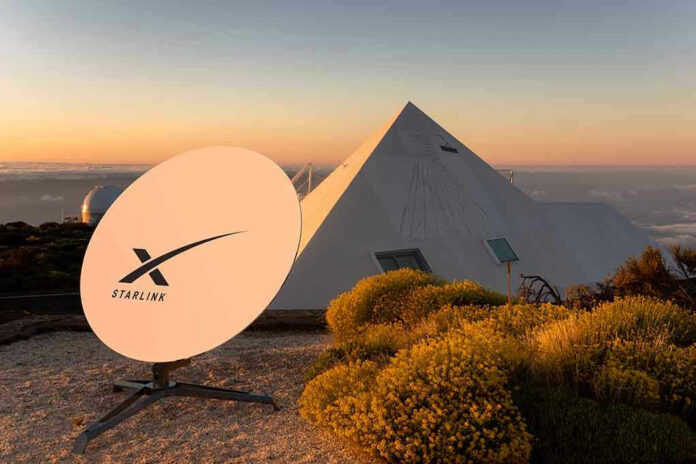
One by one, Elon Musk’s Starlink satellites are burning up in Earth’s atmosphere every single day—raising a question no one can ignore: what happens when the sky itself becomes a graveyard?
Story Snapshot
- Starlink satellites are now re-entering Earth’s atmosphere daily, with as many as five expected to fall each day in the coming years.
- Scientists and regulators are warning of unprecedented risks, from atmospheric pollution to space debris impacting people and property on the ground.
- Experts disagree on how dangerous these satellite burn-ups could be, but all agree the scale is unlike anything seen before.
- The race to dominate low Earth orbit has set off a regulatory, environmental, and scientific scramble to grasp the true cost of a crowded sky.
Falling Satellites: From Sci-Fi to Daily Reality
Starlink satellites, deployed by SpaceX since 2019, were supposed to revolutionize global internet. Instead, in 2025, they are rewriting the rules of what it means to litter the sky. Satellite trackers and the Federal Aviation Administration confirm that one to two Starlink units are tumbling back to Earth every day, with projections climbing as high as five daily as the constellation expands. This is not a distant hypothetical; it’s a spectacle visible from backyards across the world. The FAA’s latest risk assessment warns that, by 2035, tens of thousands of fragments could survive re-entry each year, raising the real possibility of debris striking people, planes, or infrastructure on the ground.
No previous satellite system operated on this scale. Past re-entries were rare events, often involving larger, longer-lived spacecraft. Starlink’s fleet, exceeding 8,000 satellites as of August 2025, changes the game. Designed for a short five-year lifespan, these satellites are intentionally deorbited at the end of service, creating a new, relentless rhythm of metal burning in the upper atmosphere. With Amazon and Chinese companies planning rival mega-constellations, the orbital environment is becoming a high-stakes traffic jam, and the risks of collisions and chain-reaction debris events are growing every year.
Risk in the Atmosphere: Pollution and Uncertainty
The environmental impact of thousands of satellites vaporizing overhead is deeply uncertain—and that uncertainty is what alarms scientists most. Astrophysicist Jonathan McDowell and atmospheric researchers warn that metals like aluminum and exotic alloys are being injected into the upper atmosphere at rates never before seen. Aaron Boley of the University of British Columbia cautions that aluminum oxide, a byproduct of these burn-ups, could deplete ozone and alter Earth’s reflectivity, with unknown consequences for climate and weather patterns. NOAA’s Karen Rosenlof voices concern over “geoengineering-like” side effects, essentially accidental experiments on a planetary scale. Despite expert disagreement on the extent of the hazard, all agree that the scale is so novel, existing environmental models may be inadequate to predict the true fallout.
Compounding the problem, the sheer brightness and number of these satellites disrupt astronomical observations, threatening to blind the world’s most sensitive telescopes. The scientific community is now grappling with the dual challenge of tracking space debris and understanding potential long-term atmospheric damage.
Regulatory and Industry Response: Scrambling to Catch Up
SpaceX, led by Elon Musk, continues to launch satellites at a breakneck pace, motivated by the promise of global internet coverage and market dominance. Regulatory agencies, including the FAA, are racing to update guidelines and risk models, but enforcement power lags behind technological reality. As re-entry events become routine, the prospect of stricter international regulations looms. Industry competitors like Amazon’s Project Kuiper and Chinese satellite operators are watching closely, knowing that any regulatory response to Starlink will set precedent for all future orbital endeavors.
The economic implications are profound. Satellite operators may soon face steep compliance costs to address debris mitigation and atmospheric impact. Insurance and liability costs could skyrocket if debris strikes become more than mere statistical risk. Public concern—once the province of science fiction fans—now has the ear of lawmakers and international bodies, raising the stakes for all involved.
Voices of Warning: The Debate Among Experts
Some in the scientific community argue that the risk from satellite re-entries remains manageable, especially if stricter debris mitigation strategies are enforced. Others, including Jonathan McDowell, call the current rate of descent “alarming” and warn that the real dangers are only beginning to manifest. The debate centers on a fundamental knowledge gap: no one has real-world data on the impact of thousands of satellites burning up every year. As more megaconstellations are planned, the need for urgent, coordinated research and regulation becomes undeniable. Leading journals and regulatory agencies now echo the call for international standards—before the consequences become irreversible.
The Starlink saga stands at the intersection of technological ambition and planetary stewardship. What happens next will shape not only the future of satellite internet, but the very air we breathe and the safety of those beneath the sky’s new, invisible rain.
Sources:
Futurism: Elon Musk’s Starlink Satellites Are Falling
Space.com: SpaceX Starlink Satellites
The Debrief: Expert Warns Starlink Satellites Are Falling to Earth Daily