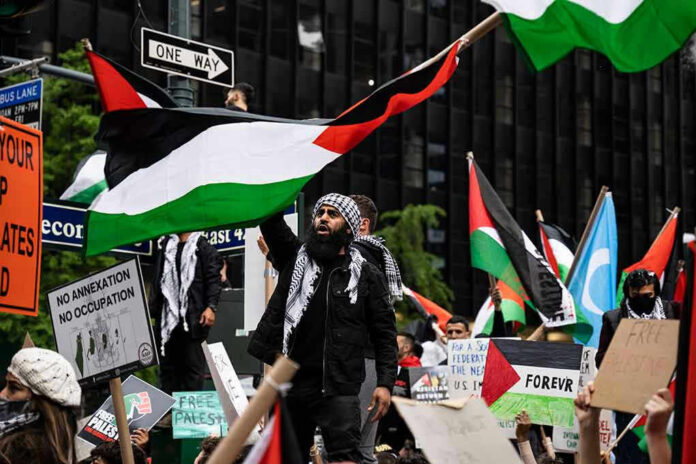
When a three-word chant can land you in handcuffs, you are not just watching a protest, you are watching a country redraw the line between security and speech in real time.
Story Snapshot
- Police in London and Greater Manchester now say chanting “globalise the intifada” can mean arrest, not just a warning.
- A terror attack on a Hanukkah event in Sydney is being used as the trigger for this sharper stance.
- Jewish security organisations welcome the shift as overdue protection; civil-liberties groups see creeping criminalisation of dissent.
- How British law treats this chant will shape the future of protest on Israel–Palestine far beyond one slogan.
Why One Protest Slogan Just Became a Police Red Line
Metropolitan Police in London and Greater Manchester Police have jointly declared that protesters who chant “globalise the intifada” should now expect to be arrested, not gently moved along. Their chiefs, Sir Mark Rowley and Sir Stephen Watson, link this shift directly to a terrorist gun attack on a Hanukkah event in Sydney’s Bondi area, where fifteen people were killed, and the surviving suspect, Naveed Akram, faces terrorism and murder charges. Jewish communities already on edge now hear police saying: this is where we draw the line.
The term “intifada” literally means “to shake off,” but history has loaded it with far more than dictionary meaning. Two Palestinian intifadas mixed boycotts and stone-throwing with bombings and shootings, leading many Jews to hear the word as shorthand for violent uprising and terrorism. When the chant calls to “globalise” that, Jewish groups and security agencies argue it sounds like an export license for violence against Jews worldwide, not a textbook slogan about decolonisation.
How Terror Abroad Is Rewriting Protest Rules at Home
British police did not land here overnight. Since October 2023, pro-Palestine marches have filled London and other cities, with slogans like “from the river to the sea” and “globalise the intifada” filling the air. For months, police relied on Crown Prosecution Service advice that many such phrases did not cross the criminal threshold if used as broad political speech rather than targeted threats. After Bondi, the same forces now say the “context has changed” and promise a “more assertive” posture toward words they believe cause real fear.
The new stance plugs into a wider domestic clampdown that conservatives concerned with law, order, and social cohesion should not ignore. The government has already proscribed direct-action network Palestine Action as a terrorist organisation, and since July 2025 more than 2,700 people have been arrested in protests related to that ban. Amnesty International reports that over 600 more were arrested in just eleven days of largely peaceful demonstrations, with around 254 people charged under counter‑terrorism laws for actions as mild as displaying “I Oppose Genocide. I Support Palestine Action.” Supporters of a tough line on extremism should still ask whether using terrorism tools on placards strengthens or just stretches the law.
"Pro-Palestine protesters chanting ‘globalise the intifada’ in the UK face arrest, police confirm" – The Independent #SmartNews )) Anyone see a problem here?? https://t.co/9iLxyGZG8S
— Max (@NoLayupsMax) December 17, 2025
The Clash Between Community Protection and Free Expression
Jewish communal bodies make a straightforward, emotionally powerful case. The Community Security Trust, which tracks antisemitic incidents and provides security for synagogues, describes a “wave of terrorism against Jews around the world” and says allowing calls to “globalise the intifada” in that climate is “intolerable.” Chief Rabbi Ephraim Mirvis has urged that such slogans be clearly treated as unlawful, arguing that public squares cannot normalise language communities hear as a call to repeated violence against them. From a conservative, common‑sense standpoint, the state has a primary duty to protect citizens from credible threat and intimidation, not wait until the worst happens again.
Pro‑Palestine protesters counter that this reading deliberately collapses all Palestinian resistance into terrorism. Many insist “globalise the intifada” expresses solidarity with people “shaking off” occupation and colonial domination, including by non‑violent methods. They point to the broad sweep of arrests over the Palestine Action ban as evidence that authorities use public order and terrorism powers not just to stop genuine incitement, but to chill any robust opposition to UK policy on Israel. Human‑rights groups echo that concern, warning that the United Kingdom is edging toward unlawful, disproportionate limits on freedom of expression and peaceful assembly. That should trouble any conservative who believes rights lose their meaning when exercised only by those with government-approved views.
Where the Law, “Common Sense,” and Future Protests Collide
British law already criminalises encouragement of terrorism and incitement to racial or religious hatred, and gives police Public Order Act powers to restrict protests that risk serious disorder or intimidation. The crucial question now is how far police stretch those tools. Frontline officers will be briefed that “words have meaning and consequence,” and that chanting “globalise the intifada” near synagogues or Jewish events can justify arrest and tight protest conditions. Courts and prosecutors will eventually decide whether those arrests rest on solid legal ground or on political pressure and fear.
American conservatives often warn about a cultural drift where elites recast speech as “violence” to police the public square. This case runs that logic in a direction some will welcome because the targets are protesters they distrust. But principles tested on fringe causes rarely stay there. If chanting a contested slogan at a march can be recast as terrorism‑adjacent crime, tomorrow’s red line could fall on another unpopular movement. The true conservative challenge is holding two thoughts at once: that Jewish communities deserve strong, visible protection from real threats and that a serious country resists the temptation to turn every alarming chant into a criminal offence. Where Britain lands on “globalise the intifada” will show whether it still trusts its own laws, and its own people, to tell the difference.
Sources:
Amnesty International Canada – United Kingdom: Over 600 more arrests made at peaceful protests
Amnesty International UK – Over 600 further arrests at peaceful protests
Le Monde – UK police arrest 890 people at Palestine Action demonstration