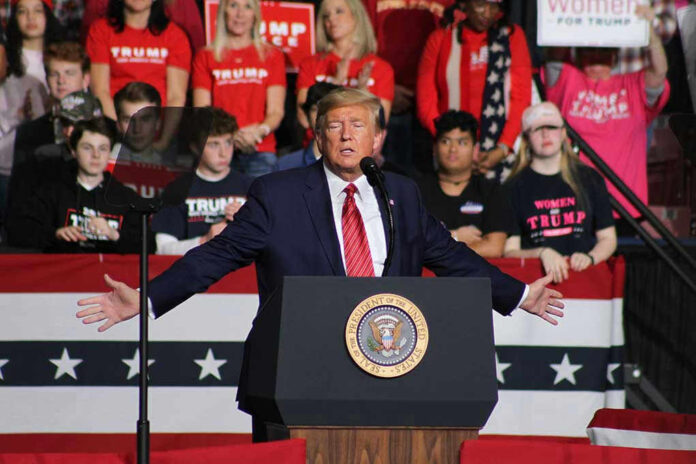
Donald Trump’s approval rating has bounced back, hitting a three-month high, but what does this really mean for his presidency?
Story Overview
- Trump’s approval rating has rebounded to 42-45% after hitting a low during the November government shutdown.
- The recovery represents a stabilization rather than a significant political victory.
- Trump faces continued challenges, especially with low economic approval ratings.
- The rebound suggests a consistent baseline of support amidst a polarized electorate.
Trump’s Approval Rating Rebound
President Donald Trump’s approval rating, which suffered a significant decline during the government shutdown in November 2025, has shown a modest recovery. As of late December, his approval rating ranges from 42.8% to 45% according to various polling aggregates. This rebound aligns more closely with Trump’s average ratings throughout 2025, indicating a return to baseline rather than a dramatic political resurgence.
This rebound is noteworthy against the backdrop of Trump’s lowest-ever economic approval ratings, which stand at 37%, according to Marist polling. This juxtaposition highlights a disconnect between general approval and specific policy performance, particularly on economic issues. Despite the improvement in his overall approval, Trump’s economic management remains a critical vulnerability.
Context and Background
Trump began his second term in January 2025 with a 49% approval rating, benefiting from a typical presidential honeymoon period. However, this approval rating has seen volatility throughout the year, influenced by major policy events such as the government shutdown and the implementation of steep tariffs. The latter has significantly affected his economic approval ratings, contributing to public concerns over cost-of-living and affordability.
The government shutdown in November 2025 marked a low point for Trump’s approval ratings, with a net approval of -15.0. The subsequent recovery to approximately 42-45% approval suggests a stabilization rather than a full recovery, but it provides Trump with some political breathing room. Economic conditions, however, continue to loom large over his presidency.
Key Stakeholders and Influences
The primary stakeholders in this scenario include Donald Trump himself, various polling organizations like Decision Desk HQ and Emerson College Polling, and the American public, particularly those affected by economic conditions. Trump’s approval ratings are a barometer of public sentiment toward his leadership, particularly on economic issues.
Polling organizations serve as neutral observers, offering data that informs public discourse and political strategy. Trump’s political strategy must navigate these approval ratings to maintain support and achieve policy goals. Economic conditions and policy decisions, particularly concerning tariffs, emerge as primary influencers of approval ratings.
Recent Developments and Implications
As of December 21, 2025, Trump’s approval rating stands at approximately 42.8%, with disapproval at 54%. Different polling organizations report slight variations, indicating consistency in the overall trend. Spencer Kimball of Emerson College Polling has emphasized the significance of Trump’s economic approval crisis, highlighting the challenges he faces.
While the rebound offers short-term political relief, long-term implications remain challenging. Trump’s lowest-ever economic approval ratings suggest ongoing difficulties, particularly with tariff policies and cost-of-living concerns. The erosion of support among his MAGA base, with “strong approval” dropping from 78% to 70%, indicates potential fractures within his core coalition.