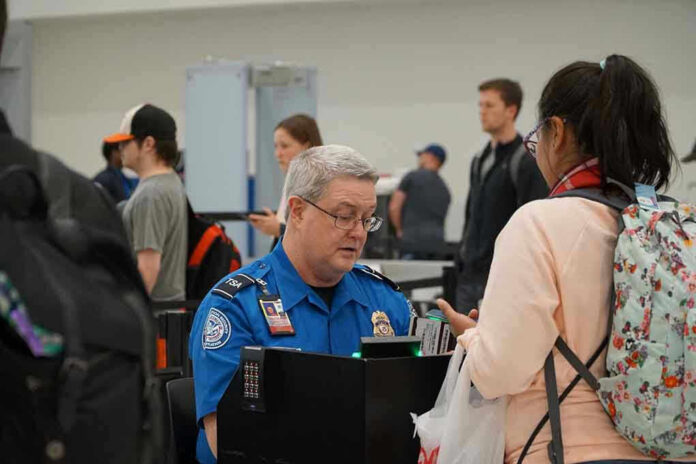
America’s airport security is getting stretched thin because “essential” federal screeners are being told to show up to work without a paycheck.
Story Snapshot
- A late-2025 funding lapse at the Department of Homeland Security pushed TSA officers into working without pay as the shutdown dragged into early 2026.
- Airport impacts showed up fast: some locations reported security lines reaching up to three hours, even while national averages looked calmer on certain days.
- The FAA reported surging callouts and staffing strain at major facilities, including broad disruption in the New York area.
- Officials and unions warned that extended unpaid work pressures families, drives unscheduled absences, and risks compounding delays across the travel system.
Shutdown Pressure Hits the Front Line at TSA Checkpoints
Transportation Security Administration officers were required to keep screening passengers even as the Department of Homeland Security ran out of funding, a structure that forces “essential” workers to work during a shutdown. Reporting compared the situation to the 2018–2019 shutdown, when TSA’s callout rate spiked to 10% near the end of the 35-day stalemate. The current episode produced visible stress at checkpoints, including reports of hourslong lines at specific airports.
Houston-area airports were among the clearest examples of what happens when staffing gets tight: security waits were reported as long as three hours, a concrete sign that even a localized surge in absences can overwhelm checkpoint throughput. At the same time, reporting also indicated the national average wait time was far lower on at least one day, underscoring a key reality for travelers: the shutdown’s impact can be uneven, with severe pinch points at certain hubs.
Air Traffic Staffing Strain Adds a Second Layer of Disruption
The shutdown story was not limited to TSA lines. The Federal Aviation Administration reported a surge in callouts over a weekend period, with half of the nation’s “Core 30” airports experiencing shortages of air traffic controllers and 80% of facilities in the New York area affected. By the following Monday, delays were tied to staffing issues in cities including Philadelphia, Jacksonville, Austin, and Washington, according to the same reporting.
Transportation Secretary Sean Duffy described the personal bind that unpaid federal workers face: covering rent, gas, groceries, and child care while still being expected to report for duty. Duffy also warned that prolonged financial strain can lead to stress and fatigue, and that distracted employees working side jobs may degrade safety margins. The FAA signaled it would “stop traffic” before allowing unsafe operations to develop, highlighting the stakes when staffing becomes unstable.
“Essential” Without Pay: The Policy Design That Drives Absences
One of the most consequential facts in the reporting is structural: roughly 95% of TSA’s screening workforce is classified as essential, meaning they must work during shutdowns even when pay is delayed. TSA leadership acknowledged that when a shutdown stretches on, basic household obligations become harder to meet, and unscheduled absences rise. That causal chain is not ideological—it is practical—and it helps explain why airport operations become a pressure point.
What the “Double Absences” and “300 Quit” Claims Actually Show—And Don’t
Social media claims circulated that TSA absences “double” and that “300 officers quit.” The provided reporting, however, does not substantiate a specific nationwide figure for resignations, and it also notes TSA lacked comprehensive callout-rate data in the current shutdown comparable to 2019’s documented 10% spike. What is documented is increased unscheduled absences at certain airports and a measurable rise in staffing-related disruptions—enough to create major lines and delays, but not enough here to confirm the specific “300 quit” claim.
TSA absences at airports double during shutdown, 300 officers quit – CBS News https://t.co/qjitbZObgw
— JOSEPH SAKOWSKI (@JOSEPHSAKOWSKI) March 10, 2026
For conservatives who want government run competently and within its constitutional lanes, this episode shows how Washington dysfunction can land hardest on working families and critical infrastructure. When policymakers treat pay and staffing as leverage, the public sees the consequences in real time: long lines, delayed flights, and mounting safety concerns. The available data also comes with limits, so readers should separate verified operational impacts from viral claims that are not backed by the cited reporting.
Sources:
Airports are seeing a spike in shutdown impacts as TSA screeners, air traffic controllers call out
Wait Times at U.S. Airports Skyrocket as Shutdown-Related TSA Absences Climb