A Navy cruiser mistook two returning American fighter jets for enemy missiles and opened fire over the Red Sea, shooting down one aircraft and nearly destroying another, in what investigators later determined was a preventable tragedy born from degraded systems, undertrained crews, and command failures.
Quick Take
- USS Gettysburg fired on its own aircraft, shooting down one F/A-18F Super Hornet and nearly destroying a second while both jets were returning from strike missions in Yemen
- Both pilots ejected safely, with one describing the moment the missile closed in as seeing his life “flash before his eyes”
- A formal Navy investigation found the shoot decision was “wrong” and avoidable, citing degraded identification systems, insufficient training, and poor situational awareness among the command team
- The incident exposed systemic weaknesses in air defense integration and crew performance during high-tempo operations in contested environments
- Senior Navy leadership has committed to reforms in training, material readiness, and command-and-control procedures across the fleet
The Moment Everything Changed
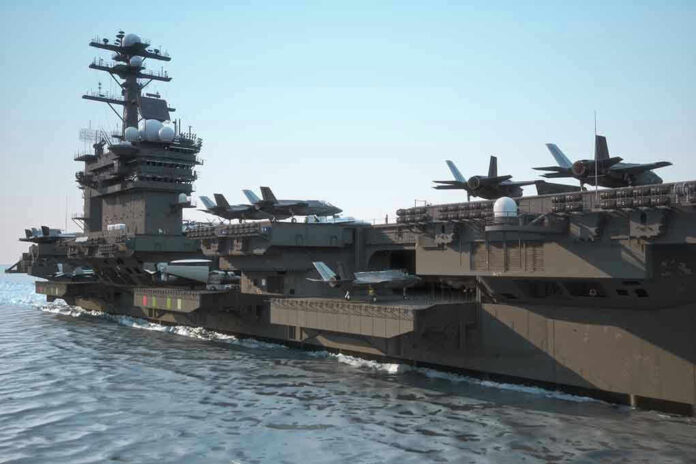
USS Gettysburg’s combat information center crew made a split-second decision that would alter the course of two aviators’ lives and trigger a sweeping review of naval air defense protocols. Operating in the Red Sea as part of the Harry S. Truman Carrier Strike Group, the guided-missile cruiser detected radar contacts returning from strike missions against Houthi forces in Yemen. Within moments, the ship’s commanding officer authorized the launch of two SM-2 surface-to-air missiles. The targets were not enemy weapons. They were American F/A-18F Super Hornets from Strike Fighter Squadron 11, the “Red Rippers,” streaking back toward the carrier after completing their combat sorties.
One jet took a direct hit. The aircraft, engulfed in flames and trailing smoke, became uncontrollable. The pilot ejected and parachuted into the Red Sea, where he was recovered by Navy personnel. A second Super Hornet detected the incoming missile, and its pilot executed violent evasive maneuvers, narrowly avoiding destruction. Both aviators survived the encounter, but the psychological and operational shock reverberated through the strike group and ultimately reached the highest levels of Navy leadership.
A Command Environment Under Strain
The friendly fire incident did not occur in a vacuum. USS Gettysburg and the Truman strike group had been engaged in intense, continuous air and missile defense operations. The Red Sea had become a shooting gallery. Houthi forces, backed by Iran, had unleashed dozens of anti-ship cruise missiles and one-way attack drones against American and commercial vessels. The strike group had successfully intercepted multiple genuine threats in the days before the shootdown, creating an environment of heightened alert and primed threat perception among watchstanders. Fatigue, cognitive overload, and the psychological weight of sustained combat operations all contributed to a command environment where errors became more likely, not less.
Investigators uncovered a troubling detail: USS Gettysburg had operated with “significant degradation” in critical combat systems before and during the deployment. The ship’s Identification Friend or Foe (IFF) system and tracking and reporting capabilities were compromised. Training opportunities for the strike group had been curtailed before deployment, reducing the integration and coordination between Gettysburg and Carrier Air Wing One. The crew lacked the familiarity and muscle memory that come from sustained, realistic training in a networked air defense environment. When the moment came to make a life-or-death decision, the foundation beneath that decision was already cracked.
The Investigation’s Verdict
The Navy released a comprehensive command investigation that laid bare the chain of events and the failures that led to the shootdown. The report concluded that the decision to fire was “preventable” and that the commanding officer’s order to engage was “wrong” given the information available at the time. Investigators identified multiple breakdown points: degraded identification systems that could not reliably distinguish between friendly and hostile aircraft, watchstanders who were insufficiently trained to manage the complex air picture, and a command team operating under physiological and psychological stress that degraded judgment. The report did not excuse these failures as the inevitable fog of war. Instead, it presented them as systemic vulnerabilities that the Navy had allowed to persist.
The incident was not an isolated mishap. The Truman strike group’s deployment had been marked by multiple serious accidents, including a collision between the carrier and a cargo vessel and two additional F/A-18 losses in separate mishaps. Collectively, these events painted a picture of a strike group pushed beyond its operational readiness envelope, asked to execute a high-tempo combat mission while operating with degraded training, material shortfalls, and insufficient integration. Senior Navy leaders acknowledged that the episode represented a failure across multiple levels of command and that corrective action was essential.
Systemic Lessons and Strategic Implications
Defense analysts and retired naval officers have cited the Gettysburg incident as a case study in how modern naval warfare can expose institutional weaknesses. A RAND Corporation researcher noted that the ship’s inability to appropriately track its own aircraft, combined with undertrained watchstanders, rendered the shoot decision inappropriate and avoidable. The case underscores the critical importance of robust interoperability between air wings and escort ships, particularly when peacetime training has been curtailed yet wartime-like complexity is demanded in theater. The phenomenon of “scenario lock-in”—where prior successful engagements against real threats bias crews to interpret new radar contacts as hostile—also played a role in the Gettysburg crew’s decision-making calculus.
The incident has become a reference point in broader strategic discussions about how U.S. and allied navies manage escalatory risks in contested environments. The Red Sea, with its dense commercial traffic, strategic importance, and active threat from Iranian-backed forces, represents exactly the kind of operating environment where missteps carry diplomatic and political consequences beyond the immediate battlefield. The shootdown of an American aircraft by an American warship, while ultimately non-fatal to the aircrew, underscored the dangers of operating complex, integrated air defense systems in high-stress, information-degraded conditions. The Navy’s commitment to reform—including enhanced training, improved material readiness, and revised command-and-control procedures—reflects recognition that the problem runs deeper than a single captain’s decision on a single day in December.
Sources:
Business Insider – Navy warship mistook US fighter jets for enemy missiles
Task & Purpose – Navy Truman planes lost
Stars and Stripes – USS Truman mishaps Navy report
AOL – U.S. fighter pilot account