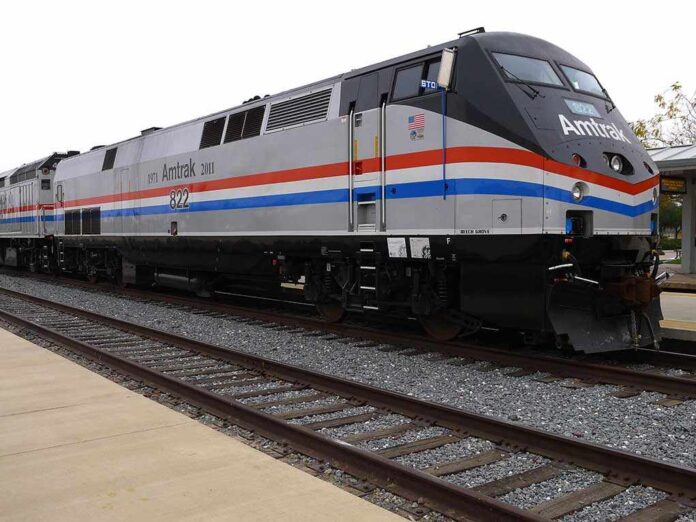
One split second at a Schertz rail crossing forced 129 lives to confront the raw reality of America’s unresolved transportation dangers—raising new questions about safety, blame, and our collective willingness to prevent the next disaster.
Story Snapshot
- An Amtrak train with 129 passengers collided with a semi-truck in Schertz, Texas, near San Antonio on October 28, 2025.
- Emergency response was immediate; injuries were reported but details remain scarce as the investigation unfolds.
- The crash highlighted persistent grade crossing hazards, reigniting debate over rail safety and infrastructure investment.
- With causes undetermined, federal and state authorities now face mounting public pressure to deliver answers and reforms.
Collision at High Noon: The Day Schertz Stopped
October 28, 2025, began as an ordinary day for 129 Amtrak passengers rolling through suburban Schertz, Texas, but at 12:11 PM, routine yielded to chaos when their train slammed into a heavy-duty semi at a rail crossing. The jarring impact upended schedules, sent emergency crews racing, and forced a community to grapple with the vulnerability of its infrastructure. As sirens echoed and first responders rushed to aid the injured, the true toll—human and logistical—remained hidden behind police tape and unanswered calls. The shockwaves rippled beyond Schertz, halting rail lines, diverting traffic, and drawing national scrutiny to a crossing where tragedy, not safety, became the headline.
Within hours, news outlets confirmed a collision of scale: a major passenger train, a commercial truck, and a community gridlocked by disaster. Yet, specifics on casualties, causes, and responsibility proved elusive. For now, the only certainty was uncertainty itself—fuel for speculation and a stark reminder of how quickly normalcy can derail.
Why Grade Crossings Still Fail Us
Despite decades of warnings, grade crossings remain America’s Achilles’ heel. Federal Railroad Administration data reveals thousands of annual train-vehicle collisions, even as billions pour into signage, gates, and public awareness. Schertz, a rapidly growing suburb northeast of San Antonio, exemplifies the collision course between expanding development and aging rail infrastructure. Increased freight and passenger traffic crisscross neighborhoods where cars and locomotives remain separated only by painted lines, flashing lights, or—too often—nothing at all. The latest crash is not an outlier but part of a troubling pattern: Texas consistently ranks among the nation’s leaders in rail-related incidents, and local residents now demand to know why, after so much investment and so many warnings, these disasters persist.
Grade crossing accidents have prompted repeated calls for overhauls—grade separation, better technology, and stricter enforcement. Yet, the debate rages between those who want immediate action and the industry lobbyists who caution that most crossings are, statistically, safe. Until the facts emerge from Schertz, both sides will marshal the tragedy as proof of their point.
Ripple Effects: From Legal Fallout to Public Outcry
Amtrak, the trucking company, emergency responders, and federal investigators each now play a role in the aftermath, their actions shaped by legal obligations, public scrutiny, and institutional self-interest. Amtrak must answer for its safety protocols; the trucking company scrambles to assess liability and shield its driver; local officials juggle rescue, investigation, and community reassurance. The National Transportation Safety Board and Federal Railroad Administration, called to the scene, will dissect every second of the crash, searching for causes and culprits amid mounting political pressure.
Passengers and their families—caught between shock and frustration—watch for updates, mindful of precedents in Texas and across the country where victims have waited years for compensation or closure. Meanwhile, the San Antonio region absorbs the economic shock: disrupted travel, closed roads, strained hospitals, and a lingering sense that mobility comes with unacceptable risks. Nationally, elected officials face a familiar cycle: denounce the tragedy, promise reforms, and contend with the reality that meaningful change requires both money and political will.
What Comes Next: Lessons, Limits, and the Long Road Forward
The Schertz crash now enters the slow churn of investigation, lawsuits, and policy debates. Experts will point to proven solutions—grade separation, advanced sensors, and relentless public education—as the only path to zero fatalities. History, though, warns that outrage fades unless community voices sustain pressure and regulators resist industry inertia. The unanswered questions—Was it human error, faulty signals, or infrastructure decay?—will shape the narrative and determine whether this disaster becomes a turning point or another footnote in a long ledger of preventable tragedies.
For now, the victims in Schertz remind the nation that every crossing is a potential crossroads between life and death. The hope is that, in remembering this day, Americans refuse to accept these odds as inevitable. The next steps—by investigators, lawmakers, and citizens—will determine if this was just another accident, or the moment when enough truly became enough.