No two presidential signatures should ever look exactly the same—so what does it mean for American trust when a president’s “handwritten” pardons appear to be stamped from the same mold?
Quick Take
- Justice Department posted Trump pardons online with signatures that forensic experts say were “identical.”
- Within hours, the DOJ replaced the documents and called it a “technical error,” insisting Trump signed every pardon personally.
- Observers question the authenticity of the signatures and the integrity of the clemency process amid political fallout.
- The episode revives partisan debate over autopen use, presidential accountability, and document transparency.
Forensic Scrutiny Uncovers a Presidential Signature Mystery
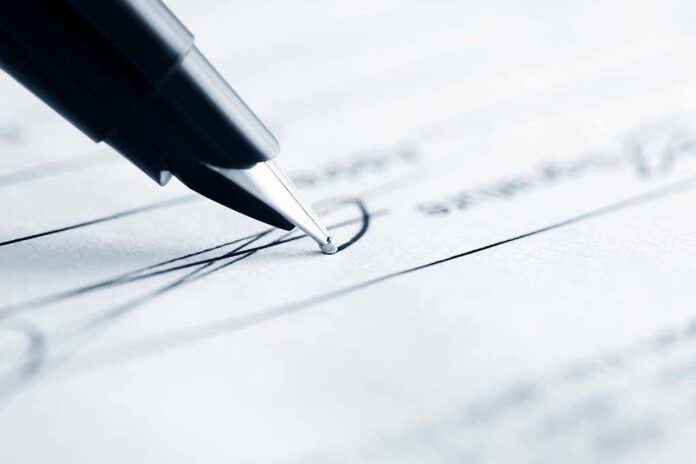
When the Department of Justice uploaded a batch of presidential pardons for public viewing, eagle-eyed observers and professional handwriting analysts alike noticed something uncanny: every one of Donald Trump’s signatures was a carbon copy. Forensic document experts quickly confirmed what many suspected—these signatures were “identical in every aspect,” an impossibility for any human hand, even one as practiced as a president’s. The finding ignited a digital firestorm, with questions ricocheting from legal scholars to congressional offices and back through the echo chambers of social media.
Within hours, the DOJ quietly replaced the suspect documents with versions containing unique Trump signatures. Their explanation? A “technical error” paired with “staffing issues.” The Justice Department maintained that the pardons were valid and that Trump had, in fact, signed every one by hand. Yet the damage was done: the initial batch’s existence had already cast doubt on the authenticity of the entire process, raising uncomfortable questions about the transparency and reliability of official government documentation in an era marked by partisan distrust.
Political Repercussions and the Question of Authenticity
Presidential pardons are more than ceremonial flourishes; they embody the executive’s ultimate authority to grant mercy. The U.S. Constitution envisions this power as a solemn, personal act—one that, by tradition and expectation, requires the president’s own hand. Yet the use of autopen, a mechanical device for reproducing signatures, has precedent. President Obama’s use of such technology sparked outcry from critics, including Trump himself, who derided the practice as impersonal and untrustworthy. Now, with all eyes on Trump’s supposedly “unique” signatures, those criticisms have come full circle.
Legal experts weighed in, agreeing that a replicated signature—if accompanied by clear presidential intent—does not invalidate a pardon. However, the optics of the DOJ’s hasty correction, paired with the administration’s insistence on authenticity, have only deepened partisan divides. Congressional Democrats called for investigations, questioning who truly oversees the clemency process. Republicans, meanwhile, defended Trump, arguing that the incident was a technical blip rather than a substantive breach. The White House and DOJ doubled down, reiterating that Trump signed each pardon by hand, but forensic experts’ earlier findings lingered in the public consciousness as a symbol of bureaucratic opacity.
The Broader Battle Over Trust and Transparency
This controversy lands at a time when the American public’s confidence in institutions is already battered. The DOJ’s rapid substitution of documents—whether a genuine correction or a frantic cover-up—has left many wondering whether the system is truly as transparent as advertised. For recipients of the pardons, including high-profile figures and controversial allies, the episode injects a note of uncertainty: is their clemency as legitimate as the paper it’s printed on? For the public, the incident illustrates how quickly even the most fundamental acts of governance can become suspect under the harsh light of scrutiny.
Handwriting experts, such as Tom Vastrick, were unequivocal: “No two signatures are going to bear the exact same design features in every aspect… It’s very straightforward.” Legal scholars like Frank Bowman pointed out that the real issue is intent, not the penmanship, but acknowledged the optics: “Any re-signing is an obvious, and rather silly, effort to avoid comparison to Biden.” The DOJ’s insistence that the validity of the pardons remains unaffected—while legally correct—sidesteps the deeper, more corrosive question of public trust.
The Future of Presidential Signatures and Executive Accountability
The fallout from this episode is likely to ripple well beyond the current news cycle. In the short term, it has eroded faith in the pardon process and prompted calls for procedural reform. Over the longer haul, this incident could spur new guidelines governing how presidential signatures are authenticated and how official documents are published. Media watchdogs and congressional committees are certain to dig deeper, seeking clarity—and perhaps leverage—amid a climate of perpetual political brinkmanship.
For Americans watching from the sidelines, the lesson is both simple and sobering: in a democracy, the tiniest details—down to the stroke of a pen—can cast outsized shadows over the legitimacy of power. Whether or not the “technical error” explanation holds up, the episode has already become a case study in how transparency, accountability, and trust are as fragile as the signatures that represent them.
Sources:
Justice Department quietly replaced ‘identical’ Trump signatures on recent pardons