Scientists propose an extreme geoengineering solution to prevent Atlantic Ocean collapse, but the plan carries massive risks, uncertain outcomes, and geopolitical barriers that make it impractical compared to addressing the root cause: emissions.
Story Snapshot
- Dutch researchers propose building a massive dam across the 50-mile Bering Strait between Alaska and Russia to stabilize a weakening Atlantic Ocean circulation system critical to global climate.
- Computer models show the dam could extend the “safe carbon budget” for emissions—but only if built before the Atlantic Meridional Overturning Circulation (AMOC) weakens too much.
- If the AMOC is already weakened, the dam could actually accelerate its collapse, trap Arctic freshwater, and devastate marine ecosystems and indigenous communities.
- Geopolitical tensions between the US and Russia, engineering challenges in the Arctic, and the lack of ecological impact studies make construction nearly impossible.
The Proposal: A Dam to Save Ocean Currents
Researchers at Utrecht University in the Netherlands published a study in Science Advances proposing construction of three linked dams across the Bering Strait to prevent collapse of the Atlantic Meridional Overturning Circulation (AMOC), a system of ocean currents that regulates global climate patterns and keeps Europe temperate [4][5]. The proposal stems from concern that the AMOC is weakening as freshwater from melting Arctic ice and increased precipitation dilutes the salty Atlantic waters that drive the circulation. The dams would block Pacific freshwater from flowing into the Arctic, theoretically preserving the saltier Atlantic waters needed to keep the AMOC strong [2][5].
When Models Show Promise—And When They Fail
Computer simulations reveal a critical timing problem: the dam works only under specific conditions. When the AMOC remains relatively strong and carbon dioxide (CO₂) emissions stay low, closing the Bering Strait could slightly strengthen the circulation from 19.6 to 19.9 sverdrups (a unit of ocean flow) and extend the safe emissions budget to approximately 4,300 petagrams of carbon [5]. However, if the AMOC has already weakened significantly or CO₂ levels rise steeply, the same dam could accelerate collapse, reducing the safe carbon budget to just 1,400 petagrams and lowering the tipping threshold from 0.220 to 0.195 sverdrups [2][5]. This state-dependent effect means intervention timing is everything—and scientists have no consensus on whether we have already missed the window [1][2].
Fundamental Problem: The Dam Does Not Address Root Causes
Even if the dam worked perfectly, it would not solve the underlying crisis. The AMOC weakens because of warming ocean temperatures and increased freshwater from melting ice sheets—consequences of rising carbon dioxide in the atmosphere [2][3]. The dam merely buys time by rearranging where freshwater goes; it does nothing to stop the warming or melting that created the problem. Scientists themselves emphasize that “reducing greenhouse gas emissions remains the only reliable way” to prevent AMOC collapse, positioning the dam as a desperate last resort rather than a genuine solution [2][3].
Geopolitical and Engineering Barriers Make Construction Unrealistic
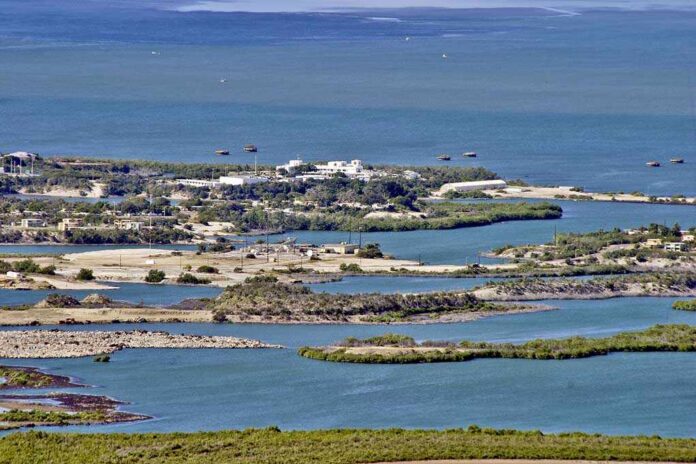
The Bering Strait lies between Alaska and Russia, separated by two islands and spanning 80 kilometers (50 miles). Building three dams across this remote, ice-choked passage would require unprecedented infrastructure in one of Earth’s harshest environments—and a binding agreement between the United States and Russia. Current geopolitical tensions, sanctions, and lack of shared interests make such cooperation virtually impossible [2][3]. No roads, ports, or supply lines exist in the region. The engineering challenges alone—designing structures to withstand sea ice pressure, Arctic storms, and extreme remoteness—remain unsolved and likely prohibitively expensive [2].
A vast dam across the Bering Strait could stop the AMOC collapsinghttps://t.co/EJGRGaWmw3
— WholeLifeCarbon (@wholelifecarbon) May 9, 2026
Ecological Devastation and Indigenous Communities at Risk
The Bering Strait is a critical migration corridor for whales, seals, and other marine mammals traveling between the Pacific and Arctic Oceans [3]. Damming the strait would alter currents, salinity levels, and ocean temperatures, disrupting entire Arctic food webs and fisheries on which indigenous Alaskan and Russian communities depend for survival [1][3]. No comprehensive ecological impact assessments exist. No indigenous groups have been consulted. No environmental organizations have endorsed the proposal. The potential for ecological and cultural catastrophe is real, yet largely unexamined [1][3].
Preliminary Science Demands Caution
The researchers themselves caution that their findings derive from simplified computer models, not real-world observations or high-resolution climate simulations [2][5]. The study is a “proof of concept”—a theoretical exercise—not a validated plan. Scientists stress that further modeling and empirical research are needed before anyone should consider such a radical intervention [2][3]. The long-term effects remain uncertain even in favorable scenarios, and no validation exists against actual ocean data or comprehensive climate models [2].
The Conservative Takeaway
This proposal exemplifies how progressive climate alarmism often leads to absurd, impractical schemes that distract from real solutions. Instead of proposing massive dams that require international cooperation with hostile regimes, disrupt ecosystems, and may not work, policymakers should focus on energy policies that reduce emissions while maintaining prosperity. The Trump administration’s emphasis on energy independence through domestic oil, natural gas, and nuclear power offers a far more practical path than betting on speculative geoengineering projects that could backfire catastrophically [2][3].
Sources:
[1]
[2] Building a massive dam between Alaska and Russia could prevent …
[3] Could a dam between Alaska and Siberia stabilise the AMOC?
[4] The effects of a constructed closure of the Bering Strait on AMOC …
[5] The effects of a constructed closure of the Bering Strait on AMOC …