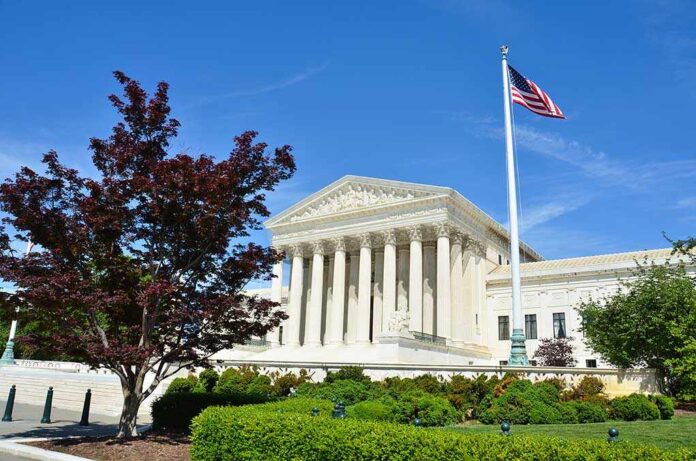
The Supreme Court’s recent order demanding California Democrats justify Proposition 50 maps is a crucial moment for constitutional values, spotlighting alleged racial gerrymandering.
Story Snapshot
- California Democrats must respond to SCOTUS by January 29 regarding Proposition 50 maps.
- Republicans and DOJ allege racial gerrymandering in the newly drawn district maps.
- The Supreme Court intervention follows a 2-1 lower court decision upholding the maps.
- Outcome could set nationwide precedent on voter-approved racial gerrymanders.
Supreme Court’s Intervention
On January 22, 2026, the U.S. Supreme Court issued a directive for California Democrats to justify the use of congressional district maps approved via Proposition 50. This directive comes in response to claims from the California Republican Party and the DOJ that these maps are racially gerrymandered, particularly affecting District 13. The Supreme Court’s intervention highlights concerns over potential unconstitutional practices, as the maps could disrupt the balance by targeting 4-6 Republican seats.
The maps were initially upheld by a three-judge U.S. District Court panel, which emphasized voter approval over allegations of racial gerrymandering. Approval of Proposition 50 maps in November 2025 by a 64% voter majority aimed to secure more Democratic seats. However, the GOP’s emergency application to the Supreme Court reflects ongoing battles over redistricting, with implications for the upcoming 2026 midterms.
Key Stakeholders in the Debate
The California Republican Party, represented by attorney Mark Meuser, is at the forefront of challenging the maps. Their motivation is to protect 4-6 GOP seats from being compromised by what they allege is a race-based redistricting strategy. On the other side, Governor Gavin Newsom and California Democrats defend the Proposition 50 maps as a necessary counter to Republican gains in states like Texas. Consultant Paul Mitchell, responsible for drawing the maps, has been criticized for allegedly prioritizing racial considerations while refusing to testify on these claims.
The U.S. Department of Justice, under the Trump administration, supports the GOP’s stance. Solicitor General John Sauer argued that the maps are “tainted by unconstitutional racial gerrymander,” particularly in District 13. This support underscores the serious constitutional questions regarding racial versus partisan motivations in redistricting, drawing parallels with the recent Supreme Court approval of Texas maps.
Implications and Future Outlook
If the Supreme Court blocks the Proposition 50 maps, it could require California to revert to previous district maps, affecting candidate filings and campaigns for the 2026 midterms. The decision may set a precedent for handling voter-approved racial gerrymanders and influence redistricting strategies across the nation. The ongoing case also ties into the broader legal landscape, with the Supreme Court’s eventual ruling potentially impacting minority district considerations nationwide.
Supreme Court Orders CA Dems To Justify Prop 50 Maps. By @susancrabtree https://t.co/CwGjJy9AIH via @ConservNewsView
— Conservative News and Views (@ConservNewsView) January 27, 2026
The outcome of the Supreme Court’s review remains crucial, not just for California but for the national dialogue on redistricting fairness and the role of race and politics in shaping electoral districts. As the January 29 deadline approaches for California’s response, all eyes are on the Supreme Court’s next move.
Sources:
RealClearPolitics: Supreme Court Orders CA Dems To Justify Prop 50 Maps
LegalNewsline: CA GOP Asks SCOTUS To Block Unconstitutional Prop 50 Maps