Supreme Court ruling empowers rapid deportations that sidestep judicial oversight, raising alarms about due process erosion for all Americans amid unchecked executive power.
Story Snapshot
- Supreme Court grants emergency relief to government, allowing swift deportations before courts can intervene despite lower court blocks.
- Justice Sotomayor dissents sharply, calling the decision a “gross abuse” that defies orders and risks lives in torture-threatened cases.
- Legal expert warns ruling creates loophole for abuse under Civil War-era Alien Enemies Act misused in peacetime.
- All justices reject no-notice deportations, but speed now trumps full protections, fueling bipartisan fears of government overreach.
Supreme Court Grants Deportation Relief
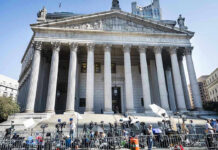
The Supreme Court issued an emergency ruling in case No. 24A1153, granting the government relief from a lower court order. This action dissolved safeguards requiring reasonable time for habeas corpus challenges. The government had deported a plaintiff to Guatemala despite an Immigration Judge’s finding of likely torture there. Lower courts documented repeated defiance of their orders blocking such removals. Chief Justice Roberts noted the need for a “reasonable time” for challenges, but the majority prioritized executive speed.
Sotomayor, joined by Justices Kagan and Jackson, dissented. She described the Court’s intervention as “incomprehensible as it is inexcusable,” labeling it a gross abuse of emergency powers. The dissent highlighted life-and-death stakes, urging caution before overriding lower courts. All nine justices agreed against “rushing people onto planes with no notice,” yet the ruling permits preemptive removals if executed quickly enough to evade orders.
Sotomayor’s Dissent Signals Due Process Risks
Justice Sotomayor’s dissent warns that the ruling eliminates a key check against government abuse. Legal expert Aaron Reichlin-Melnick analyzed it as “terrifying,” noting it allows deportations before courts intervene. This creates a practical loophole where speed defeats judicial review. Reichlin-Melnick emphasized ICE often retrieves wrongfully deported individuals, but the decision removes mandates for good-faith efforts to reverse hasty actions. The Fourth Circuit echoed similar concerns hours before the ruling.
The case involves Venezuelans removed to El Salvador under disputed authority. Sotomayor stressed constitutional freedoms at stake, refusing to stand “idly by while our constitutional freedoms are lost.” Her words resonate beyond immigration, underscoring frustrations with federal overreach that bypasses checks. Both conservatives wary of executive fiat and liberals guarding rights see echoes of deep state priorities over citizen protections.
Alien Enemies Act Invokes Wartime Precedent in Peacetime
The government invoked the 1798 Alien Enemies Act, a wartime law for deporting enemy nationals during declared wars. Historical uses occurred in World Wars I and II, including Japanese internment later repudiated. No declared war exists today, yet the administration applies it to modern enforcement. Reichlin-Melnick called this an “odd argument,” predicting Supreme Court merits review will reject peacetime use as unlawful.
This shadow docket decision fits a pattern of fast-tracking executive immigration requests. It overrides lower courts that found government defiance, including torture-risk deportations. Implications extend to broader communities fearing arbitrary seizures based on appearance or low-wage jobs. Economically, it cuts detention costs but invites lawsuits. Socially, it heightens immigrant fears while politically bolstering security narratives amid 2025 crises.
Both sides of the aisle share distrust in federal reliability. Conservatives decry misuse of ancient laws for mass actions, echoing illegal immigration frustrations. Liberals highlight minority targeting and welfare strains. Yet the overriding concern unites them: elites in Washington prioritize power over American principles of fair process and limited government. This ruling departs from founding ideals of restrained authority, alerting citizens to deepening divides between rulers and the ruled.
Sources:
Transcript: Sotomayor’s Harsh New Dissent Contains One Terrifying …
[PDF] SUPREME COURT OF THE UNITED STATES
[Solved] Select the correct answer Read the excerpt from paragraph …
KEMIYA MURPHY – Americas Changing Views on Immigration …