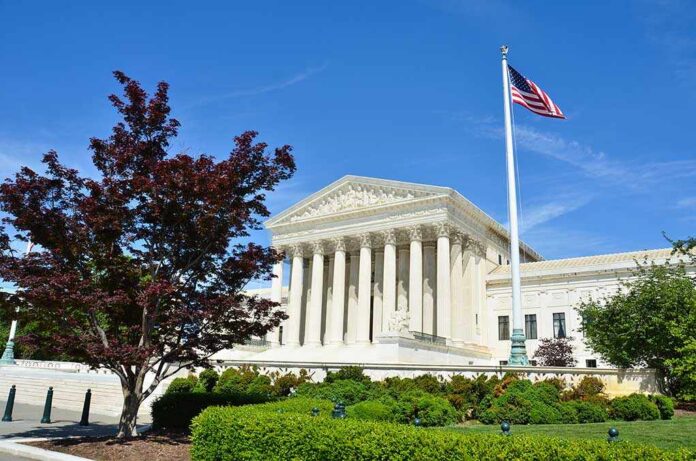
The Supreme Court just locked in Texas’ new congressional map for 2026—fueling “bombshell” headlines while reigniting an older, unresolved fight over whether federal courts can police partisan line-drawing.
Story Snapshot
- The Supreme Court issued a 6–3 summary reversal that effectively ends, for now, the legal effort to block Texas’ mid-decade congressional redistricting for the 2026 cycle.
- The decision cements a map that could advantage Republicans in Texas, with analysts and advocates citing a potential net gain of up to five House seats.
- The Court did not add fresh reasoning in the final order, leaning on its earlier posture that federal courts can’t fix “partisan gerrymandering” claims.
- Voting-rights groups argue the lower court found racial vote dilution, while the Supreme Court’s move narrows what plaintiffs can realistically win before Election Day.
What the Supreme Court actually did—and why the timing matters
The Supreme Court’s late-April order upheld Texas’ newly drawn congressional map after a lower federal court had blocked it in November 2025. The justices’ move was a summary reversal, meaning the Court ended the lower court’s ruling without issuing a full, detailed opinion. Practically, that matters because the map is now locked in for the 2026 primaries and midterms, removing uncertainty for candidates, parties, and election administrators.
The timeline explains why coverage has been so heated. A three-judge panel initially ruled against Texas, citing concerns tied to the Voting Rights Act and racial gerrymandering allegations. In early December 2025, the Supreme Court stepped in with a stay that allowed Texas to proceed temporarily. The April 27–28, 2026, order largely finishes that job, keeping the map in place through November unless a new case changes the rules.
Why “partisan vs. racial” gerrymandering is the whole ballgame
The legal dispute turns on a distinction most voters never asked for but now live with. Supreme Court precedent has generally treated partisan gerrymandering as a political question that federal courts can’t remedy, while racial gerrymandering and certain Voting Rights Act claims can still trigger federal intervention. In this Texas case, critics say the lower court identified racial vote dilution, while the Supreme Court’s actions signal skepticism that the claims can overcome the partisan-gerrymandering barrier.
That’s where the “bombshell” framing can mislead. The Supreme Court didn’t announce a brand-new national redistricting standard in April. It used a procedural mechanism to settle the status of Texas’ map for 2026, with the majority and dissent split along familiar ideological lines. For conservatives who prefer clear rules and limited judicial micromanagement of elections, the Court’s posture reinforces federal restraint. For liberals focused on minority representation, the move reads like a door closing.
Political consequences: a Texas ruling with national ripple effects
Texas alone is large enough to affect the House balance, which is why the decision is being described in election terms. Reports tied to the litigation have suggested the new map could net Republicans as many as five seats. In a closely divided Congress—even with Republicans currently holding both chambers—margins still matter for committee control, impeachment-style showdowns, and the day-to-day ability to move a president’s agenda without constant internal defections.
The decision also lands in a climate where both sides distrust the system. Conservatives remember years of cultural and economic pressure—from energy-cost spikes to border chaos—and see election fights as one more arena where bureaucracy and courts pick winners. Many liberals, meanwhile, see redistricting as one more tool that protects incumbents and entrenches power. The shared frustration is that voters often feel like the rules are set by political professionals, not by communities.
What to watch next: copycat maps and the next Voting Rights Act test
Outside Texas, reform advocates warn the ruling could encourage other states to attempt mid-decade redistricting, especially if upcoming Supreme Court decisions further narrow Voting Rights Act enforcement. One closely watched case, Louisiana v. Callais, is being treated as a potential trigger point for broader changes in how maps get challenged—and how quickly states could redraw lines before an election. The closer the calendar gets to November, the more courts tend to avoid disruptions.
BREAKING: Supreme Court BOMBSHELL RULING Just CHANGED The MIDTERMS!!! https://t.co/jAERwjUl6a via @YouTube
— MY LORD (@enrique93917707) April 29, 2026
For voters trying to cut through the noise, the takeaway is straightforward: the Supreme Court’s Texas order is less a single “midterms changer” than a sign of how elections are increasingly settled by procedural rulings and tight timelines. Republicans view it as a lawful check on federal-court overreach and a win for state authority. Democrats view it as a setback for minority voting power. Either way, it underscores a system where the fight over representation keeps moving from ballots to court dockets.
Sources:
https://issueone.org/press/scotus-ruling-could-trigger-widespread-pre-midterm-redistricting/
https://statecourtreport.org/election-2026