
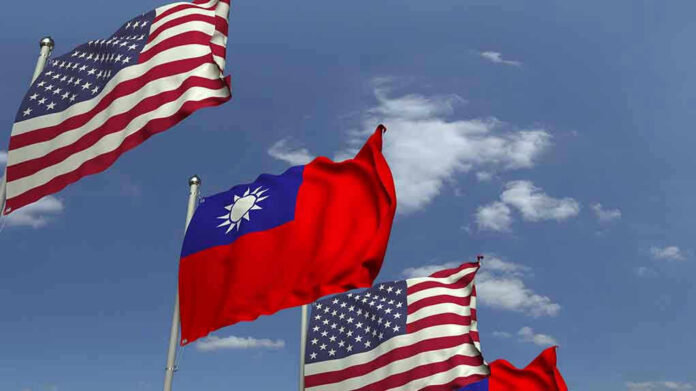
Beijing pushed threats while pundits peddled panic, but Washington’s message was firm: U.S. policy on Taiwan is unchanged and America will keep Taiwan armed and supported.
Story Snapshot
- Secretary of State Marco Rubio said U.S. Taiwan policy remains unchanged after the Trump–Xi meeting [1].
- Trump’s team backed historic and ongoing arms sales to Taiwan, signaling sustained defense support [4].
- Xi warned of “clashes” if Taiwan is mishandled, underscoring Beijing’s pressure campaign [3].
- Trump advanced deeper official contact with Taipei through new legislation in 2025 [2].
Rubio Reaffirms Policy Continuity After Trump–Xi Talks
Secretary of State Marco Rubio stated that United States policy toward Taiwan remains “unchanged” following President Trump’s meeting with China’s Xi Jinping in Beijing, emphasizing that the United States will defend Taiwan consistent with longstanding policy. Rubio described continuity across multiple administrations and rejected the notion of a sudden departure from established commitments. His remarks directly counter claims that the administration would bargain away Taiwan’s security for short-term deals, anchoring the dialogue in clear, on-the-record U.S. assurances [1].
China’s leader publicly warned of “clashes” if the Taiwan issue is mishandled, language calibrated to raise costs and test Washington’s resolve. Beijing’s rhetoric followed the summit optics and sought to frame Taiwan as a red line under Chinese terms. The warning highlights why clarity from U.S. officials matters: it deters miscalculation and reassures allies. Rubio’s explicit statement—paired with defense moves detailed below—situates the administration’s stance as steady under pressure, not transactional drift [3].
Record Arms Sales Underscore Practical Support for Taiwan’s Defense
Trump’s first term approved approximately $18 billion in arms sales to Taiwan over four years, surpassing the prior administration’s eight-year total and streamlining approvals from annual batches to rolling decisions. Analysts also credit Trump-era trade pressure on China with encouraging Taiwanese economic diversification, strengthening resilience. These concrete steps reinforce deterrence, contradicting claims that Washington treats Taiwan as a bargaining chip, and demonstrate that practical capability-building has matched stated policy continuity on security ties [4].
Current planning highlights continued large-scale arms packages, building on prior authorizations for advanced systems that raise the cost of coercion across the strait. While commentators debate “strategic ambiguity,” the measurable trend line in equipment flow and training support points to long-run fortification of Taiwan’s defenses. These sales, conducted under law and congressional oversight, align with an American interest in deterring aggression without greenlighting unilateral declarations of independence that could trigger crisis escalation [4].
Legislative Moves Expand Official Contact, Challenge Self-Imposed Limits
President Trump signed the Taiwan Assurance Implementation Act in December 2025, tasking the executive branch to explore removing self-imposed “red lines” on official U.S.–Taiwan contacts. This follows the 2018 Taiwan Travel Act, which lifted long-standing restrictions on exchanges after the 1979 diplomatic shift. Together, these laws deepen practical ties, improve coordination, and signal that the United States will not let Beijing dictate the terms of democratic engagement with Taipei—an approach consistent with American sovereignty and constitutional prerogatives [2].
Think tanks critical of the administration describe a “compounding strategic ambiguity,” arguing that record arms sales coupled with pressure for higher Taiwanese defense spending send mixed signals. That critique warrants attention but does not negate the observable policy pillars: more capability for Taiwan, more official interaction, and reiterated deterrence statements by senior leaders. Where documents are thin—such as unverified letters warning against “bargaining chips”—the public record still shows concrete actions outweighing speculative fears of a trade-for-security swap [2].
How Conservatives Should Read The Noise: Deterrence, Not Concessions
Conservative readers should separate media speculation from traceable facts. Beijing’s threats are designed to intimidate. American policy statements, arms deliveries, and pro-contact legislation are designed to deter. There is no public evidence of a deal to trade Taiwan for cooperation on Iran or anything else. Instead, the administration’s track shows a thicker network of ties and tools that raise costs on Chinese aggression while keeping American decision-making independent of foreign pressure—an outcome aligned with U.S. strength and sovereignty [1].
Sources:
[1] YouTube – U.S. Taiwan policies ‘unchanged’ after Trump-Xi meeting, Rubio says
[2] Web – Trump’s Policy toward Taiwan: Compounding Strategic Ambiguity
[3] YouTube – Xi Warns Trump of Possible ‘Clashes’ If Taiwan Issue Mishandled
[4] Web – Taiwan and Trump 2.0: Partner or Bargaining Chip?