
Trump’s military takes unprecedented action by airlifting massive M1 Abrams tanks and Bradley fighting vehicles directly to Middle East bases, signaling America’s readiness to defend our forces against escalating regional threats.
Story Highlights
- U.S. Army deploys M1 Abrams tanks and M2A3 Bradley fighting vehicles via strategic airlift to CENTCOM bases
- National Guard’s 278th Armored Cavalry Regiment executes rapid deployment in days instead of weeks
- Deployment responds to increasing drone attacks and missile threats against American personnel
- Move demonstrates Trump administration’s commitment to protecting U.S. forces and deterring adversaries
Strategic Airlift Demonstrates American Military Superiority
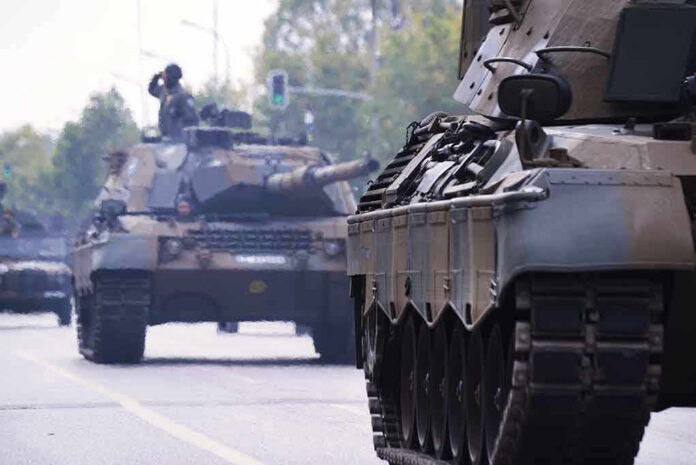
The U.S. Army launched an extraordinary deployment operation, utilizing C-17 Globemaster III aircraft to transport M1 Abrams main battle tanks and M2A3 Bradley infantry fighting vehicles to Central Command areas of responsibility. This unprecedented use of strategic airlift for heavy armor typically transported by sea demonstrates the Trump administration’s commitment to rapid force projection. The 3rd Squadron of the 278th Armored Cavalry Regiment, known as Task Force “Reaper,” executed this complex operation with precision.
The deployment timeline reveals the operation’s urgency and strategic importance. Beginning in recent days prior to January 20, 2026, airlift operations were observed unloading combat vehicles at CENTCOM facilities throughout the region. Visual documentation confirmed the arrival of these formidable weapons systems, representing a significant enhancement to America’s defensive capabilities in this volatile theater of operations.
Enhanced Protection Against Growing Regional Threats
American forces face escalating threats from drone swarms, ballistic missiles, and coordinated attacks on U.S. facilities across the Middle East. The deployment creates a “shield wall” of heavy armor specifically designed to counter these evolving dangers. M1 Abrams tanks provide unmatched firepower and protection, while M2A3 Bradley vehicles offer infantry support with 25mm cannons and TOW missile systems, creating integrated combined arms capabilities.
This defensive enhancement comes amid broader regional instability and follows strategic adjustments like the Iraqi army’s assumption of control over Ain al-Asad airbase on January 17, 2026. The U.S. maintains approximately 30,000 troops across Middle East bases in Qatar, Jordan, Iraq, and Syria, making force protection a critical priority for American military leadership and the safety of our service members.
Trump Administration Sends Clear Deterrence Message
Pentagon officials emphasize the defensive nature of this deployment while maintaining strategic ambiguity about exact locations and force levels. This approach signals tactical flexibility to adversaries, particularly Iran-backed groups that have targeted American facilities. The rapid deployment capability demonstrates America’s ability to project an “iron fist” anywhere threats emerge, reinforcing our commitment to protecting personnel and allies.
The broader implications extend beyond immediate defensive needs. This deployment underscores sustained American commitment to Middle East stability while potentially escalating tensions with regional adversaries who now face enhanced deterrence. For our troops and regional allies, these combat vehicles provide critical protection and tactical advantages against sophisticated threats that have evolved significantly in recent years.
Sources:
US Army bolsters Middle East presence with heavy armored vehicles
U.S. deploys EAGLS counter-drone system in Middle East
Abrams tanks Middle East deployment
U.S. Army deploys heavy combat vehicles to Middle East