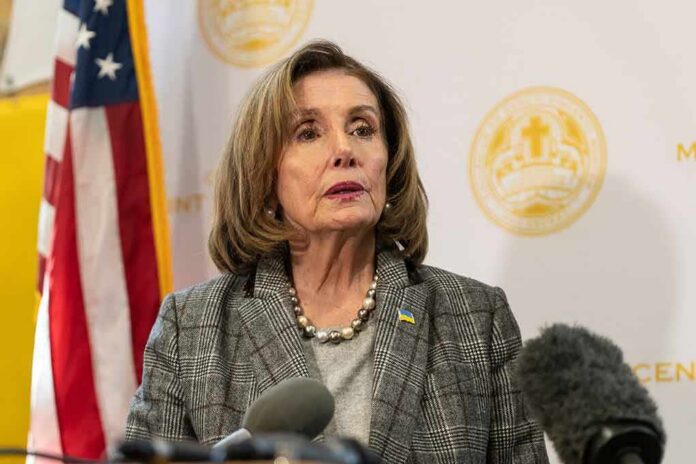
Nancy Pelosi’s retirement message about “service” is colliding head-on with a new report detailing roughly $130 million in stock profits tied to her family during her decades in Congress—exactly the kind of optics that drives Americans to believe Washington plays by different rules.
Story Snapshot
- A report says Pelosi and her husband Paul Pelosi generated about $130 million in stock profits during her nearly 40-year House career, with returns far outpacing the broader market.
- Pelosi announced in February 2026 that she will not seek re-election, finishing her term through 2027.
- Watchdog and media reporting highlights the broader congressional stock-trading problem as bipartisan, driven by lawmakers’ access to nonpublic information.
- Past allegations and controversies cited in reporting remain disputed, with Pelosi denying wrongdoing and no new illegality established in the available sources.
Retirement Video Meets a Brutal Optics Problem
Nancy Pelosi’s February 2026 retirement announcement, framed around gratitude and continued service through the end of her term, landed amid renewed attention to her family’s market performance. According to reporting, the Pelosis’ stock profits over her congressional tenure amount to about $130 million, and her holdings grew from hundreds of thousands in the late 1980s to well over $100 million today. That timing is why the retirement message is being scrutinized so intensely.
The figures cited in the reports are especially striking because they compare Pelosi’s returns to ordinary benchmarks. One report describes a roughly 16,930% return versus about 2,300% for the Dow Jones over a similar span. Even without proving any illegal conduct, the contrast naturally fuels questions about whether lawmakers should be allowed to trade individual stocks while voting on policies that move markets. For voters already tired of elites cashing in, it is the definition of a trust problem.
How Congressional Trading Became a National Flashpoint
Congressional stock trading has drawn criticism for years because lawmakers routinely receive briefings and information the public does not. Watchdog analysis cited in the research argues that this access creates conflicts of interest even when trades are disclosed and technically legal. The available reporting also emphasizes that this is not a “one party only” issue, pointing to examples across multiple years involving different lawmakers. That bipartisan pattern strengthens the case that the system itself invites abuse.
Pelosi’s case is prominent partly because of her influence and seniority. She served in the House starting in 1987 and twice held the Speaker’s gavel, giving her a central role in shaping legislation touching major sectors like finance and technology. Reports also note that members of Congress earn a base salary of $174,000, which makes the scale of wealth accumulation more politically explosive. When everyday families feel squeezed by inflation and policy failures, this kind of wealth gap becomes gasoline on a distrust fire.
Past Allegations, Denials, and What the Sources Actually Prove
The research cites older controversies that have followed Pelosi for years, including a 2011 “60 Minutes” segment alleging she benefited from information related to Visa, as well as earlier accusations connected to Del Monte Foods and legislative decisions. Pelosi has described such claims as politically motivated smears. Based on the provided sources, the strongest verified facts are the disclosed wealth figures and the unusually strong market returns attributed to the Pelosi household—not a definitive finding that specific trades violated criminal insider-trading laws.
That distinction matters, but it does not resolve the ethics question. A system can be legal and still be unacceptable to citizens who expect representatives to put public duty before private gain. Conservative voters have long argued that Washington’s permanent class uses complexity and loopholes to protect itself. When a career politician retires while headlines highlight enormous trading profits, it becomes a real-world example of why reforms like trading bans, blind trusts, or stricter rules keep coming back—because the current arrangement cannot earn public confidence.
What Comes Next: A Reform Moment or Another Media Cycle?
Pelosi’s retirement creates a natural moment for Congress to confront the trading issue directly, especially as attention shifts to who will succeed her in California’s 12th district. The research references ongoing calls for restrictions and notes that the controversy extends far beyond a single personality. Still, the sources also show a familiar pattern: major headlines, public anger, and then slow movement once the spotlight fades. Whether lawmakers finally tighten the rules will likely depend on sustained pressure rather than another round of talking points.
Nancy Pelosi Wants to Make It Clear She Was NOT in Congress for the Money (Cue Eye Rolls and Spit Takes) https://t.co/vBSmtVgXLj
— Marlon East Of The Pecos (@Darksideleader2) February 26, 2026
For a country trying to re-anchor itself in constitutional principles and accountable government, the bigger question is simple: should elected officials be allowed to trade like hedge funds while writing laws like rulers? The reporting provided does not prove Pelosi committed a crime, but it does document numbers and circumstances that intensify a longstanding conflict-of-interest debate. If Congress wants legitimacy, it will need rules that pass the common-sense test for ordinary Americans—not just the lawyerly one inside the Beltway.
Sources:
Report shares Nancy Pelosi made $130 million in stock profits during her political career