
A British swimmer crossing the Strait of Hormuz heard two explosions and watched a tanker burst into flames just a few miles away, putting a human face on a war that has already damaged dozens of ships and left hundreds of oil slicks across the Persian Gulf.
Story Snapshot
- Endurance swimmer Lewis Pugh finished a three-day, 15-kilometer swim through the Strait of Hormuz and described explosions, fireballs, and a strong chemical smell.
- India’s government confirmed an attack on the tanker MT TARA GAS on November 16, leaving one Indian seafarer missing and two hospitalized.
- Greenpeace satellite tracking found more than 500 oil-spill events across the Gulf, covering a combined area close to the size of Wales.
- British maritime watchdog UKMTO still rates the strait “severe,” though it says nearly 40% of attacked ships kept moving safely afterward.
Swimmer Describes Explosions and Flames in War Zone
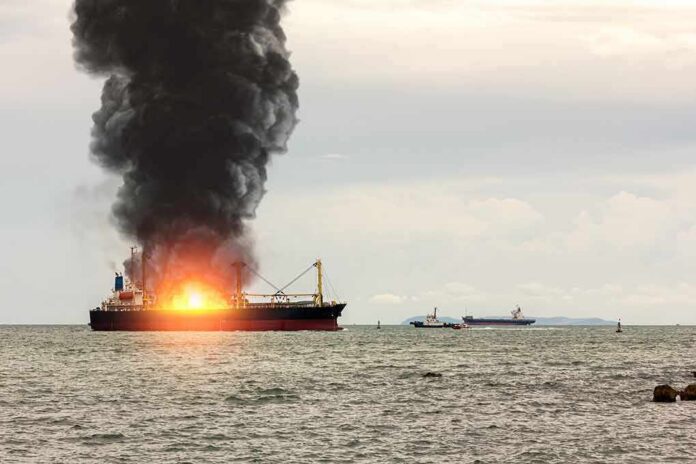
Lewis Pugh, a United Nations Patron of the Oceans, swam through one of the world’s most dangerous waterways to draw attention to the war’s toll on the sea. During the crossing, he said he heard “two very loud explosions” and saw an oil tanker about four kilometers away engulfed in flames, with fireballs shooting into the sky.
Pugh also reported an intense chemical smell during parts of the swim, though his account does not identify the tanker, its cargo, or the exact cause of the fire. Still, the firsthand description lines up with a broader pattern of tanker attacks that have made the strait one of the riskiest shipping lanes on Earth.
Indian Tanker Attack Shows Human Cost
India’s Ministry of External Affairs confirmed the attack on the Panama-flagged LPG tanker MT TARA GAS on November 16. Of 24 Indian crew members aboard, 21 were evacuated safely, two were hospitalized, and one remained missing as of the government’s statement. India called the continuing attacks a “grave threat to civilian seafarers” and demanded they stop.
That attack is one entry in a long list documented by British maritime monitor UKMTO, which has tracked repeated strikes on commercial vessels in the region. The group rated the Strait of Hormuz threat level “severe,” citing hostile action, navigation interference, and possible mining activity still affecting the waterway.
Satellite Data Reveals Scale of Gulf Pollution
Greenpeace used satellite monitoring to identify more than 500 oil-spill events across the Gulf, the Strait of Hormuz, and the Arabian Sea since the war began. Some spills were clearly tied to attacks on ships, while the cause of others could not be confirmed. Added together, the spills covered roughly 20,000 square kilometers, an area close to the size of Wales.
British endurance swimmer Lewis Pugh has completed a three-day swim through the Strait of Hormuz to highlight the environmental consequences of war.
Pugh said an oil tanker was struck just minutes after he began swimming, with further attacks on commercial vessels taking place… https://t.co/TnlWwtUPjc
— NewsWire 🇱🇰 (@NewsWireLK) November 23, 2026
Not every attack has caused lasting disruption. UKMTO has recorded cases, including one LNG tanker hit by a projectile, where crews extinguished fires with no reported environmental damage. The group also found that nearly 40% of attacked vessels safely continued their voyages, a detail that complicates claims that every strike leaves a lasting mark on the water.
History suggests the damage can outlast the headlines. During the 1991 Gulf War, an estimated one million metric tons of crude oil spilled into the same waters, and international compensation efforts later covered only a small fraction of the claimed environmental harm. Researchers studying that spill say it offers a troubling preview of what today’s attacks could leave behind for decades.
Together, the swimmer’s account, India’s official statement, and the satellite data point to the same uncomfortable truth: a vital global shipping route has become a battleground, and the people and ecosystems caught in the middle are paying a price that outside governments have yet to fully measure or stop.
Sources:
youtube.com, newindianexpress.com, hindustantimes.com, ukmto.org
© patriotpostnews.com 2026. All rights reserved.