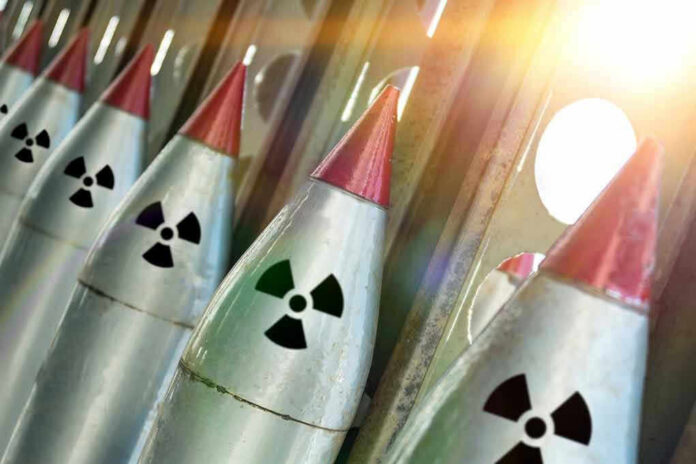
For the first time since the Cold War’s end, America’s nuclear arsenal is being guarded by a skeleton crew—because Congress can’t agree on a budget.
Story Snapshot
- The shutdown has forced the first-ever mass furlough of the National Nuclear Security Administration (NNSA) workforce.
- Only a fraction of staff remain to secure and oversee the US nuclear weapons stockpile.
- Political gridlock in Congress over health care and budget issues triggered the crisis.
- The event exposes national security vulnerabilities when government shutdowns drag on.
Nearly All Nuke Guardians Sent Home: Unprecedented Risk
October 20, 2025, marked an inflection point for the US government’s nuclear security mission. The NNSA, the agency founded in 2000 to safeguard America’s nuclear warheads, furloughed roughly 1,400 of its workers, leaving “fewer than 400” on post to manage the nation’s deadliest arsenal. It’s a moment that security insiders swore would never be allowed to happen. Yet, as the government shutdown slogged into its third week, the unthinkable became real: nuclear security is now operating with a bare minimum of oversight, and the world is watching.
For NNSA employees, the news arrived with the force of a gut punch. Seasoned engineers, cyber specialists, and safety managers—essential to the daily rituals of maintaining and securing the nuclear stockpile—were told to stay home, unpaid and uncertain when, or if, they’d return. Their absence leaves the remaining skeleton staff scrambling to uphold a task where “good enough” simply doesn’t cut it. For the first time in its 25-year history, the NNSA’s mission to keep nuclear materials secure is being tested not by foreign adversaries, but by political stalemate in Washington.
Shutdown Stalemate: Who’s to Blame and What’s at Stake
The proximate cause of the standoff is a bitter dispute in Congress, where Republicans demand a “clean” spending bill to reopen the government, while Democrats insist that Affordable Care Act subsidies be addressed first. Energy Secretary Chris Wright publicly pinned the blame on Senate Democrats, while Speaker Mike Johnson warned that the shutdown could soon become the longest in American history. Under the Constitution, only Congress can appropriate funds—so when lawmakers deadlock, even the highest-stakes agencies are left twisting in the wind.
The NNSA’s parent, the Department of Energy, has warned that a prolonged shutdown means more than just delayed paychecks. It invites risk: as maintenance routines are deferred and layers of oversight thin, the potential for error, mishap, or exploitation by foreign intelligence grows. While some experts argue that a core contingent of staff can maintain basic safety, others counter that any reduction in vigilance is an unacceptable gamble when it comes to nuclear weapons.
The Trump administration by Monday will furlough about 1,400 workers at the agency that manages the US nuclear weapons arsenal due to the government shutdown, the Department of Energy said https://t.co/YsOE7X9JbA
— Reuters (@Reuters) October 17, 2025
A New Precedent: When Political Drama Becomes a Security Threat
Government shutdowns aren’t new—America’s longest lasted 35 days in 2018-19—but never before has the NNSA’s workforce been gutted on this scale. During prior shutdowns, national security posts were considered untouchable, funded even as parks closed and passport offices shuttered. Now, that firewall has crumbled. The shutdown’s reach into the NNSA ranks as a watershed moment, signaling that no agency is immune when appropriations stall. The immediate consequence is a dramatic reduction in nuclear oversight and a surge of anxiety among defense officials tasked with worst-case scenario planning.
The human toll is equally acute. Furloughed workers—many with decades of specialized experience—face not only financial strain but a growing sense that their mission is undervalued. Morale, already fragile in the face of political headwinds, stands to erode further if the shutdown drags on. Long-term, the danger is less visible but just as real: institutional memory and expertise bleed away, leaving the nation’s most sensitive programs vulnerable to both error and attrition.
Broader Implications: How Shutdowns Expose Critical Weaknesses
This episode is more than a footnote in budgetary brinksmanship; it’s a warning flare for anyone concerned about the continuity of America’s most vital security operations. When one of the world’s most sophisticated nuclear programs can be kneecapped by politics, it raises urgent questions about contingency planning and the resilience of critical infrastructure. Policy analysts point out that other high-risk sectors—cyber defense, pandemic response, border security—are only as durable as the funding that sustains them.
For those who still believe that government shutdowns are mere political theater, the NNSA furloughs are a sobering reminder: in a world of real threats, security is only as strong as the weakest link—and sometimes, that link is the willingness of lawmakers to do their job.