
patriotpostnews.com — Gunfire near the White House again exposed how quickly a federal security failure can put journalists, officers, and the public at risk.
Quick Take
- Secret Service officers shot and killed a man after he opened fire near a White House security checkpoint [1].
- A bystander was wounded, while no Secret Service officers were reported injured [1][2].
- Reporters on scene heard gunfire and were rushed inside as the area locked down [1][3].
- Authorities identified the suspect as 21-year-old Nasir Best through a person familiar with the investigation [1].
What Happened Near the White House
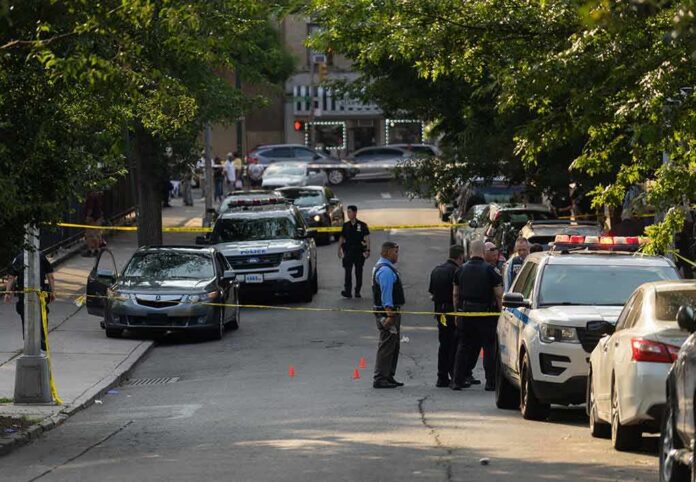
The U.S. Secret Service said the shooting began near a checkpoint outside the White House, where officers responded with return fire and struck the suspect [1]. Coverage from the Associated Press and CBS News said the man died after being taken to a hospital, and that the president was inside the White House at the time [2]. CBS also reported that multiple law-enforcement sources described roughly 15 to 30 shots fired in the area [1].
That sequence matters because this was not a distant crime scene or a random street disturbance. It was a shooting at one of the most guarded locations in the country, where any gunfire forces an immediate armed response. CBS News reported that reporters on the North Lawn heard shots and were ushered indoors as the situation unfolded [1]. On a practical level, that is exactly the kind of chaos Americans expect when security is breached in the nation’s capital [3].
What Authorities Have Said So Far
Officials have not publicly announced a motive, and the public record remains incomplete on several key points [1]. CBS News reported that the bystander’s injury was confirmed, but it was unclear whether that person was hit by the suspect’s gunfire or by officers’ return fire [1]. That detail matters, because headlines can move faster than the evidence. Without a released forensic reconstruction, there is still a gap between the initial law-enforcement account and a full accounting of what happened [1][2].
Reporting also said the suspect was identified as 21-year-old Nasir Best by a person familiar with the investigation [1]. Separate coverage noted that Best had previously been arrested by the Secret Service after an incident near the White House last summer [2]. That earlier contact does not explain Saturday’s shooting on its own, but it does show why protective agencies take repeated boundary-testing seriously. When a person has already drawn attention at a federal perimeter, the public deserves clear answers, not spin [1][2].
Why This Incident Raises Bigger Concerns
This case highlights a familiar problem for Americans who are tired of public institutions moving slowly and explaining little. In the first hours after a security incident, officials control the scene, reporters are moved back, and the public hears only the first version of events [1][3]. That can be necessary for safety, but it also means the government’s account often dominates before independent verification is possible. For a country already fed up with weak borders and weak accountability, that is not a reassuring pattern [1].
A Boston Fire Dept. veteran dies battling a house fire in Dorchester, police arrest a man connected with a shooting in Dorchester, and journalists ran for cover while on the grounds of the White House. Stay in "The Loop" with WBZ Newsradio.https://t.co/HgdIgzCtj8
— WBZ NewsRadio (@wbznewsradio) May 24, 2026
The White House incident also reinforces how fragile public order can become when a gunman forces a lockdown at the center of federal power. The Secret Service acted quickly, and the available reporting supports that officers stopped the threat [1][2]. Still, the broader question remains whether federal agencies are operating with enough discipline, transparency, and readiness to prevent these moments from becoming routine. Americans should expect stronger protection of secure sites, faster public clarity, and fewer unanswered questions after the smoke clears [1].
Sources:
[1] Web – Gunman killed after opening fire on Secret Service checkpoint …
[2] YouTube – Secret Service kills gunman near White House after shots were fired
[3] YouTube – Bystander wounded, suspect dead after shooting near White House …
© patriotpostnews.com 2026. All rights reserved.