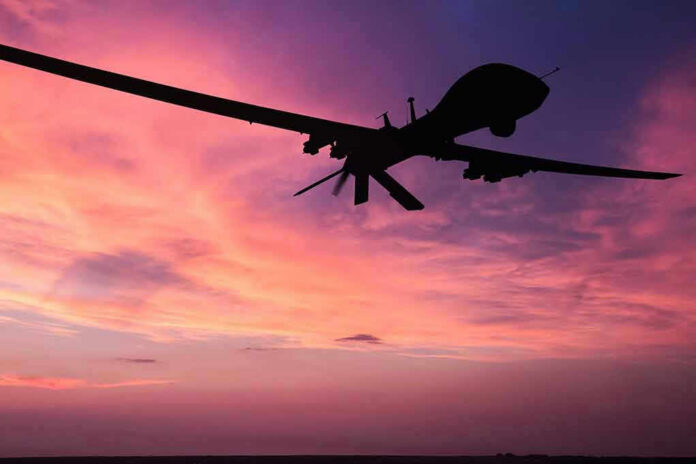
patriotpostnews.com — As artificial intelligence turns the battlefield into a web of cheap drones and invisible propaganda, American taxpayers and warfighters are being dragged into a new kind of conflict where truth, money, and lives are all on the line.
Story Snapshot
- Cheap, software-driven systems and drones are changing how wars are fought and financed, favoring scale and speed over giant legacy platforms.[4][5]
- Artificial intelligence is supercharging information warfare, flooding crises with fake images, videos, and narratives that overwhelm ordinary citizens and decision-makers.[1][2][3]
- Experts warn that artificial intelligence acts as a “threat multiplier,” degrading trust and raising nuclear and geopolitical risks, especially under impulsive or personalist leaders.[7]
- Conservatives face a double danger: economic strain from endless conflict and an information environment where it is harder than ever to tell what is real.[1][2][4][7]
Cheap Drones, Costly Wars: How the Battlefield Is Flipping
Analysts now argue that the “new economics of war” rests on cheap, autonomous systems that can punish expensive aircraft, ships, and armored vehicles, forcing militaries to think in terms of mass, software, and rapid iteration instead of a few exquisite platforms.[4][5] The National Interest describes how the United States military is moving to deploy large numbers of low-cost drones, acknowledging that the traditional model of a small fleet of highly expensive systems is becoming harder to sustain against swarms of inexpensive threats.[4] In Ukraine, economic analysts note that Kyiv’s survival against a larger invader has depended heavily on innovation, agility, and the ability to use lower-cost capabilities to offset Russia’s size advantage, showing that sheer scale now matters less than it used to.[5] For Americans who watched Washington waste trillions on drawn-out wars and bloated procurement, this shift raises a hard question: are we finally using technology to save lives and money, or just rebranding a permanent war economy with new gadgets?
Economists emphasize that even when the weapons change, the basic financial reality of war remains brutal: conflict destroys capital, diverts resources from schools and infrastructure, and leaves deep economic scars long after the shooting stops.[1][2] One analysis of modern conflicts found that wars typically cause an immediate economic output loss of around 3 percent of gross domestic product in the first year, with cumulative losses reaching about 7 percent after five years.[2] Postwar recoveries, far from delivering a quick rebound, often claw back only a little more than half of that lost output, because rebuilding shattered capital and restoring productivity takes years.[2] For families already squeezed by inflation and high energy prices, that means every new conflict layered onto the budget threatens higher taxes, more borrowing, or more money printing—all the ingredients for the kind of inflationary pain conservatives have been warning about for decades.[1][2]
Artificial Intelligence Turns the Information Space into a Battlefield
While drones and autonomous vehicles are changing the hardware of war, artificial intelligence is transforming the information environment in ways that cut directly against free speech, informed consent, and the public’s ability to hold leaders accountable.[1][3] Researchers writing in MIT Sloan Management Review report that generative artificial intelligence tools now allow propagandists to produce convincing fake images, audio, and video at scale, accelerating the spread of misleading narratives during conflicts.[1] A British report on artificial intelligence-driven information warfare describes how bots already account for a large share of online traffic and how deepfakes are surging, turning social media feeds into fertile ground for psychological manipulation.[2] Georgetown University’s Center for Security and Emerging Technology warns that advances in artificial intelligence can automate and optimize disinformation campaigns, making it easier for hostile actors—foreign and domestic—to target specific audiences with tailored falsehoods.[3] For conservative Americans accustomed to media bias and spin, this is something even more dangerous: an environment where seeing is no longer believing, and where citizens cannot easily verify the basic facts needed for democratic self-government.[1][2][3]
Strategic analysts caution that this information chaos is not just a cultural problem; it can feed directly into military and nuclear risk.[7] A recent academic study on artificial intelligence in the information ecosystem concludes that artificial intelligence acts primarily as a “threat multiplier,” worsening the impact of already degraded information environments and potentially increasing the risks of miscalculation in crises, especially when personalist leaders are in charge.[7] Another assessment of artificial intelligence at war warns that as these tools spread faster than governance and norms, the gap between capability and control grows more dangerous, particularly when decisions about escalation must be made within minutes. In a world where a doctored video or synthetic casualty report can go viral before anyone can debunk it, leaders may face intense pressure from angry, misinformed publics to retaliate—or may themselves be fooled by fabricated “intelligence.”[1][7] That is exactly the kind of scenario where America could be dragged into costly missteps or even wider war without clear facts, leaving ordinary citizens to pay the price in both blood and treasure.
Trump’s Second Term, Big Tech, and the Fight for Control of War Data
Conservative commentators have begun to connect these developments to the broader crisis of control around artificial intelligence, warning that Washington still lacks a serious consensus on how to manage the expanding security risks posed by advanced systems.[4][5] The Council on Foreign Relations notes that policymakers remain years away from agreement on artificial intelligence governance, even as the technology races ahead and embeds itself in military planning and intelligence.[4] Technology critics argue that as artificial intelligence-generated propaganda and cyber tools escalate, public backlash is likely, and they speculate that by the end of 2026 President Trump will distance himself from the aggressively pro-industry artificial intelligence policies seen earlier in the decade.[5] For a conservative base tired of seeing unelected bureaucrats and Silicon Valley executives make life-and-death decisions, this moment is an opportunity—and a warning: unless elected leaders assert real control, defense contractors and big tech firms will shape the future of war in ways that serve their interests, not the Constitution.[4][5]
Experts on fact-checking and information integrity stress that once artificial intelligence-driven deception becomes routine, even honest evidence and real footage can be dismissed as “fake,” undermining accountability and enabling both foreign adversaries and domestic elites to shrug off inconvenient truths.[1][2][6] Panel discussions on artificial intelligence and information warfare describe how these tools “flood the zone” with synthetic content, exploiting already polarized societies and weakening the shared reality needed to debate war powers, budgets, and civil liberties.[1][6][7] For conservatives who cherish the First Amendment, strong families, and limited government, the new economics of war therefore demands vigilance on two fronts: pushing for a defense posture that truly leverages low-cost systems to protect American lives and wallets, and insisting on transparent, verifiable information so that no administration—Republican or Democrat—can hide reckless military adventures behind a wall of artificial intelligence-generated fog.[1][2][3][7]
Sources:
[1] Web – The New Economics of War
[2] Web – How the Current Conflict Is Accelerating AI-Powered Information …
[3] Web – AI-Driven Information Warfare: Disinformation and Psychological …
[4] Web – AI and the Future of Disinformation Campaigns – CSET
[5] Web – AI Is Facing a Crisis of Control—and the Industry Knows It
[6] Web – The (possibly) coming AI backlash and information warfare
[7] YouTube – How AI Is Escalating Information Warfare? (International …
© patriotpostnews.com 2026. All rights reserved.