
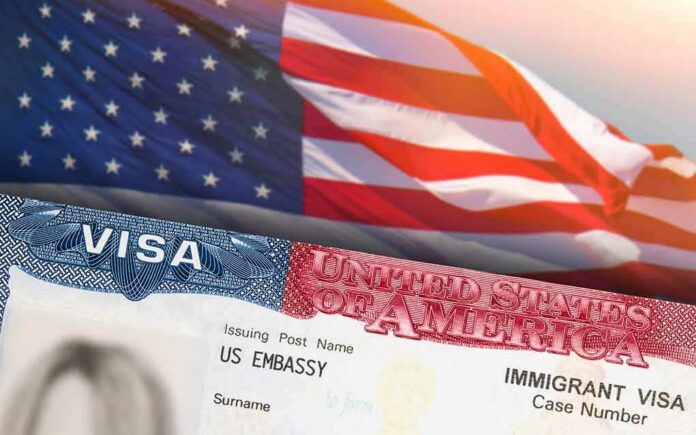
The White House is touting a sharp fall in legal immigration after new executive orders and visa pauses cut immigrant visas roughly in half compared with pre-2025 levels.
Story Highlights
- New York Times data shows immigrant visas fell to about half of pre-2025 monthly levels.
- Executive orders signed in January 2025 set stricter entry vetting and limits.
- The State Department paused immigrant visas to 75 countries during new screening.
- Total application approvals fell at United States Citizenship and Immigration Services in 2025.
What Triggered The Drop In Legal Immigration
President Trump signed two executive orders on January 20, 2025, that laid the groundwork for tighter entry rules and expanded vetting. One order focused on stopping an “invasion” at the border, and another directed national security reviews of foreign nationals seeking entry. The White House later said agencies used those orders to assess country risks and restrict entry when needed. These directives set policy for stricter screening and helped reshape the pace of legal immigration processing.
The State Department reported pausing immigrant visa issuance to 75 countries while it overhauled vetting and public-charge screening. That pause, combined with new eligibility filters, slowed visa pipelines worldwide. According to a New York Times analysis, immigrant visas, which lead to green cards, dropped to about 26,000 in February, compared with an average of roughly 52,000 per month before Trump returned to office. This marked a clear, measurable shift tied to policy and administrative changes.
What The Numbers Show Across Agencies
Consular visa issuance mirrored a wider slowdown in the legal system. The Boston Globe reported that the United States issued about 250,000 fewer visas in the first eight months of 2025 than during the same period in 2024, pointing to a broad decline across categories as the new rules took hold. Inside the country, United States Citizenship and Immigration Services approved 8.3 million applications in 2025, down from 11.4 million in 2024, a 27 percent drop across employment-based and humanitarian cases in particular.
Foreign outlets citing the New York Times echoed the same pattern. Coverage noted a global fall in immigrant, student, and work visas, with immigrant visas roughly halved early this year as restrictions took effect. While news reports varied in focus by region, they aligned on the scale of the change: a sharp, policy-driven decline in legal pathways as screening grew stricter and backlogs adjusted to new standards. The administration framed these results as planned outcomes of its border and security agenda.
How This Fits A Long U.S. Policy Pattern
United States immigration policy has long shifted through executive direction, agency rules, and consular practice, even without new laws from Congress. Since the 1920s, the visa system has given officials control over the pace and shape of legal entries through screening and quotas. That history shows how an administration can reduce legal entries by tightening vetting and changing processing, without rewriting the Immigration and Nationality Act. Today’s decline follows that well-known pattern of administrative control.
🚨 HISTORIC IMMIGRATION COLLAPSE 🚨
New from the NYT: By executive action ALONE, the Trump administration has delivered the LARGEST cuts to legal immigration since the 1920s. 📉🇺🇸
Muslim & African migration has PLUNGED over 90%. 🌍❌ pic.twitter.com/WNeHFXZiWH— Commentary whipp (@Commentarywhip) October 19, 2026
For many readers, the stakes tie back to shared worries about fairness, security, and a system that often seems to serve insiders. Supporters see tighter vetting and lower numbers as a win for public safety and labor markets. Critics warn that cutting legal routes can push families and workers into limbo and reward well-connected applicants. Both sides can agree on one point: the government’s complex system can change people’s lives fast when rules shift, and those decisions often come from executive power, not open debate in Congress.
What To Watch Next
Policy watchers are tracking three levers that could move the numbers again this year. First, the State Department’s country-by-country vetting reviews could end pauses or expand them, altering monthly visa totals. Second, United States Citizenship and Immigration Services processing choices could raise or lower approval volumes, especially in employment and humanitarian cases. Third, court rulings could force revisions to parts of the orders. Any of these would ripple quickly through family, work, and student pathways.
Sources:
mediaite.com, govinfo.gov, biz.heraldcorp.com, bostonglobe.com, nytimes.com, asiae.co.kr, state.gov, chosun.com, congress.gov, whitehouse.gov
© patriotpostnews.com 2026. All rights reserved.