

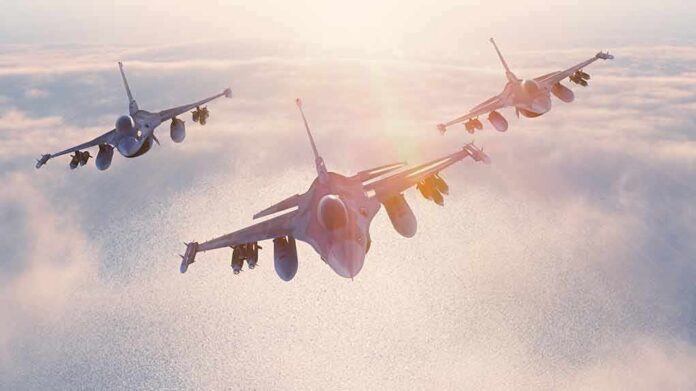
NATO’s top commander warned that any attack on the alliance would be blocked, blunted, and then broken—along with “anything and everything” that supports it.
Story Highlights
- NATO’s Supreme Allied Commander Europe outlined a three-stage plan to defeat any attack.
- The warning covered not only enemy troops but also supporting systems and infrastructure.
- The remarks came at the Warsaw Security Forum during a panel on deterring Russia.
- NATO’s pledge aligns with Article 5’s collective defense promise, shaped by each nation’s decision.
Commander’s Message: Block, Blunt, and Break
U.S. Air Force General Alexus Grynkewich, NATO’s Supreme Allied Commander Europe, said an attack on the alliance would be “utterly futile.” He laid out a sequence to stop it: block the initial strike, blunt any follow-on push, and, if needed, break the enemy’s forces and the warfighting system behind them. He added that NATO does not seek war but is “ready to fight tonight” if required, stressing clear resolve to deter aggression.
General Grynkewich said the response would not stop at front-line units. He stated that NATO would target “anything and everything” that supports, sustains, or controls the attacking force. That language signals pressure on logistics, command nodes, and enabling networks that make an offensive possible. The aim is to raise the cost of aggression so high that an opponent decides not to test the alliance in the first place.
Setting and Focus: A Deterrence Forum on Russia
The remarks came on October 12, 2026, at the Warsaw Security Forum during a session titled “Theory of Victory: How Do We Achieve Military Success Against Russia in Deterrence and Defence?” Coverage identified Grynkewich as NATO’s top military commander and framed the discussion around European fears of a possible Russian move. The statements did not name Russia directly, but the panel’s theme underscored that audience focus.
Reporters across major outlets highlighted the commander’s three-step plan and the wider target set. The strong phrasing drew attention because it suggests rapid and deep response across the enemy’s system, not just at the point of contact. That wording can also sound escalatory to some readers. The media noted that this was a deterrence message meant to show readiness, not a prediction of war.
How This Fits NATO’s Collective Defense
NATO’s core promise, set in Article 5 of the North Atlantic Treaty, treats an armed attack on one ally as an attack on all. After such an attack, each ally agrees to take “such action as it deems necessary,” which can include armed force. That means the response is collective but not automatic or identical for each country. National governments and the North Atlantic Council shape the scale and tools of the response.
Since the Cold War, NATO has balanced firmness with ambiguity. The alliance moved from “massive retaliation” language to “flexible response,” keeping options open while warning that aggression will fail. Today’s deterrence uses clear red lines about defending allies, but it avoids listing exact targets or timelines. That mix aims to keep an adversary guessing while assuring members that help will come if they are attacked.
What Was Said—and What Was Not
The commander’s statements set intent, not a step-by-step playbook. The reporting does not include force numbers, readiness timelines, or rules for how far strikes on support systems would reach. The warning also did not say Russia by name in the quoted lines, even as the forum context focused on that threat. The bottom line remained direct: if an aggressor attacks a NATO member, the alliance plans to stop the attack and dismantle the machine behind it.
The message speaks to concerns on both the right and the left about national security and government resolve. Many citizens feel elites talk but do not deliver. This statement tried to do the opposite: give a clear plan in simple terms. It promised that if a hostile state tests the alliance, NATO will act fast, strike deep into the attacker’s support network, and make sure the attack fails—so families at home do not pay the price for slow or weak decisions.
On 6 October, Russia, via Belarus, sharply raised the level of provocation on the border with Latvia. At least 20 migrants were accompanied by armed people in masks who threatened Latvian troops and forcibly directed people across the border. A few hours later, these same men… pic.twitter.com/nXdxpqiI2D
— Anton Gerashchenko (@Gerashchenko_en) October 7, 2026
Sources:
foxnews.com, apnews.com, aljazeera.com
© patriotpostnews.com 2026. All rights reserved.