
President Trump said he will accept the midterm results “if they’re honest,” while his administration moved to block Alaska from certifying a Senate race under certain conditions.
Story Snapshot
- Trump said he would accept results but warned against “cheating,” without defining terms.
- The Justice Department sued to stop Alaska from certifying a Senate result if name confusion swung the race.
- Trump said he ordered the lawsuit himself, tying the White House to the move.
- Alaska officials, including Republicans, sought to dismiss the suit as lacking legal basis.
What Trump Said And Why It Matters
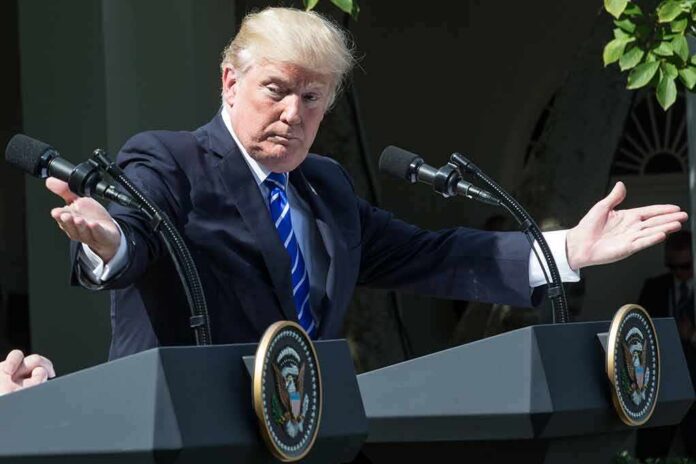
President Trump told reporters he would accept the midterm results “of course,” then added the results must be “honest” and free of “cheating.” The comment set a condition but gave no definition, proof standard, or end point for disputes. The timing mattered because it came as votes were nearing. Supporters heard a promise to ensure fair elections. Critics heard a setup to question results after the fact. Both reactions come from the same short exchange.
The ambiguity has political stakes. A conditional pledge can calm or inflame public trust. Vague phrases invite people to fill in the blanks with their own fears. Conservatives worry about ballot handling and rules that change late. Liberals worry about pressure on election workers and rules used to toss votes. Many Americans across parties share a different concern. They see leaders using process fights to protect power instead of earning trust through clear rules and proof.
The Alaska Lawsuit And The “Two Dan Sullivans” Problem
The United States Department of Justice filed a lawsuit to halt Alaska from certifying a United States Senate result under one scenario. The complaint said two candidates with nearly the same name, incumbent Senator Dan S. Sullivan and Daniel J. Sullivan Jr., could confuse voters. The department asked a judge to stop certification if the incumbent lost and if reassigning confused votes would change the outcome. The filing framed this as an election integrity duty.
Trump then told reporters he personally directed the action. “I’m the one that said do it,” he said, linking the White House to the specific legal move. That admission made the case more than a routine filing. It became a presidential priority. The case, however, did not identify voters who said they were misled. The request aimed to pause certification before proof of confusion changed a known result. That made the remedy look outcome-dependent, which drew fire.
Pushback From Alaska And Legal Tension Over Certification
Alaska’s Republican-led government moved to dismiss the case. State officials said the lawsuit lacked a legal basis. Reporting described the requested pause as an extraordinary step. The pushback created an unusual split. A Republican state challenged a Republican administration’s request. That placed the debate on authority, not party lines. The clash focused on who decides when a claim is strong enough to stop certification and under what law that can happen.
The legal tension fits a broader pattern since 2020. Some fights have moved from recounts and audits to the certification step itself. Courts often treat certification as a required duty once legal checks are done. Efforts to delay or deny certification have drawn fast court orders to proceed. That does not end integrity questions. It does show judges want claims to come with specific proof tied to margins, not general suspicion or one-off risks raised late.
What Election Safeguards Already Exist
Election security experts say almost every vote in the United States has a paper record. States use those records for audits and recounts. Most states run audits before certification to check totals. Some run risk-limiting audits designed to confirm winners with high confidence. This does not mean mistakes never happen. It does mean there is a path to check and correct errors without halting the process based on fear alone.
Former election officials also note that machines are tested before voting and checked after. Manual sample recounts help find issues. These steps aim to fix problems early and document results that hold up in court. These facts do not settle the Alaska name-confusion question. They do explain why many judges and states expect clear evidence that a problem changed enough votes to matter before stopping certification. Process faith grows when leaders follow those rules.
Why This Resonates With Voters Tired Of Power Games
Many Americans on the right and left feel the system serves insiders first. They see leaders bend rules for advantage, then preach trust after the fact. Trump’s “if they’re honest” promise speaks to real fears about fairness. The Alaska filing speaks to a real risk that names could confuse some voters. But power cuts both ways. Without specific proof, emergency court moves look like pressure tactics. Trust rises when claims are tested by evidence, not by who benefits.
Trump says he will respect midterm results ‘if they’re honest elections’https://t.co/HbrqvW5ZkI
— The Hill (@thehill) October 28, 2026
Ultra-wealthy executives who built fortunes in and around cryptocurrency have become major players in American politics, collectively pouring more than $56 million into the current midterm election cycle. This surge in spending reflects the industry’s determination to lock in a… https://t.co/9hDHFdRh2B
— ZEROBASE (@zerobasezk) October 28, 2026
Sources:
nytimes.com, politico.com, washingtonpost.com, cnn.com, cnbc.com, newsweek.com, silive.com, sciline.org
© patriotpostnews.com 2026. All rights reserved.