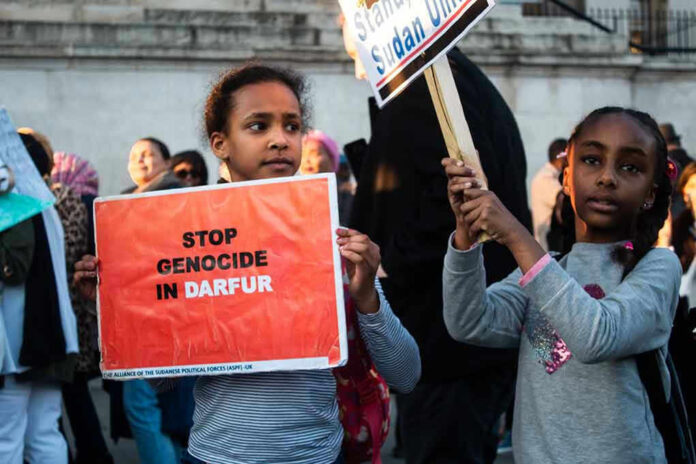
Sudan has become a killing field where civilians are slaughtered in their own streets while the world watches in horrified silence, as two military factions wage the deadliest urban warfare the region has witnessed in decades.
Story Overview
- Over 8.8 million people internally displaced with 3.5 million refugees fleeing brutal civil war between military factions
- RSF paramilitary forces capture strategic El Fasher after 500-day siege, triggering mass atrocities and ethnic cleansing
- October 2024 marked deadliest month for civilians with RSF massacres in Gezira State killing at least 300 people
- Both warring sides deliberately target civilian infrastructure while international community fails to halt genocide-level violence
Urban Warfare Transforms Major Cities Into Graveyards
Since April 2023, Sudan’s capital Khartoum has become an apocalyptic battleground where the Sudanese Armed Forces clash with the paramilitary Rapid Support Forces in unprecedented urban warfare. Both factions deliberately target civilians, turning residential neighborhoods into killing zones. The SAF controls most of Khartoum and Omdurman, while RSF forces have consolidated power across Darfur and central Sudan territories.
The violence has escalated beyond conventional military conflict into systematic civilian targeting. Human rights organizations document deliberate destruction of hospitals, schools, and water treatment facilities. This isn’t collateral damage from military operations – it’s calculated warfare designed to terrorize entire populations into submission through mass starvation and displacement.
RSF Massacres Echo Darfur’s Darkest Chapter
The Rapid Support Forces emerged from the notorious Janjaweed militias responsible for Darfur’s genocide in the early 2000s. Under Mohamed Hamdan Dagalo’s leadership, RSF forces have resumed ethnic cleansing tactics against non-Arab populations. October 2024 witnessed the deadliest civilian massacres since the war began, with RSF fighters systematically executing hundreds in Gezira State.
Satellite imagery from Yale Humanitarian Research Lab reveals mass graves throughout Darfur regions under RSF control. These aren’t random acts of violence but coordinated ethnic cleansing operations targeting specific communities. The international community’s failure to intervene mirrors the world’s delayed response during Rwanda’s genocide, allowing preventable atrocities to escalate into systematic extermination campaigns.
El Fasher’s Fall Triggers Humanitarian Catastrophe
The RSF’s capture of El Fasher in October 2025 after a brutal 500-day siege represents a strategic victory achieved through deliberate civilian starvation. UN officials describe “horrific” violence as RSF forces executed remaining defenders and targeted fleeing civilians. This conquest gives RSF control over North Darfur’s capital, cementing their territorial dominance across western Sudan.
The siege tactics employed at El Fasher demonstrate RSF’s willingness to use mass civilian suffering as a military weapon. Food supplies were systematically blocked, medical facilities bombed, and escape routes mined. These are war crimes by any international standard, yet the global response remains limited to strongly-worded condemnations while Sudanese civilians face extermination.
International Community’s Shameful Inaction Enables Genocide
Sudan filed a case at the International Court of Justice alleging UAE complicity in RSF atrocities through weapons supplies, highlighting how regional powers fuel this catastrophe. Meanwhile, humanitarian organizations struggle with overwhelmed capacity and restricted access. The contrast between international attention given to other conflicts versus Sudan’s ignored genocide reveals uncomfortable truths about global priorities and racial bias in humanitarian responses.
The RSF has established a parallel government in Nairobi, complete with new constitution, currency, and identification documents. This fragmentation threatens to permanently divide Sudan into competing territories controlled by warlords. Without immediate international intervention, Sudan faces complete state collapse and decades of ethnic warfare that will destabilize the entire Horn of Africa region.
Sources:
Wikipedia: Sudanese Civil War (2023–present)
Fanack: Sudan Conflict Timeline
Human Rights Watch: World Report 2025 – Sudan
Council on Foreign Relations: Civil War in Sudan
UN News: El Fasher falls, “horrific” violence
International Rescue Committee: Crisis in Sudan
Doctors Without Borders: Timeline of war in Sudan
Security Council Report: Sudan Monthly Forecast