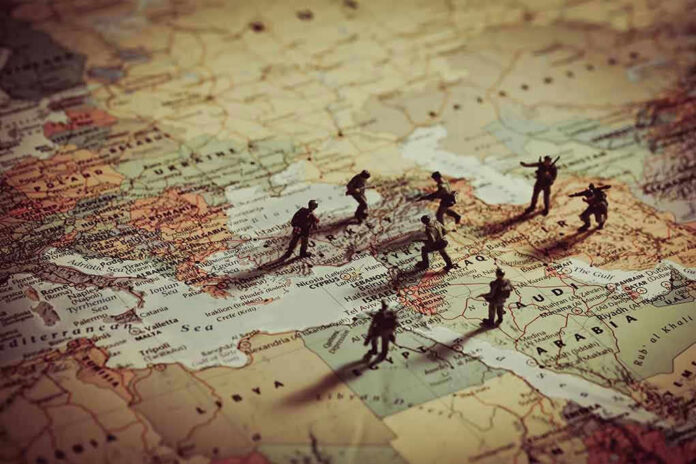
Europe’s criminal underworld now rivals a shadow army, with hundreds of thousands of gangsters hiding inside “legit” businesses while officials insist everything is under control.
Story Snapshot
- Europol says 731 top criminal networks in the European Union use about 400,000 members from 118 nationalities to exploit Europe’s open economy.
- Most dangerous networks are not street gangs but business-style crime corporations, often embedded in real companies and public contracts.[1]
- Law enforcement disrupted most networks flagged in 2024, yet 533 new ones appeared, showing crime regenerates faster than governments can adapt.[7]
- Critics question a jump from 25,000 to 400,000 members and warn that changing counting rules may hide how officials really measure threats.[6]
Europol’s new numbers show a vast, embedded criminal ecosystem
Europol, the European Union’s law enforcement agency, now counts 731 of the most threatening criminal networks operating across the European Union, with about 400,000 members from 118 nationalities.[1] These are not petty thieves. Europol describes them as long‑standing, often hierarchical organizations able to run complex schemes across borders.[7] Many readers in America will recognize the pattern: global crime networks thrive in the same open markets, loose borders, and elite‑friendly systems that already feel rigged against regular people.[14]
The new report builds on a 2024 assessment that identified 821 “most threatening” networks with just over 25,000 members.[5] At first glance, that looks like fewer groups and far more people. Europol explains the drop from 821 to 731 as a change in how it ranks threats, not a real fall in crime.[6] This shift, plus the huge jump in member counts, fuels concern that crime data can be reshaped by experts and officials in ways ordinary citizens can neither check nor challenge.
Crime corporations hide inside legal businesses and exploit the system
Europol warns that about 85 percent of these top networks use real companies and other legal structures to move and hide their money.[1] Earlier reports showed nearly the same share, 86 percent, in 2024, meaning this tactic is now a stable feature of modern organized crime.[4] These crime corporations buy or build firms in transport, logistics, real estate, and services, then use them to launder profits, win public contracts, and gain influence over local officials.[14] This blurs the line between “respectable” business and gangster cash.
Drug trafficking remains the single biggest criminal market. About 36 percent of the most threatening networks focus mainly on drugs, with many tied to Latin American suppliers, especially for cocaine.[1] That means European and non‑European cartels are tightly linked. At the same time, Europol and other studies note rising use of cybercrime, financial fraud, and tax scams by traditional gangs.[17] Once again, both conservatives and liberals see a familiar problem: powerful actors quietly exploit global trade, digital tools, and weak oversight, while average families deal with addiction, street violence, and rising costs.
Regenerating networks and the limits of “success” stories
Europol stresses that law enforcement has disrupted or downgraded about three‑quarters of the 821 networks flagged in 2024.[1] That sounds like a major win. Yet the same report says 533 new threatening networks have appeared since then.[7] A hard core of about 198 older groups remains in the top‑risk category, many with rigid hierarchies and international reach.[7] When old networks are broken, pieces often re‑form in new shapes, using fresh leaders, shell companies, and new technology.
The agency also highlights that criminals increasingly rely on encrypted communication, online platforms, artificial intelligence, cryptocurrencies, and professional “helpers” such as corrupt lawyers, accountants, and notaries.[4] This matches what many Americans suspect at home: crime is no longer only about street violence. It is about smart operators inside the system who know which loopholes to use and which officials to lobby. For citizens who already think the “deep state” and connected elites look after themselves first, the idea of 400,000 gangsters embedded in Europe’s legal economy reinforces that fear on a global scale.
Method disputes and why skepticism about official numbers is growing
Not everyone accepts Europol’s “surge” framing. The 2024 report clearly stated that 821 most threatening networks held just over 25,000 members.[5] Jumping to 400,000 members two years later suggests either a massive change in reality or a major change in how “member” is defined.[6] Analysts point out that Europol has not fully explained this bridge in public, and that evolving assessment criteria may turn the numbers into more of a model than a direct headcount.[6]
Independent watchdogs and crime indexes describe Europe’s organized crime picture as stable overall but “adapting” and “expanding” in certain markets like cocaine and cybercrime.[16] They stress regeneration and shape‑shifting, not a simple upward curve. That nuance matters. If crime agencies stretch the word “surge” to justify budgets or new powers, while hiding key data, it feeds the broader belief shared by many on the right and left: big institutions talk about protecting citizens, but keep the full playbook to themselves.
What this means for Americans watching Europe and their own government
The Europol report confirms that serious organized crime can live inside respectable business, move across borders with ease, and exploit gaps between countries.[1] It shows that even when police score big wins on paper, new criminal structures grow back quickly. For American readers who already see similar failures on immigration, drugs, fraud, and corruption, Europe looks less like a distant problem and more like a warning about how complex, globalized systems can leave ordinary people exposed.
The report also underscores a deeper issue: trust. When agencies use huge, scary figures but do not share enough detail to test them, citizens on all sides grow wary. Conservatives doubt whether elites really want to stop crime that runs through big banks and companies. Liberals question whether tough rhetoric masks unequal enforcement or abuses of power. Both worries point to the same truth: if governments want people to believe they are fighting crime for the common good, they need more transparency, clearer methods, and proof that the rules apply to the powerful as well as to the poor.[14]
Sources:
[1] Web – Criminal Gangs in Europe Are Surging, With an Army of 400,000 …
[4] Web – Europol identifies 731 organized crime networks in Europe – Yahoo
[5] Web – Europol: EU Crime Networks Regenerate Fast – OCCRP
[6] Web – New Europol report delves into EU’s most threatening criminal …
[7] Web – Europol ¦ The Blueprint of Criminal Opportunism | FinancialCrime.lu
[14] Web – Europe facing huge threat with 400,000 gangsters hunted
[16] Web – [PDF] CRIMINAL NETWORKS THE EU’S MOST THREATENING DECODING
[17] Web – Organized crime in Europe: A country-by-country breakdown
© patriotpostnews.com 2026. All rights reserved.