
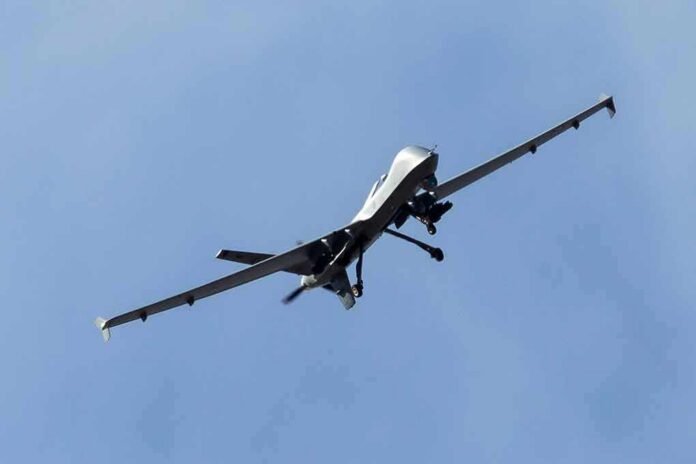
An American fighter jet fell from the sky over Iran, and the most detailed eyewitness says he saw a giant “jellyfish” made of drones just seconds before it happened.
Story Snapshot
- A downed U.S. F‑15E pilot reported a swarm of Iranian drones moving together like a single “jellyfish.”
- His account hints at advanced drone “mesh networking,” but there is still no public sensor proof.
- Officials think a missile likely downed the jet, yet admit the swarm might have helped target it.
- The Pentagon’s silence and intel infighting are fueling UFO rumors and public distrust of Washington.
What The Pilot Says He Saw In The Sky
A U.S. F‑15E Strike Eagle pilot shot down over Iran in April told debriefers he saw “multiple drones interconnected and moving as one with smaller drones below the bigger drones like legs,” forming what looked like a giant jellyfish in the air.[5] Sources who heard his account say he also described a “minefield of drones” that his jet had to fly through just before it was hit, and reportedly called the sight “real alien s—.”[5]
According to reporting based on four people familiar with his classified debrief, analysts linked his description to a concept called “one‑to‑many meshed networking,” where many drones share data and act like one coordinated system instead of separate aircraft.[5] Some early internal assessments even raised the possibility that this formation helped Iran detect, track, or box in the F‑15E before it was shot down, though investigators still have not stated exactly what weapon struck the jet.[1]
What We Actually Know About The Shootdown
The F‑15E was brought down during combat operations over Iran and the crew was later rescued in a high‑risk special operations mission.[3] Public reporting on the shootdown has long suggested that a shoulder‑fired surface‑to‑air missile probably hit the jet, not a drone itself.[2] That means, even if the “jellyfish” formation was real, it would likely have been part of a layered air defense picture that helped guide a more traditional missile shot rather than acting as a sci‑fi weapon on its own.[2]
Right now there is no released radar track, cockpit video, or other sensor data that confirms the jellyfish‑like swarm, only the pilot’s recollection filtered through anonymous sources.[2] U.S. Air Force officials, U.S. Central Command, and the Office of the Director of National Intelligence have all declined to issue on‑the‑record statements about the drones, keeping the whole episode in a gray zone that invites rumors, YouTube theories, and talk of “UFOs” instead of sober answers.[2]
Why Some Officials Doubt The Story
Intelligence officers who spoke about the case say they are divided over how much weight to give the pilot’s report, mainly because he suffered a concussion during ejection and rescue.[5] During his debrief, some officials bluntly asked him whether he was sure he saw what he said he saw, raising the possibility that stress, shock, or partial memory loss may have warped his sense of distance, number of drones, or how they moved.[5]
This shootdown was also the second time the same pilot had lost an aircraft in just weeks, after an earlier friendly‑fire incident involving Kuwaiti forces in the war.[5] That history, plus the lack of matching testimony from his back‑seat Weapon Systems Officer, makes skeptics in the intelligence community treat the jellyfish account as a single, unverified data point rather than a proven fact about Iran’s arsenal.[2]
How Advanced Could Iran’s Drones Really Be?
Experts already agree that Iran uses large numbers of small, cheap drones and has been pushing swarm tactics for years.[18] Panelists at the Council on Foreign Relations have noted that since about 2021 Iran has showcased swarming concepts at defense fairs, and has also received support from Russia, including imagery and targeting data on U.S. and allied forces in the Gulf.[18] Reports also say China and Russia likely possess mature drone networking technology that Iran could try to copy or import.[1]
"The U.S. Air Force F-15E Strike Eagle pilot who was shot down over Iran in April says he saw a jellyfish-like drone swarm, or maybe even a flying drone minefield, operating in Iranian airspace shortly before his fighter was hit by a surface-to-air missile.
Let’s talk about…
— Taliesien (@spiritramblings) June 27, 2026
If Iran is now fielding true “mesh‑networked” swarms, that would mark a major jump in its war tech and pose a serious challenge to U.S. air power.[5] But for now, even supportive analysis admits there is no public proof that Tehran has a fully developed version of this system, only this one pilot’s dramatic account and a lot of classified guessing behind closed doors.[12] That gap between what people see in combat and what the Pentagon is willing to admit is exactly where distrust of the so‑called “deep state” grows.
How This Feeds Public Distrust On Left And Right
Many Americans look at this story and see a familiar pattern: a high‑stakes incident, a strange eyewitness report, blaming foreign rivals like Iran, China, and Russia, and then a wall of official secrecy. Conservatives upset with years of endless wars and wasted defense billions suspect the Pentagon is hiding failures in order to protect careers and defense contracts. Liberals who worry about secret tech, surveillance, and civilian harm see another example of powerful agencies shielding the truth.
Both sides also notice how fast the story gets twisted into clickbait about “alien jellyfish UFOs” while the real questions go unanswered. Did Iran use new drone networking that U.S. planners failed to prepare for? Did poor planning or bad intel put that crew in a no‑win situation? Why is there still no public report on what weapon brought the jet down? When Washington keeps those answers locked away, it deepens the sense that the people in charge are more focused on managing the narrative than being accountable.
What Would Actually Settle The Question
To move this out of rumor territory, the government would need to release at least some hard data: radar logs from the F‑15E and supporting aircraft, cockpit video, and a clear forensic timeline of the shootdown. Freedom of Information Act requests could also force the release of the pilot’s full debrief transcript, redacted for safety, along with the intelligence community’s written assessments of his claims about a mesh‑networked swarm.
Short of that, Congress could demand closed‑door briefings and then publish an unclassified summary that explains whether Iran really used an advanced drone network, or whether this was more likely a stressed pilot trying to describe a confusing, deadly sky. Until elected leaders push for that level of transparency, citizens are left to crowd‑source the truth from leaks, foreign media, and social platforms. That is not how a healthy republic is supposed to work, especially when American lives and billions in taxpayer‑funded hardware are on the line.
Sources:
[1] YouTube – Did a giant jellyfish UFO bring down an American fighter jet?
[2] YouTube – U.S. F-15 E Pilot CONFIRMS Iran’s SECRET “Jellyfish …
[3] Web – Downed U.S. F-15E Pilot Reportedly Observed Unusual Iranian …
[5] Web – Downed U.S. F-15E Pilot Reportedly Observed Unusual Iranian …
[12] Web – Networked drone swarm tech behind US F-15 downing over Iran …
[18] YouTube – U.S Deploys F 15E “Drone Killer” Squadron: The End of Iran’s Threats
© patriotpostnews.com 2026. All rights reserved.