
France’s leaders ordered crisis steps as student blockades over missing teachers and crumbling schools spread to hundreds of campuses nationwide.
Story Snapshot
- Students protested staff shortages, crowded classes, and aging buildings across France.
- Authorities recorded actions at hundreds of schools and rolled out remote-teaching guidance.
- Reports said many teaching hours went untaught last year due to non-replacement.
- The government pledged 3,000 substitute teachers and flagged a budget increase.
What Sparked the Wave of School Blockades
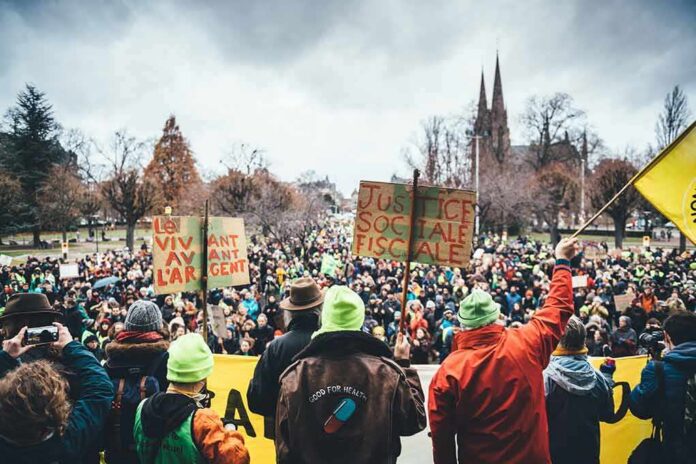
Le Monde and other outlets reported that students in Paris and nearby suburbs cited daily problems, not one-off events. They pointed to absent teachers, lack of substitutes, classes with around thirty-five students, heavy timetables, and buildings in poor shape. Le Monde described a spontaneous blockade in Créteil as a trigger, with students listing overloaded schedules and inadequate facilities. Radio France Internationale reported similar demands for more funding, smaller classes, and proper teacher cover.
Interior Ministry data, cited in reporting, showed the movement had wide reach. Accounts noted actions at more than a thousand schools in one tally, with hundreds of blockades. Other coverage counted hundreds of demonstrations across the country. The Education Ministry told teachers to switch to remote classes when access was blocked, showing that officials treated the crisis as national in scope. The prime minister held a crisis meeting as tensions rose around campuses.
The Classroom Reality Students Say They Face
The Nation reported that nearly one in ten teaching hours went untaught last year, often because absent teachers were not replaced. Students and staff described missing instruction for weeks or even months in some subjects. Reports also highlighted building problems. Coverage cited aging high schools, many past sixty years old, and more than one-third at or above capacity. Unions described widespread heat and ventilation issues during warm spells. These conditions framed the call for immediate relief.
Students argued that crowded rooms and frequent teacher gaps made learning unpredictable. Overloaded schedules, they said, stacked strain on top of lost hours. Le Monde and Radio France Internationale both reported these recurring complaints at blockade sites. While national figures cannot confirm the exact status of every Paris school, the mix of staffing gaps, capacity limits, and old buildings aligns with what many students described on the ground.
Government Response and Limits of the Data
Education Minister Édouard Geffray said education remained a priority and pointed to demographic shifts to explain budget choices. He pledged to deploy 3,000 replacement teachers, using new ministry software to steer help to roughly five hundred schools with the greatest needs. Officials said about two thousand had already been dispatched, with priority for one hundred fourteen of the most challenged schools. Lawmakers also discussed a one point two billion euro increase for the education ministry in the 2027 budget.
The October 17, 2026 unrest in France grew out of weeks of student protests (starting in Paris suburbs over teacher shortages, crumbling schools, and infrastructure) that merged with broader anger over the cost of living, fuel prices, public services, and government inaction.…
— Cathy Morgan (AFH) I exist 🌸 (@CathyMo41926708) October 21, 2026
These steps show the government recognized serious strain. But the sources available here have gaps. Much of the evidence merges Paris-area stories with nationwide statistics, and does not supply school-by-school data for Paris itself. The reporting does not present detailed vacancy counts, hours lost per campus, or a full record of repairs underway in each school. That limits how precisely we can judge local progress, even as the broad national picture looks stressed.
Why This Matters Beyond France
This dispute sits at the core of a shared concern many Americans recognize: systems drift while leaders argue. Students want stable teachers, safe buildings, and clear paths to college or work. Officials promise fixes, but the fixes lag the daily need. French history shows that school protests often push leaders to act, yet trust breaks when classrooms still lack basics. The lesson travels: publish the data, prove the hires, and show the repairs in plain sight.
Sources:
youtube.com, rfi.fr, yahoo.com, lemonde.fr, en.wikipedia.org, slovaknews.com
© patriotpostnews.com 2026. All rights reserved.