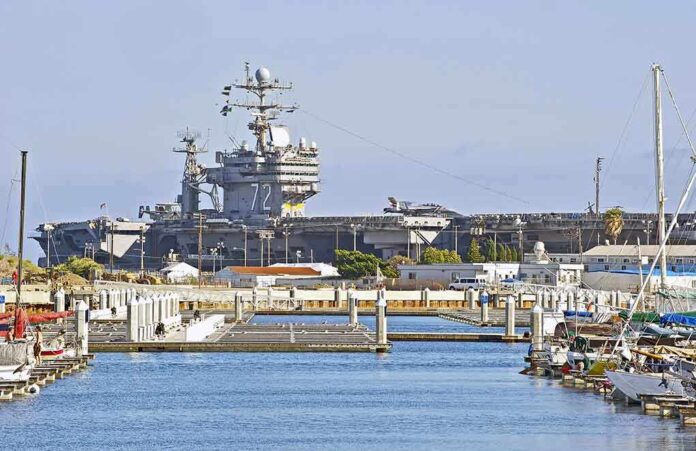
If you think the arrival of the USS Gerald R. Ford in the Caribbean is just another military maneuver, you’re missing the undercurrents that could reshape US-Latin America relations for a generation.
Story Snapshot
- The US Navy’s largest and most advanced aircraft carrier is now stationed near Venezuela, officially for counter-narcotics operations.
- This deployment marks the most significant American military buildup in the Caribbean in decades, involving 12,000 personnel and nearly a dozen warships.
- The move intensifies pressure on Venezuelan President Nicolás Maduro and escalates tensions across the region.
- Regional allies and international observers debate whether the operation is about drugs or a broader power play.
USS Gerald R. Ford Ignites Regional Anxiety
The USS Gerald R. Ford’s arrival isn’t business as usual for the Caribbean’s tranquil waters. The carrier, accompanied by warships and thousands of personnel, signals a forceful American presence not seen since the Cold War. Official statements frame the operation as a fight against drug trafficking, but the timing—amid deadlocked US-Venezuela relations—has set off alarms from Port of Spain to Bogotá. Regional governments are weighing their options: embrace US security cooperation or push back against perceived encroachment.
The operation, named Southern Spear, brings advanced fighter jets and Marines into joint exercises with Trinidad and Tobago, and US troop training in Panama. This isn’t just about intercepting drug boats; the sheer scale of assets deployed hints at a strategic demonstration of power. For many, the carrier’s arrival is less about chasing traffickers and more about flexing muscle in Maduro’s backyard, with implications echoing far beyond Venezuela’s borders.
The Political and Historical Context
US-Venezuela relations have long been fraught, but the recent buildup is unprecedented. Since Hugo Chávez’s rise and Maduro’s succession, Washington has accused Caracas of authoritarianism and drug ties, responding with sanctions and diplomatic isolation. The Caribbean remains a key corridor for narcotics, and the US has previously justified military presence under anti-drug missions. However, the Ford’s deployment dwarfs prior operations, fusing security objectives with unmistakable political signaling. The echoes of past US interventions in Latin America loom large, fueling speculation and uncertainty about Washington’s ultimate intentions.
Joint training exercises with Trinidad and Tobago and Panama underscore the US effort to build alliances while projecting strength. Caribbean leaders, conscious of their own sovereignty, balance the benefits of cooperation with the risks of inflaming regional tensions. International observers, including the International Crisis Group, warn that the carrier’s presence raises anxieties and uncertainty about whether American warplanes might target land assets inside Venezuela—a scenario with unpredictable consequences.
Stakeholders and Power Dynamics
Key players are locked in a tense, high-stakes chess match. The US government, led by President Trump and the Pentagon, controls overwhelming military resources. Rear Adm. Paul Lanzilotta and Adm. Alvin Holsey direct the carrier strike group, while US Southern Command orchestrates operations. Venezuela’s government, under Maduro, denounces the buildup as aggression and leans on diplomatic protest and regional alliances for leverage. Allies like Trinidad and Tobago and Panama find themselves in the crosshairs of cooperation and caution, seeking security while guarding against escalation.
The balance of power is clear: Washington holds the cards, but regional governments and international organizations can influence outcomes through diplomacy and public opinion. Decision-makers must weigh the risks of confrontation against the rewards of political and security gains. The Ford’s presence changes the calculus, challenging old certainties and forcing new alliances and strategies.
Implications and Expert Perspectives
Short-term, regional tensions are spiking. Venezuelan officials decry the operation as a threat to sovereignty, while Colombian and Caribbean leaders brace for fallout. Drug trafficking routes face disruption, but the broader question is whether the carrier’s deployment is a prelude to direct intervention or a show of force meant to intimidate. Long-term, the US may maintain an enhanced military footprint, reshaping the region’s security landscape and deepening divisions between allies and adversaries.
Experts like Elizabeth Dickinson of the International Crisis Group argue that the deployment is a major signal of US willingness to use force, sparking anxiety across the hemisphere. Analysts question the practicality of aircraft carriers for anti-cartel missions, suggesting political motives outweigh tactical ones. The debate now centers on whether US warplanes will be used against land targets—a red line that would redefine the balance of power and potentially trigger wider conflict.