An artist strapped a “mummified” man to the Hollywood Sign for 25 minutes, then left in handcuffs for trespassing.
Story Snapshot
- Artist Sabine Tautou staged a 25-minute stunt at the Hollywood Sign and was cited for trespassing.
- The act, called “Public Figure, 2026,” aimed to contrast fame with erased identity, according to a release.
- Past Hollywood Sign stunts also drew arrests or citations, even without damage.
- The stunt revives a long fight between unpermitted public art and basic access laws.
What Happened On The Hillside
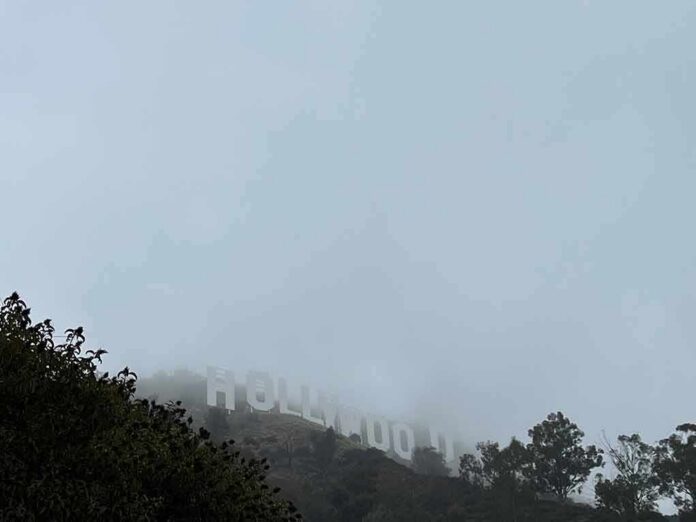
On Friday around 10 a.m., artist Sabine Tautou staged a public performance at the Hollywood Sign. The act featured a nearly naked man, wrapped and strapped to the landmark, for about 25 minutes. Los Angeles police detained Tautou after the display and issued a trespass citation. Reporters described the sign as “hijacked” during the event. Coverage quoted a press release that framed the work as art, not vandalism, and gave the piece its title, “Public Figure, 2026”.
The artist’s accompanying language said the Sign stands for aspiration and fame, while the mummified figure signaled limits on movement and identity. That concept tried to put a human body in tension with a global icon. The point landed because most people know the Sign on sight. The event’s short window suggests planning for a quick hit and fast removal, which is common in this genre of public interventions that rely on speed and spectacle to avoid harsher charges.
How Police And Prior Cases Frame These Stunts
Police and prosecutors tend to treat unpermitted landmark actions as basic trespass, even when there is no damage. After the “HOLLYWeeD” change in 2017, police arrested the artist on a trespass suspicion, not for speech or art crimes. Officials called it misdemeanor trespass because the structure was intact. That pattern repeats across incidents tied to the Sign: enter a marked off area, get detained, and face simple enforcement instead of a complex free speech case.
That response aligns with broader practice in uncommissioned urban art. Scholars and case summaries note that governments enforce standard access rules first. If you go past a fence or restricted boundary, you can be arrested, no matter the message. Even chalk on a sidewalk can draw a charge if it violates local rules. This is why many artists build their message into quick, site-specific actions that can be filmed, shared, and then defended in public debate, not in court.
Why This Taps A Bigger Frustration
Fans call this art because it uses a shared symbol to question who gets seen and who gets silenced. Critics call it reckless because it risks safety and diverts police time. Both views reflect a larger tension in today’s culture: people feel locked out of elite spaces that shape meaning and money. A famed sign sells a dream. A bound body shows a limit. The scene turns a skyline into a mirror, and the reaction shows distrust in how rules are applied.
The stakes are simple yet familiar. The Hollywood Sign has long been a target for quick-hit statements, and officials have answered with arrests, citations, and tighter security. Enforcement does not settle the message, but it does end the stunt. For readers on the right and the left, the through-line is control. Who controls the symbols? Who controls the space? When institutions guard both, many see proof that public life feels less public than the name suggests.
Sources:
© patriotpostnews.com 2026. All rights reserved.