
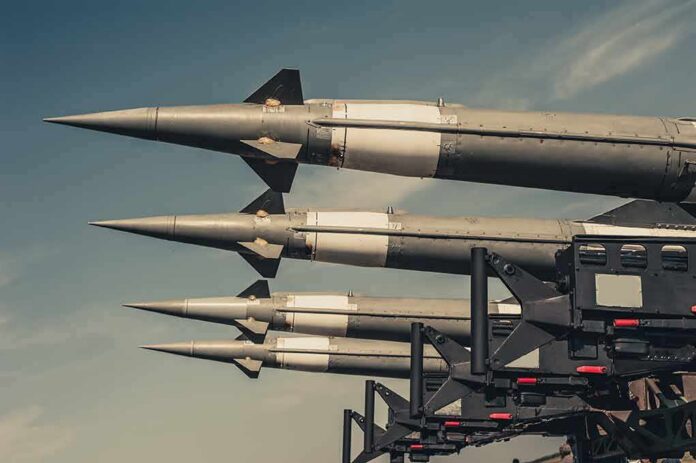
The United States blocked F-35 fighter transfers to a NATO ally over fears Russia’s S-400 could expose the jet’s stealth secrets — a rare case where policy admits a hard technical threat.
Story Snapshot
- U.S. officials removed Turkey from the F-35 program after it bought Russia’s S-400, citing stealth security risks.
- Analysts say S-400 radars may detect stealth jets at long range, but struggle to get a missile-quality lock until much closer.
- No verified combat has tested an S-400 against an F-22 or F-35, leaving key performance claims unproven.
- The real issue is the kill chain: detection, tracking, targeting, and guidance are separate hurdles that stealth aims to break.
Why the U.S. Treated Turkey’s S-400 Purchase as a Real Threat
In 2019, the Pentagon began removing Turkey from the F-35 program after Ankara bought Russia’s S-400 air defense system. Officials warned that co-locating F-35s with S-400 radars could expose the jet’s low-observable features to Russian intelligence. The move showed Washington viewed the S-400 as more than a brochure claim. It treated the system as able to collect data that could weaken U.S. airpower over time.
Congressional research later underscored the same concern. Turkey’s ejection carried real cost, ending industrial work and blocking aircraft deliveries. The stated reason stayed consistent: the S-400 could help adversaries learn how to better see or track the F-35. That risk spoke to a core truth about modern warfare. Sensors and data collection can be as dangerous as missiles when they shape future counters to U.S. technology.
What the S-400 Brings to the Fight — and Its Limits
Russian sources and open references describe the S-400 as a networked system with layered radars and long-range missiles. Its 40N6 family is credited with engagements out to hundreds of kilometers against large targets. The suite pairs wide-area surveillance with a dedicated tracking and guidance radar to steer missiles. Supporters argue this mix can challenge stealth aircraft by spotting and fixing them for a shot under the right conditions.
Independent write-ups draw a sharper line between “seeing” and “shooting.” Lower-frequency radars may notice a stealth jet is in the area, but that does not give a precise, stable track. For a missile shot, the system needs a weapons-quality track, usually from a higher-frequency fire-control radar. That is the band where stealth shaping and materials aim to cut returns the most. Several estimates suggest a reliable lock might only come at short ranges against F-35-class targets.
What We Know — and Do Not — About Stealth Versus S-400
Public estimates often cite ranges of tens of kilometers for detection or lock against approaching F-22 and F-35 jets. One reported analysis pegged possible detection for an F-35 around 34 kilometers, and an F-22 around 21 kilometers, using open data and assumptions. Those figures, while debated, fit the broader idea that long-range “pings” are not the same as a firing solution. The most sensitive numbers remain classified.
Open-source summaries stress that no verified combat has matched an S-400 against U.S. fifth-generation fighters. That gap matters. Manufacturer claims are not battlefield proof. Until real-world engagements occur, both sides will point to simulations, test ranges, and intelligence judgments. For now, the evidence says the S-400 is a serious system that may corral stealth jets, but sustained, weapons-grade tracking is the hardest step.
The Kill Chain Lens: How Stealth Still Bends the Odds
Defense analysts describe this contest as a kill chain problem. An air defense must detect, classify, track, target, guide a missile, and fuse data across nodes. Stealth aims to lower the odds at each step, not turn jets invisible. If a system detects a jet but cannot keep a precise track, it struggles to hand off to missiles in time. That time squeeze lets a stealth jet fire from outside or at the edge of engagement and exit before a firm lock.
This debate also taps a larger public worry: do governments level with citizens about risk and cost. The U.S. decision on Turkey signaled quiet consensus inside the system. Leaders judged the intelligence threat too high, even with political and economic pain. For readers right and left, that choice confirms two things at once. Adversaries are closing gaps, and the margin for error is shrinking if we forget how fast data can erode an edge.
Sources:
19fortyfive.com, war.gov, congress.gov, reuters.com, militarymachine.com, theaviationgeekclub.com, defenseone.com
© patriotpostnews.com 2026. All rights reserved.