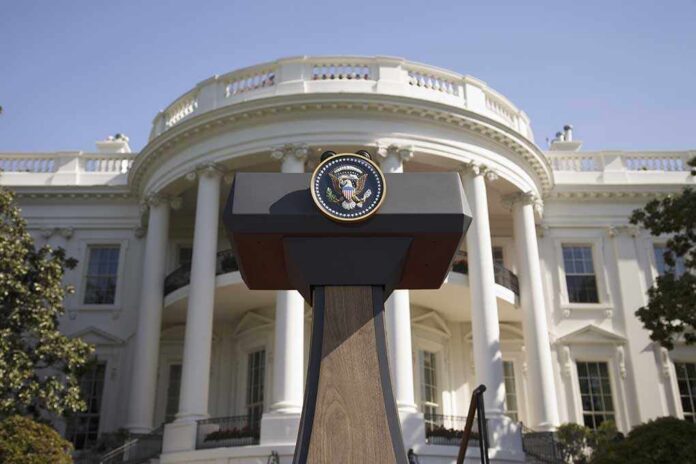
The plan to fence off parts of Pennsylvania Avenue near the White House would let federal security quietly lock down one of America’s most symbolic public spaces whenever they judge the risk high enough.
Story Snapshot
- The Trump administration is proposing permanent fencing along Pennsylvania Avenue and around Lafayette Square as a new security measure.
- The White House and Secret Service could close these fences during perceived threats, sharply limiting public access to a major civic space.
- Members of Congress, including Rep. Eleanor Norton, argue this would turn public property into a locked-off zone and plan legislation to stop it.
- The fight reflects a long pattern: each new White House barrier promises safety but deepens fears that Washington is becoming a fortress for elites.
What the new fencing plan would do
Trump administration officials are discussing permanent security fencing along the block of Pennsylvania Avenue directly in front of the White House and around Lafayette Square Park across the street. Reports say new fences would go at the intersections of Pennsylvania Avenue with 15th and 17th Streets Northwest, creating a defined security edge that can be sealed when needed. Officials frame the move as a way to “bolster security” by tightening control over crowds, vehicles, and protests near the executive mansion.
Under the proposal, the White House and the United States Secret Service would have authority to close the new gates during what they view as threats, turning an open block into a controlled zone. That power would sit on top of the temporary barriers and anti-scale fencing Washington has already seen for protests, inaugurations, and unrest in recent years. In practice, this means everyday people, from tourists to local workers and demonstrators, could find a core part of the capital suddenly fenced off whenever security officials decide the risk is high.
Supporters’ case: hardening a vulnerable target
Supporters inside the administration point to repeated intrusions and security scares near the White House as proof that stronger, permanent barriers are needed. Temporary barricades on Pennsylvania Avenue have already been used to stop people from rushing the grounds, and security experts note that the area invites crowds, cars, and fast-moving events. A taller, more solid fence can slow threats, channel movement through checkpoints, and give Secret Service agents more time to react if someone tries to break through or use a vehicle as a weapon.
This debate fits into a long history of the White House perimeter growing higher and tougher over time. Early presidents lived behind simple wooden and stone fences, but modern plans call for anti-climb features and intrusion detection technology embedded in the structure. The Commission of Fine Arts and the National Park Service have previously backed a new, stronger perimeter around the entire complex, not just Pennsylvania Avenue, after high-profile fence-jumping incidents. To many security planners, this new street fencing is just the latest step in a slow march toward a more sealed federal core.
Opponents’ case: turning democracy into a fortress
Opponents warn that permanent fences across Pennsylvania Avenue and around Lafayette Square would chip away at a basic American promise: that the people can freely approach and see their seat of power. Representative Eleanor Norton, who represents Washington, D.C., announced plans for a bill to prohibit new White House fencing, arguing that public property “should be open to the public” and that citizens should not have to “peer at their democracy from behind fences.” For civil liberties advocates, a lockable fence is not just a safety tool; it is a symbol that leaders want distance from the people they serve.
🔥🔥 White House Eyes Permanent Fencing On Pennsylvania Ave
“Trump administration officials are discussing a plan for permanent fencing on the block of Pennsylvania Avenue near the White House and around Lafayette Square, in an effort to bolster security and reduce…
1/2— ˶˃ News Reader Cat 📰🗞️NO DMs˂˶ (@typocatCAv2) July 10, 2026
Recent history gives them concrete examples. During protests and unrest, Lafayette Square has been closed for months at a time, with high fences that kept both tourists and demonstrators away from a park long used for free speech and assembly. A Council of Fine Arts blog has already warned that an 11-foot, 7-inch fence on top of a raised base is “higher than it needs to be,” suggesting design choices that emphasize separation as much as security. Critics across the spectrum see these choices as part of a trend where Washington’s answer to anger, inequality, and distrust is to build taller walls instead of fixing root problems.
Deeper worries shared by the left and right
For many conservatives and liberals alike, the fence fight taps into a broader fear that the federal government is closing ranks while everyday Americans struggle outside. Longtime conservatives upset by globalism, high energy costs, and rising prices see another step toward a “fortress capital” that protects elites but not jobs or savings. Liberals worried about inequality, deportations, and discrimination see an administration that responds to protests not with listening, but with locked gates and more police lines.
In that sense, the argument is not only about metal bars along a street; it is about who Washington is built to serve. Each new barrier makes it easier for presidents, lawmakers, and agency heads to move through a secure bubble, far from the daily lives of the people who pay for that security. The plan to fence off Pennsylvania Avenue fits a decades-long pattern where real security problems are met with physical walls, while deeper issues like trust, openness, and accountability go unaddressed. The result is a capital that looks safer on paper, but feels less like a shared home for the nation and more like a guarded compound for those in power.
Sources:
cbsnews.com, cfa.gov, facebook.com, instagram.com, x.com, norton.house.gov, reddit.com, yahoo.com, codelibrary.amlegal.com, waterlandlife.org, dcist.com, securityfence.com, detroitnews.com, whitehousehistory.org
© patriotpostnews.com 2026. All rights reserved.