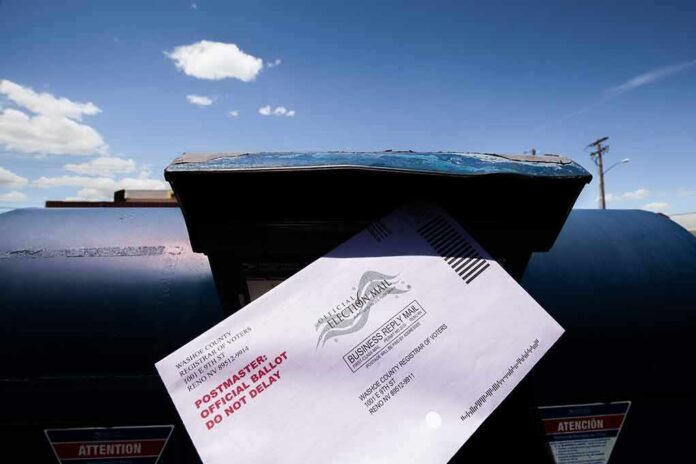
Federal courts have blocked major parts of President Trump’s order to rewrite mail-in voting rules, even as a separate appeals court let the Postal Service test new ballot verification steps while the legal fight drags on.
Quick Take
- Trump’s March 31 order told the Postal Service and Homeland Security to verify mail ballot eligibility before delivery.
- A Massachusetts judge ruled the president has no constitutional power to set election rules.
- A separate appeals court let the Postal Service move ahead with some verification steps during the appeal.
- The Supreme Court has asked the administration to weigh in on a related Pennsylvania ballot-date case.
- A federal judge said the fraud-prevention reason for one ballot rule “lacked evidence.”
What the Executive Order Tried to Do
President Trump signed the order on March 31, directing the Postal Service to work with Homeland Security and the Social Security Administration to build lists of eligible voters. The goal, according to the administration, was to stop ballots from going to outdated addresses or ineligible people, including noncitizens or people who have died. Voting rights groups quickly sued, calling it illegal interference in elections run by states.
Democratic attorneys general from multiple states joined the legal fight soon after the order was signed, arguing it threatened to disenfranchise eligible voters ahead of the midterms. Their lawsuits, along with challenges from civil rights groups, argue the White House overstepped its authority by trying to dictate how mail ballots are verified and delivered nationwide.
Judges Keep Ruling Against the Order
A federal judge in Massachusetts ruled in June that key parts of the order could not stand, writing that “the Constitution does not grant the President any specific powers over elections.” That decision blocked federal agencies from using the order’s provisions to interfere with mail voting in the states that sued, and the administration appealed the ruling days later.
Another judge reached a similar conclusion in July, again siding against the administration’s effort to limit mail-in voting. Courts have repeatedly pointed to the same basic problem: the Constitution puts control of election rules with states and Congress, not the president acting alone through an executive order.
A Partial Win for the Postal Service Plan
Not every ruling has gone against the administration. A separate appeals panel allowed the Postal Service to move forward with some ballot verification steps while the broader legal fight continues, giving the White House at least a temporary win even as other courts blocked different parts of the same order. That split outcome has left the rules in a confusing, half-enforced state for election officials.
Old Postal Settlement Complicates the Rules
A federal judge also blocked the Postal Service from carrying out its verification plan, ruling it conflicted with a 2020 settlement tied to an earlier NAACP lawsuit. That settlement requires the Postal Service to prioritize timely delivery of election mail through 2028, creating a legal obstacle to the new rules that has nothing to do with fraud claims at all.
Fraud Claims Face a Weak Evidence Record
Separately, a federal judge reviewing a Pennsylvania rule requiring handwritten dates on mail ballots found the state Republican Party’s fraud-prevention argument “lacked evidence.” An appeals court went further, saying the rule had an “extremely limited and unlikely capacity to detect and deter fraud.” The Supreme Court has now asked the Trump administration for its views on that specific case.
𝗦𝘁𝗮𝗿𝘁 𝗽𝗮𝗿𝘁 2
Maricopa County in Arizona remains famous for its roots in 2020 election denialism. After the 2020 contest, widespread conspiracies spread about the county’s vote, resulting in an audit that confirmed President Joe Biden’s victory. Still, Trump and…— Russell Shaw (@therussellshaw) July 25, 2026
None of the court records reviewed so far include audited fraud numbers, sworn agency findings, or case-by-case proof that mail ballots caused widespread cheating on a scale big enough to justify nationwide rule changes. That gap matters to voters on both sides who want honest elections and clear rules, not a running legal fight that leaves the actual policy unsettled election after election.
The dispute now heads toward the Supreme Court, which will decide whether Congress’s Election Day laws support stricter ballot deadlines. Until then, mail voting rules remain a patchwork shaped by dueling court orders rather than a single, settled federal standard.
Sources:
pjmedia.com, aclum.org, theguardian.com, pbs.org
© patriotpostnews.com 2026. All rights reserved.