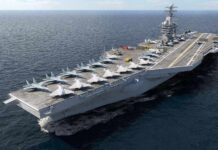

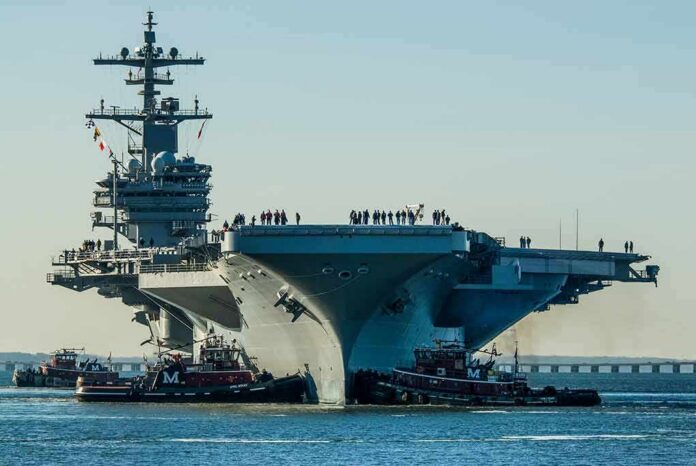
Amid a violent storm in the South China Sea, a U.S. Navy F-14 Tomcat trapped aboard USS Enterprise with minimal visual cues, guided by cockpit instruments and a calm voice from the deck.
Story Snapshot
- A named pilot, radar intercept officer, and landing-signal officer executed a successful arrested landing.
- The approach aimed for tight “on-speed, on glide-slope, on centerline” parameters with a three-wire target.
- The crew relied on instruments and radio calls as the flight deck pitched several feet in heavy weather.
- A naval biography confirms the pilot’s Enterprise service and deep carrier-landing experience.
Who Did What: The Aviators And The Ship
Captain John Monroe “Hawk” Smith flew the F-14 Tomcat. Lieutenant Joe “Crash” Zahalka served as the radar intercept officer. Lieutenant Grover “Skip” Giles acted as the senior landing-signal officer for Carrier Air Wing 14. Reporting says the jet recovered aboard the aircraft carrier USS Enterprise and the tailhook caught the number-two wire. The account places the action at sea and credits teamwork across cockpit and deck to complete the landing under severe weather stress.
The aviation biography for Smith records his duty with Carrier Air Wing 14 and USS Enterprise, F-14A operations, and major landing-signal-officer roles. It lists hundreds of fixed-wing carrier landings and highlights his part in early fleet qualifications for the F-14. That record supports the level of skill and experience described in the storm recovery narrative, even as it functions as background rather than a minute-by-minute log of the event itself.
How They Landed: Instruments, Calls, And Wire Engagement
Accounts describe a demanding approach with little usable view of the ship. Zahalka worked the F-14’s radar to maintain awareness as Smith flew the profile. Giles kept steady radio contact and coached the glideslope and lineup. The team aimed for a standard three-wire target and held “on-speed, on glide-slope, and on centerline.” After touchdown, Smith advanced both throttles, and the tailhook engaged the number-two wire, stopping the jet on the deck despite the harsh conditions.
One book-length account adds color on the sequence of touchdown and arrestment, placing the event aboard Enterprise in the South China Sea and describing the two-wire engagement during the storm recovery. This narrative framing aligns with naval carrier procedures that call for precise airspeed and attitude control on approach, throttle response at touchdown, and rapid confirmation of wire engagement to avoid a bolter or an overrun in bad weather.
Why It Matters: Skill, Training, And The Limits Of Visibility
The core takeaway is not a stunt but a system doing its job. Naval aviation trains for instrument approaches when visibility fades. On this day, instruments in the cockpit, calm voice control from the landing-signal officer, and the ship’s arresting gear formed a safety net. The reported geometry cites about fourteen feet of hook-to-ramp clearance and deck pitch between six and eight feet. Those figures come from later reconstructions that illustrate the narrow margin of error during the approach.
These stories resonate because they show people doing hard things under pressure, far from home, with little room for error. They also show why trust in training and teamwork is not a slogan but a survival rule. In an era when many Americans doubt large institutions, the picture here is different. Individuals made the system work. The landing shows how craft, discipline, and clear roles can still deliver when the sea and sky do not care who is in charge back in Washington.
Sources:
19fortyfive.com, theaviationgeekclub.com
© patriotpostnews.com 2026. All rights reserved.