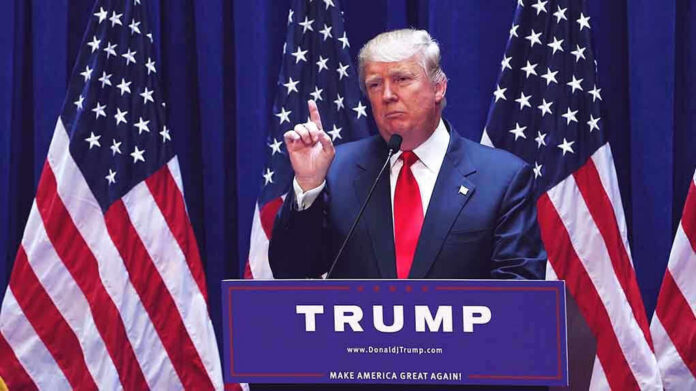
Standing below the stone faces at Mount Rushmore, President Trump told Americans that “nobody can be like us” and warned that the country’s very identity is now under attack.
Story Snapshot
- Trump used the 250th anniversary kickoff at Mount Rushmore to declare the United States “the most exceptional nation ever to exist in human history.”
- He tied America’s greatness to its people, culture, and history, and to trillions of dollars in investment he says are now flowing into the country.
- He warned of a “communist menace” and said Americans must choose loyalty to America over Karl Marx, casting communism as the greatest threat in U.S. history.
- The speech thrilled supporters who braved dangerous heat and storms, but critics on both sides saw it as a campaign-style rally that deepened worries about a failing, self‑serving government.
Trump’s 250th Birthday Message: ‘Nobody Can Be Like Us’
President Donald Trump opened the nation’s 250th birthday weekend at Mount Rushmore with an emotional defense of American greatness. Speaking Friday night beneath the carved faces of Washington, Jefferson, Roosevelt, and Lincoln, he called the United States “the most successful, most accomplished, most exceptional nation ever to exist in human history” and told the crowd, “Nobody can be like us.” He said the “birth and survival of the American nation under God” is “the best and most incredible thing ever to happen on this planet by human hands.”
Trump did more than praise documents like the Declaration of Independence and the Constitution; he said America’s strength comes from the “culture and character” of its people. He pointed to victories in two world wars and the Cold War, and to inventions from the light bulb to the internet and global positioning systems, as proof that American creativity has changed the world. He told supporters that for “a quarter of a millennium, liberty, justice, equality, self‑government, and unmatched prosperity have flourished here as they have never flourished anywhere before.”
Economic Pride and the Promise That ‘America Is Back’
To back up his claims about success, Trump pointed to hard numbers, saying “$19.2 trillion” is “pouring into the United States right now.” He argued that this investment shows the world still sees America as the safest and strongest place to build and grow. He contrasted this figure with what he said were “much less than one trillion” under the prior administration, framing his economic policies as the reason factories are being built at “record levels” and jobs are returning to American towns.
For many viewers, those boasts tapped into long‑running anger at global trade, past “green energy” rules, and the sense that elites shipped work overseas while ordinary families were left behind. Older conservatives who blame “woke” agendas and climate mandates for higher energy bills heard a president promising that “America is back” and that the nation’s wealth belongs first to its own workers. Older liberals who worry about the widening gap between rich and poor saw a familiar pattern: leaders touting big numbers while millions still struggle to pay rent, medical costs, and college for their kids.
‘Communist Menace’ and a Fight Over American Identity
Midway through the Mount Rushmore speech, Trump shifted from praise to warning. He said “American identity is under attack” and described a “resurgence of the communist menace” that he called “a mortal threat to American liberty.” He went further, declaring communism “the greatest threat to our country, including World War I, World War II, Pearl Harbor or even 9/11,” a comparison that many historians and security experts later criticized as rhetorical and lacking clear measures of “threat.”
Trump linked this “menace” not just to foreign enemies but to “radicals” and “extremists” at home whom he accused of tearing down statues and rewriting history. On social media, he was quoted saying, “You can be loyal to Karl Marx or you can be loyal to America. You cannot be both.” Supporters cheered the sharp line, seeing it as a defense of traditional values, the flag, and the belief that the United States is a force for good in the world. Critics said the language painted fellow Americans as enemies and risked turning a unifying 250th celebration into another front in the nation’s culture war.
A Patriotic Festival or a Political Rally?
The America 250 kickoff at Mount Rushmore was planned as a major national event, with organizers promising fireworks, military flyovers, and tributes to history. Despite record‑breaking heat and violent thunderstorms across the region, thousands showed up, filling the grounds and staying through delays to hear Trump’s remarks. Many attendees told local stations the speech was “inspiring” and praised him for honoring “the American citizens who made America great.”
Trump gives campaign-style July 4 speech on National Mall for US 250th anniversary https://t.co/ByCo68cRoN
— Politiko (@Politiko_Ph) July 5, 2026
Major outlets, however, framed the night differently. USA Today and NBC News described the Mount Rushmore event and related America 250 celebrations as having a strong campaign feel, noting the president’s focus on his own crowd size and his record rather than only on the country’s founding. The New York Times said he “veered from patriotism to ‘communism,’” branding opponents as communists in what looked like a preview of the next election fight. That divide fed a broader worry that both parties are using national milestones more to energize their bases than to tackle deep problems like inflation, broken immigration systems, and the shrinking middle class.
Why This Speech Hits a Nerve Beyond Left and Right
Trump’s claim that “nobody can be like us” fits a long tradition of presidents talking about “American exceptionalism,” the idea that the United States is different from and better than other nations. Research shows most presidents since the late 1800s have used similar language, especially during big anniversaries or wars, to rally support and justify policy. Scholars say Trump’s Mount Rushmore remarks fall into “messianic Americanism,” a style that casts America as chosen by God to defeat evil, in this case communism.
For many Americans, this story has two edges. On one side, it speaks to real pride: a country that survived civil war, beat fascism, helped win the Cold War, and drove huge advances in science and technology. On the other side, both conservatives and liberals now fear that leaders talk about destiny while ignoring daily reality. People on the right see a “deep state” that protects itself while borders stay insecure and crime rises. People on the left see corporate and political elites cashing in on big events, like the America 250 shows, while basic needs like health care and housing stay out of reach.
Unanswered Questions and What Comes Next
Some of Trump’s strongest claims still lack clear proof. The $19.2 trillion investment figure did not come with a time frame or a breakdown, making it hard for citizens to check against independent economic data. His statements that the United States is the “most powerful nation on earth” and “oldest republic” echoed familiar talking points but did not include defense or historical comparisons that could settle those points. Those gaps matter to Americans who want less spin and more evidence from their leaders.
Meanwhile, critics worry that branding rival ideas as “communist” and “the greatest threat” could be used to justify more crackdowns, more surveillance, or more favoritism for connected insiders, all in the name of saving the country. Supporters argue the danger is real and say strong words are needed to wake people up. As America moves through its 250th year, the core question is whether leaders of either party will use this moment to address shared frustrations about a government that feels captured by elites, or simply to double down on speeches that say “nobody can be like us” while millions wonder if the system still works for them.
Sources:
usatoday.com, youtube.com, instagram.com, facebook.com, nbcnews.com, theatlantic.com, nytimes.com, swp-berlin.org, en.wikipedia.org
© patriotpostnews.com 2026. All rights reserved.