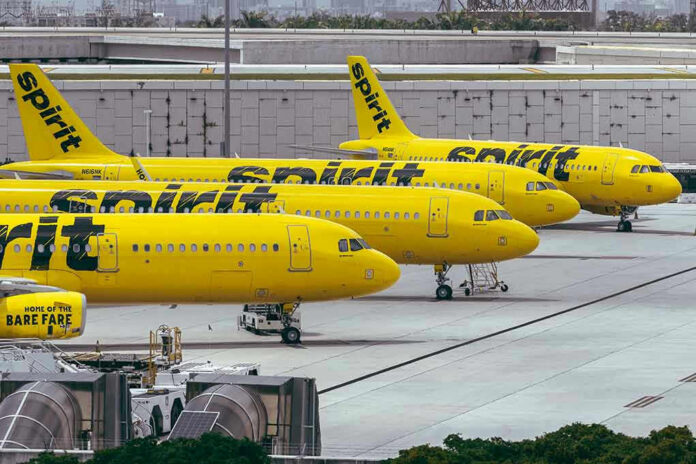
Spirit Airlines’ sudden shutdown eliminated 17,000 jobs and left thousands stranded, reigniting fierce debate over whether a blocked merger two years ago sealed the carrier’s fate—or whether soaring fuel costs and executive mismanagement were the real culprits.
Quick Take
- Spirit Airlines ceased operations in late April 2026 after failed bailout talks, eliminating approximately 17,000 jobs and stranding passengers nationwide.
- Republicans and conservative outlets blame Sen. Elizabeth Warren for opposing the 2024 JetBlue-Spirit merger, claiming the deal could have saved the airline.
- Warren and Democrats counter that spiking fuel prices—driven by Trump administration foreign policy—and longstanding financial distress caused the collapse, not the merger block.
- Transportation Secretary Sean Duffy acknowledged the Trump administration explored bailout options but faced creditor obstacles that prevented rescue.
The Merger Block and Political Blame
In January 2024, a federal judge blocked JetBlue’s proposed acquisition of Spirit Airlines, citing antitrust concerns that the deal would reduce competition and raise fares for consumers. Sen. Elizabeth Warren publicly celebrated the decision, posting on social media that blocking the merger was “a Biden win for flyers.”[1] Two years later, as Spirit filed for bankruptcy and ceased operations, conservative critics seized on Warren’s statement, arguing that her opposition to the merger directly contributed to the airline’s demise and the loss of thousands of American jobs.[1][2]
Warren’s Defense and Counterarguments
Warren has firmly rejected responsibility for Spirit’s collapse, attributing the airline’s failure to external economic factors beyond regulatory decisions. She pointed to skyrocketing fuel prices—which reached $4.51 per gallon in April 2026, more than double Spirit’s projected $2.24 forecast—and linked this spike to Trump administration foreign policy, particularly tensions with Iran.[3][4] Warren also questioned the proposed $500 million government bailout, asking what taxpayers would receive in return and whether failed airline executives should face accountability.[3]
Spirit’s Underlying Financial Crisis
Spirit Airlines had struggled financially for years before the merger block, filing for bankruptcy twice in 2024 and 2025. The carrier faced mounting debt exceeding $3 billion, capacity utilization drops of 80 percent, and operational challenges including aircraft engine shortages that grounded portions of its fleet.[1][3] These structural problems existed independent of the JetBlue merger decision, suggesting Spirit’s troubles ran deeper than any single regulatory action. The airline’s business model—relying heavily on ultra-low-cost operations from concentrated hubs like Miami and Detroit—left it vulnerable to external shocks like fuel price spikes.[3]
Trump’s DOJ blocked B6 & NL merger on antitrust grounds. Then, when Spirit Airlines attempted to secure a government bailout and it collapsed, the Trump crew blamed Elizabeth Warren. It’s quite interesting. Spirits assets will help several airlines fill gaps in their narrow…
— Jace Cole (@jacecole) May 3, 2026
The Bailout Question and Bipartisan Skepticism
The Trump administration explored a potential $500 million bailout package to keep Spirit operational, but negotiations collapsed before a deal materialized. Transportation Secretary Sean Duffy told reporters that President Trump was “like a dog on a bone trying to figure out a way to keep Spirit afloat,” yet a creditor disagreement ultimately undermined rescue efforts.[1] Notably, opposition to the bailout extended beyond Warren; Republican Senator Ted Cruz also called bailouts a “terrible idea,” reflecting broader bipartisan concern about using taxpayer funds to rescue struggling private companies.[3]
Competing Narratives and Shared Frustrations
The Spirit Airlines collapse has exposed a fundamental tension in how Americans across the political spectrum view government intervention. Conservatives frame the shutdown as evidence that Biden-era regulatory overreach and Democratic obstructionism destroyed American jobs and economic opportunity. Liberals counter that protecting consumers from airline consolidation and unchecked corporate power remains the correct policy, regardless of Spirit’s fate. Yet both sides increasingly recognize a shared concern: whether elites in government and business are making decisions that serve ordinary Americans or merely protect their own interests and power.
Sources:
Sen Warren faces backlash over JetBlue merger block after Spirit …
Spirit Airlines shutdown row: The key Elizabeth Warren angle in …
Elizabeth Warren Blames Trump’s Iran War For Doing in Spirit …