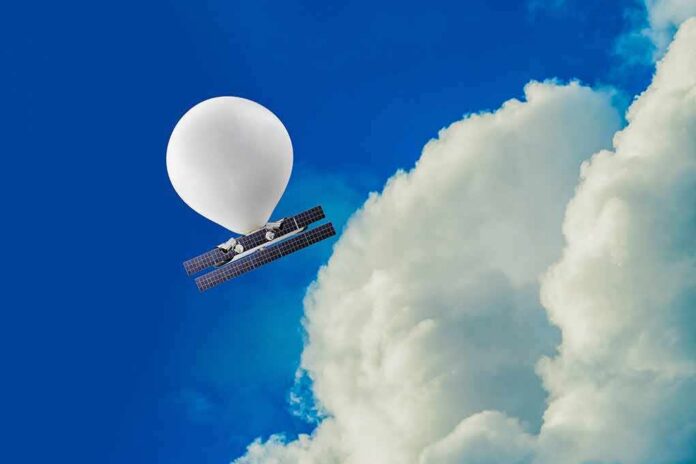
As companies quietly plan up to 1.7 million satellites, scientists warn the night sky itself could become another asset captured by powerful interests.
Story Snapshot
- Astronomers say massive satellite fleets could wipe out huge chunks of usable telescope data.
- Studies already show today’s smaller constellations are ruining key twilight and wide-field observations.
- Weak global rules let corporations file for hundreds of thousands of satellites with little regard for science.
- Mitigation steps like darker satellites help somewhat but do not solve the core problem.
What this new wave of satellites could do to astronomy
European Southern Observatory experts and other teams warn that planned “mega-constellations” could fundamentally change how we study the universe. Ground-based telescopes already see bright streaks from existing satellites across their images, especially during twilight when sunlight reflects strongly off metal surfaces. For the Vera C. Rubin Observatory, studies assuming 26,000 to 48,000 satellites predict that 20 percent of midnight images and up to 80 percent of twilight images will contain trails that can badly damage the data. If operators scale fleets toward hundreds of thousands or more, astronomers fear losing large fractions of their field of view on many exposures, making some faint and time-sensitive science nearly impossible.
Scientists also worry about space-based observatories, which many assumed would escape these problems. A recent study in the journal Nature found that low Earth orbit communication constellations will contaminate images from several upcoming space telescopes by reflected light. If all proposed constellations are built, the authors forecast that about 96 percent of exposures from missions like SPHEREx and China’s Xuntian will contain at least one sunlit satellite trail. That means even high-cost missions in orbit, funded by taxpayers, could have their data undercut by commercial networks operated mainly for profit and national advantage rather than science or the public’s view of the sky.
Evidence from current constellations: a warning sign
We do not have to imagine the entire 1.7 million satellite scenario to see the risk; today’s smaller fleets already cause serious trouble. An official European Southern Observatory study, looking at constellations totaling about 26,000 satellites, estimated that up to 3 percent of long twilight exposures from large telescopes would be ruined. For wide-field surveys like those planned at Vera Rubin Observatory, that same work projected 30 to 50 percent of twilight images would be severely affected, with some detectors saturated by bright trails. Other research found that many modern observatories now record satellite streaks in a large share of their photographs, and that removing those trails later often leaves scars in the data, hurting automated searches for faint galaxies or near-Earth asteroids that matter for basic science and safety.
Radio astronomy faces a similar storm. Studies and workshops from major astronomy groups describe satellite radio transmissions as thousands or millions of times stronger than the cosmic signals telescopes try to detect. One analysis compared this to shining a flashlight directly into someone’s eyes in a dark room. As more satellites broadcast internet and other services, their combined noise risks overwhelming sensitive receivers, especially at key bands reserved for science. Legal scholars warn that this interference is “unavoidable” with current designs and that it may render some planned observatories effectively useless unless rules change. All of this is happening while global regulators move slowly and companies press ahead, using space as a new arena for commercial control.
Attempts to fix the problem and their limits
Satellite operators say they are working on solutions, and there is some progress. SpaceX tested a “Darksat” with a special coating that cut brightness by about half compared with the original Starlink design, making it invisible to the naked eye under good conditions. The company has also talked about sunshade devices and changing solar panel angles at operational altitude to reduce visible glints. Astronomers welcome these steps, and early measurements show meaningful improvements for casual stargazers. However, wide-field surveys like Vera Rubin Observatory still find that even dimmer satellites can mar ultra-deep images aimed at the very faint edge of the universe, so these fixes lower the harm but do not remove it.
More broadly, technical patches cannot change the basic math. When tens of thousands of satellites crisscross the sky, many exposures will contain trails, even if each trail is slightly dimmer. Reports from the American Astronomical Society and international unions say wide-field optical surveys and twilight searches will remain “severely affected” even under optimistic mitigation. Astronomers can adjust schedules and process data to mask some streaks, but every extra step costs money, staff time, and lost science. That burden falls on publicly funded observatories, while the main benefits of global broadband go to companies and, indirectly, governments that license them. This imbalance feeds the growing sense among many citizens that the system favors well-connected elites over long-term public goods like open science and a clear night sky.
Regulation, power, and why both left and right are worried
The deepest concern is not just the satellites themselves, but who decides what happens in orbit. International Telecommunication Union records show plans for more than a million low Earth orbit satellites, with slots handed out largely on a first-come, first-served basis. Legal analysis from Georgetown University argues that current space law was never designed for giant commercial fleets and offers weak tools to protect astronomy. Without stronger rules, corporations and major states can claim large pieces of the sky for decades, while scientists, local communities, and ordinary stargazers have almost no formal say. For many people, this looks like a “deep state” of global regulators and corporate lobbyists quietly reshaping a shared natural heritage into a private network grid.
Both conservatives and liberals have reasons to be uneasy. People on the right already distrust distant global bodies that seem to favor corporate interests over national sovereignty; here they see foreign and domestic companies racing to lock in orbital rights with little democratic debate. People on the left worry about growing gaps between the powerful and everyone else; they see billionaires and large firms gaining control of a key information highway and even the night sky, while public science and cultural traditions that rely on the stars are pushed aside. Across the spectrum, many share a simple fear: once hundreds of thousands of satellites are up, the damage to astronomy and to our view of the heavens will be hard, maybe impossible, to undo. The fight over mega-constellations is therefore not only about astronomy; it is a test of whether government still works for the people when the stakes involve both cosmic discovery and corporate control of the sky.
Sources:
insiderpaper.com, eso.org, facebook.com, sciencesprings.wordpress.com, telescope.live, reddit.com
© patriotpostnews.com 2026. All rights reserved.