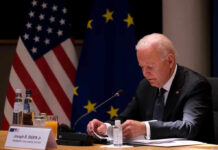


The world watched as President Trump slammed the gavel on global trade, threatening a blanket 10% tariff on any country cozying up to BRICS—because apparently, defending American sovereignty is now “controversial.”
At a Glance
- President Trump vows a 10% tariff on countries supporting BRICS “anti-American” policies
- BRICS expands, admitting new partner states and doubling down on alternatives to U.S. dominance
- Global markets brace for volatility as America draws a hard line in the sand
- The U.S. dollar’s supremacy, and the very idea of national self-determination, now face direct challenges
Trump’s Tariff Ultimatum: Drawing the Line Against BRICS Expansion
On July 6, 2025, President Trump announced, via his favored Truth Social platform, that any nation daring to align itself with BRICS’ “anti-American” policies would be slapped with an across-the-board 10% tariff. No exceptions. Not surprisingly, he left the definition of “anti-American” as vague as a DC budget promise. But we all know what’s really at stake here: BRICS, originally a club of Brazil, Russia, India, China, and South Africa, has ballooned to include a host of new “partner states”—and is itching to take a sledgehammer to American economic leadership. The announcement dropped just as BRICS leaders opened their 2025 summit in Brazil. They wasted no time issuing a declaration condemning U.S. military actions and doubling down on their dream of a multipolar world where the dollar isn’t king.
Trump’s warning came after months of saber-rattling. Back in December, he threatened BRICS over plans to develop a rival currency. By mid-2025, Vietnam joined as a BRICS partner, and the bloc welcomed nine more “partners,” from Belarus to Uzbekistan. This isn’t your grandfather’s trade spat—it’s a full-blown contest over who gets to write the rules of the global economy.
The Stakes: America’s Economic Backbone Versus Global Fragmentation
BRICS isn’t just out to grab headlines. With every new member, they’re building the muscle to challenge U.S. influence head-on, especially by eroding the dominance of the dollar. Their New Development Bank is already funding projects in non-dollar denominations, while their leaders openly debate ways to bypass American oversight in global finance. What’s the U.S. response? Tariffs—a tool that, like a well-worn firearm, has proven effective when wielded with resolve. Trump’s administration, fresh off new border clampdowns and a national mood sick of endless global entanglements, is making it clear: line up with anti-American schemes, and you’ll pay dearly at the loading dock.
BRICS finance ministers, predictably, denounced the tariffs as “a threat to the global economy,” but for American workers and manufacturers, this is about survival. The immediate effect? Uncertainty for exporters in BRICS-aligned countries, volatile markets, and a diplomatic chill so cold you could store vaccines in it. But let’s not kid ourselves—this isn’t about hurting foreign businesses. It’s about reminding the world that the American market, and the American worker, still matter.
Who Wins, Who Loses: The Real-World Fallout From Drawing a Hard Line
Exporters and importers in BRICS-aligned countries are already scrambling to figure out how to navigate Trump’s tariff threat. Consumers could see higher prices on imported goods, and global markets are bracing for a rocky ride. For developing economies flirting with BRICS membership, the message is clear: you can’t have your cake and eat it too. Align with anti-American agendas, and access to the world’s largest, most lucrative market just got a lot more complicated.
Industry experts are calling this a dramatic escalation, warning it could accelerate the very global divisions Trump wants to prevent. Yet, as any clear-eyed conservative knows, the alternative—rolling over while foreign cartels rewrite the rules—is far worse. Some in the foreign policy establishment are clutching their pearls over America’s “isolationism,” but for the rest of us, this is common sense. If we don’t defend our economic backbone, nobody else will. The idea that we should subsidize the ambitions of countries openly working to sideline us? That’s not just ridiculous—it’s dangerous.
A Broader Battle: Defending the Dollar, Defending America
This tariff threat isn’t just another chapter in a never-ending trade war—it’s a declaration that the days of the U.S. being the world’s economic doormat are over. The dollar’s supremacy is at stake, and with it, America’s ability to shape global affairs on its own terms. BRICS wants a world where American values—individual liberty, free enterprise, constitutional government—mean less and less. Trump’s tariffs are a blunt instrument, but sometimes that’s exactly what’s needed when the stakes are this high.
Whether this move will ultimately fracture global trade or force fairer deals remains to be seen. What’s clear is that the fight for American prosperity and sovereignty is far from over. And if defending those things makes us “controversial” on the world stage, maybe that’s a badge of honor we should wear a little more proudly.
Sources:
TIME, “Trump’s Tariff Threat to BRICS Over ‘Anti-American’ Concern”
WION, “Trump Labels BRICS as ‘Anti-American’, Renews 10% Tariff Warning”