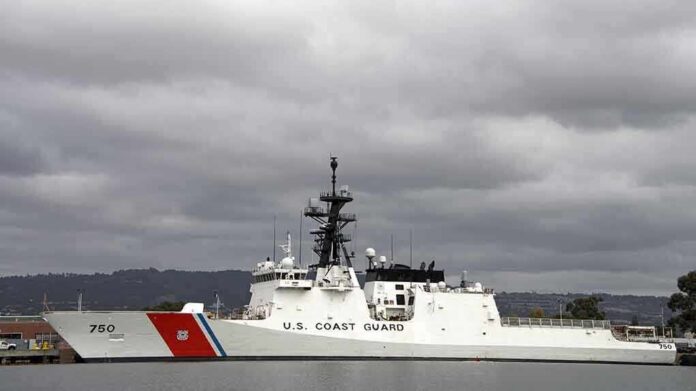
While Washington argues over budgets and borders, the Coast Guard just stopped $33.9 million worth of cocaine from ever reaching American streets.
Quick Take
- The Coast Guard Cutter Escanaba seized 4,510 pounds of cocaine off Manta, Ecuador, valued at about $33.9 million.
- The interdiction was tied to Easter Sunday operations and coordinated through Joint Interagency Task Force South.
- The seizure underscores how maritime trafficking routes in the Eastern Pacific keep feeding U.S. drug demand despite years of enforcement.
- Officials reported the drugs were offloaded for adjudication and destruction; available reporting did not detail arrests.
Easter Sunday seizure spotlights a war most Americans rarely see
The U.S. Coast Guard announced that the Cutter Escanaba intercepted and recovered 4,510 pounds of cocaine in the Eastern Pacific, off the coast near Manta, Ecuador. The agency-valued haul came in at roughly $33.9 million, making it a major interdiction by any measure. The timing—Easter Sunday—added a symbolic edge to an operation that usually stays out of public view, even though its stakes ultimately land at home.
Coast Guard Confiscates Over $33 Million of Cocaine in Major Bust | The Gateway Pundit | by Jack Davis, The Western Journal https://t.co/77tjfdZiyK
— Tammie Adams (@tammieadams31) April 12, 2026
The reported details place the bust in a high-traffic smuggling corridor, where “go-fast” boats and semi-submersible vessels have increasingly been used to move cocaine north. Joint Interagency Task Force South provided intelligence and coordination, a reminder that these seizures are rarely a single-agency event. The basic picture is straightforward: U.S. forces patrol international waters, identify suspected smugglers, and take drugs off the maritime pipeline before they can fragment into inland distribution networks.
Why Ecuador’s Pacific coast keeps showing up in U.S. drug cases
Trafficking routes from South America run through predictable geography, and Ecuador has grown as a transit point because of major ports and uneven local controls. Manta, a key Pacific port city, sits along corridors that have also been linked to rising violence tied to narcotrafficking in the region. That matters for Americans because instability abroad often translates into stronger cartels, more sophisticated smuggling, and more pressure on U.S. interdiction forces to cover a vast ocean with finite ships and aircraft.
In the background, the Coast Guard’s Eastern Pacific mission has been a long-running element of U.S. counternarcotics policy, coordinated with regional partners and other U.S. agencies. The reporting also notes historical totals—hundreds of tons confiscated since 2010—illustrating that seizures add up over time. Still, the scale of supply makes the problem stubborn. Analysts cited in the reporting argue that even big busts can represent a small share of overall production, which keeps the strategic question alive: how to reduce demand and disrupt networks faster than they adapt.
What a $33.9 million hit does—and doesn’t—change
The immediate impact is easy to grasp: cocaine seized at sea cannot be sold, cut, and distributed in U.S. communities, and the trafficking organization takes a direct financial loss. Interdictions can also force cartels to reroute shipments, incur higher costs, and take bigger risks, which is part of the logic behind sustained patrols. Officials framed this seizure as a clear win against cartels, crediting multi-agency coordination that helps locate targets in open water.
The limits are also real and worth stating plainly. The valuation is a “street value” style estimate that can fluctuate with markets, purity, and geography, and the available reporting does not provide a full chain-of-custody narrative beyond offload for destruction and adjudication. No additional seizures or arrests were detailed in the source material. For policy watchers, that gap matters because enforcement success is measured not only in pounds seized, but in dismantled networks, prosecutions, and sustained reductions in availability.
The political backdrop: Americans want competence, not bureaucracy
In 2026, with Republicans controlling Congress and President Trump in a second term, law-and-order voters expect visible results against cartels and traffickers—especially when illegal immigration and fentanyl-era overdose concerns remain top-of-mind. At the same time, many Americans across the spectrum increasingly believe the federal government is failing at basic competence, consumed by bureaucracy and partisan theatrics. A clear-cut seizure like this offers a rare, measurable result—one that doesn’t require spin to understand.
The broader test is whether such operations translate into sustained public safety gains without ballooning waste or leaning on empty slogans. Maritime interdiction can disrupt supply, but it also highlights an uncomfortable truth: global trafficking is resilient, and U.S. agencies are often playing defense across enormous distances. The Coast Guard’s success off Ecuador is significant, but it also functions as a snapshot of a much larger struggle—one where voters want enforcement, accountability, and strategies that actually reduce the harm reaching American families.
Sources:
Coast Guard Cutter Seizes More Than $33 Million Worth of Cocaine in Easter Sunday Bust