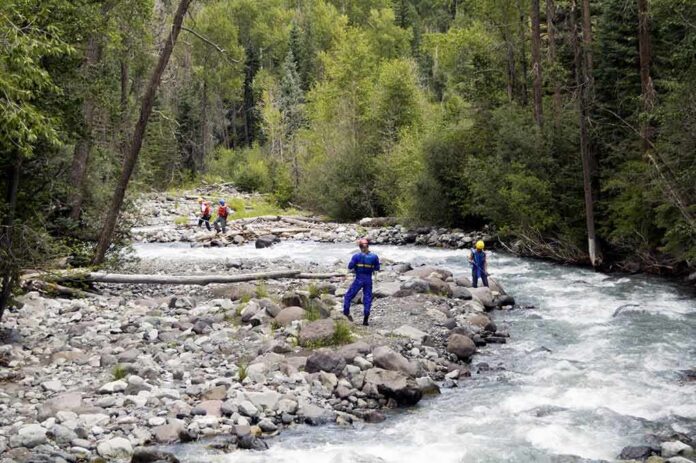
A rescue video from the Muskegon River shows three missing tubers found alive after three days in the woods, but the public record is thinner than the headline suggests.
Quick Take
- Officials say Jazmin Hock, Sarah Vida, and Kayden Kovalcik were found alive after a three-day search.
- Body camera footage and state releases show search crews following footprints and other clues into dense woods.
- Some reports say the trio described surviving on bark, flowers, and river water, but that detail is not fully backed by the public record.
- Police also said the recovered flotation devices looked like pool floats, not river-rated tubes.
What the Rescue Video Shows
Michigan Department of Natural Resources footage and local reports show rescue crews locating the missing group on Friday afternoon near the Mill Iron Boat Launch area. Officers found the three after tracking footprints, bent grass, broken sticks, and a path through thick brush. The footage turned a tense search into a clear rescue moment, with rescuers carrying the child out and helping the two women after nearly 72 hours in the wilderness.
The names stayed consistent across reports: Jazmin Hock and Sarah Vida, both 28, and Vida’s 9-year-old son, Kayden Kovalcik. Several outlets said the group was dehydrated, bruised, bitten by insects, and treated for infections or rashes after being taken to the hospital. That part of the story is solid. The broader survival narrative, including exactly what they ate and drank, is less certain and relies mostly on later interviews and short clips.
What Is Confirmed, and What Is Still Fuzzy
The strongest confirmed facts are the rescue itself, the three-day search, and the location clues that led officers to the group. Reports also place the rescue at about 4:30 p.m. and roughly three-quarters of a mile northeast of the Mill Iron Boat Launch. Those details matter because they show how search crews narrowed a large wooded area. They also show how much of the public story comes from official narration rather than a full independent reconstruction.
One point of tension remains the flotation equipment. Michigan State Police Lt. Pat Agema said officers found four inflatable pool floats and were still trying to verify they were the same devices used by the missing group. That does not change the rescue, but it does leave room for doubt about the exact equipment failure. The public record also does not fully prove how the tubes failed, even though some reports say the group hit logs and the tubes popped.
Why This Story Resonates
This case fits a familiar pattern in modern rescue coverage. A dramatic “found alive” video becomes the main story, while the harder questions about safety, planning, and search methods get less attention. That matters because the facts that shape survival are often basic: time, terrain, and how quickly search teams find a track to follow. Here, the rescue video is real and powerful, but it also crowds out the parts of the incident that still need fuller documentation.
Three people who went missing during a tubing trip on Michigan’s Muskegon River have been found alive after spending nearly four days stranded in remote woods.https://t.co/QXKDCzWT0Y#BreakingNews #Michigan #Rescue #MuskegonRiver #USNews
— Lokalupdate (@LokalupdateX) August 12, 2026
The strongest caution is simple: the public sources do not fully support the viral claim that the group lived only on bark and flowers for three days. One report says the child described that survival method in the rescue video, and another says the trio drank river water. But the available reporting does not include medical records, witness statements, or forensic scene evidence that would lock that detail down. In a case this dramatic, that gap is worth noticing.
Sources:
wilx.com, youtube.com, freep.com, facebook.com, woodtv.com, cbsnews.com
© patriotpostnews.com 2026. All rights reserved.