
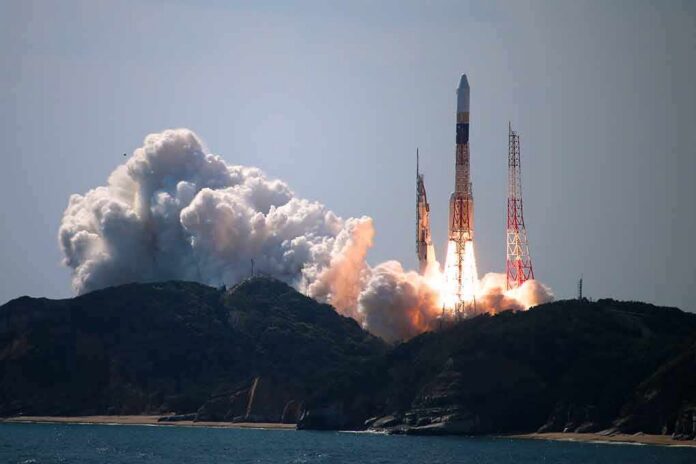
Japan’s space agency launched a spacecraft to bring home a piece of Mars’s moon Phobos, marking a rare win for real science over government drift and delay.
Story Highlights
- Japan’s Martian Moons eXploration spacecraft launched and reached its planned orbit.
- The mission aims to collect at least 10 grams of material from Phobos.
- Plans call for two soft landings on Phobos and a return to Earth around 2031.
- Independent European groups confirmed the launch details and mission goal.
Launch Success and Verified Trajectory
The Japan Aerospace Exploration Agency reported a successful liftoff at 04:41:03 Japan Standard Time on October 20, 2026, using an H3 rocket from Tanegashima Space Center. Mission controllers confirmed spacecraft separation about 71 minutes after launch and injection into the planned orbit. Japan calls the mission the Martian Moons eXploration, or MMX. This first step matters because it sets the timing for the long cruise to the Mars system and enables the later sampling plan.
The European Space Agency also reported the launch and described MMX as the first mission designed to bring samples back from Phobos, a moon of Mars. That outside confirmation adds confidence to the basic facts of the ascent and the mission’s core purpose. The Observatoire de Paris, a major French research institution, issued a separate note that the launch was successful. These reports help show agreement across agencies about what happened and what comes next.
What MMX Plans to Do at Mars’s Moons
Japan’s plan is to fly to the Mars system, observe both moons, and then focus on Phobos. The spacecraft is designed to enter a special orbit near Phobos to support close-up mapping. The mission plan calls for two soft landings on Phobos to collect at least 10 grams of surface material. After sampling, the spacecraft will send a sealed capsule back to Earth for recovery and lab study. Japan targets an Earth return around 2031 if operations go as planned.
The Institute of Space and Astronautical Science, which is part of Japan’s program, describes this flight plan in detail. The spacecraft will study Deimos and Phobos, enter a quasi-satellite orbit around Phobos, collect the samples, and bring them home. This approach gives engineers time to map safe landing zones and plan short, controlled touchdowns. These steps lower risk by separating observation, navigation, landing, and collection into clear phases.
Why This Mission Matters for Science and the Public
Returned samples let scientists test rock and dust on Earth with strong tools, not just cameras and sensors in space. A small amount of material can answer big questions about where Phobos came from and whether it holds bits blasted off Mars long ago. The mission’s five-year plan shows how space exploration often spans election cycles and budget fights, which can shake public trust. Clear milestones help people see real progress over time instead of promises that drift.
🚀 Japan Launches Mission to Bring Back a Piece of Martian Moon Phobos
Japan has launched a mission to bring soil back to Earth from Phobos, a moon of Mars, for the first time. The MMX probe is expected to return about 10 grams of samples in 2031.
The spacecraft will arrive at… pic.twitter.com/UX0DiEkN7M
— THE TRADESMAN 📈 (@The_Tradesman1) October 21, 2026
Other space programs show how tough sample return can be. High hopes at launch can run into delays, cost problems, and design changes later. Analysts have flagged how big space efforts can slip on schedule and go over budget when goals are not matched to resources. MMX begins by setting concrete steps and clear targets that the public can track. That approach helps taxpayers see value beyond headlines and helps scientists plan their work.
What Has Happened and What Has Not Yet Happened
So far, Japan launched MMX, confirmed separation, and set the craft on its planned path. Agencies in Europe echoed these facts. The sample return, the two soft landings, and the 2031 homecoming remain goals for later phases. Those events will rest on navigation accuracy, safe landings, and clean handling of the sample. One caveat is simple: no sample has been collected or returned yet, so scientific results will follow only after recovery and lab study.
Sources:
youtube.com, global.jaxa.jp, observatoiredeparis.psl.eu
© patriotpostnews.com 2026. All rights reserved.