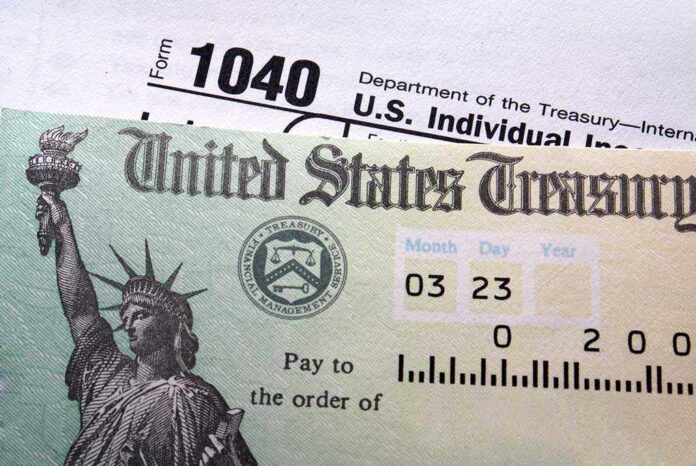
Trump’s economic team is promising Americans the largest tax refund season in U.S. history, with some families potentially receiving $11,000 to $20,000 in savings when they file their 2025 returns.
Story Highlights
- Kevin Hassett predicts “biggest refund cycle ever in the history of America” for 2026 filing season
- Trump claims families could see $11,000-$20,000 in annual savings from tax policy changes
- Retroactive 2025 tax cuts created withholding mismatch, leading to larger expected refunds
- Independent analysis shows benefits heavily favor high-income households despite broad impact
The Bold Prediction Taking Shape
Kevin Hassett, Director of Trump’s National Economic Council and leading contender for Federal Reserve Chair, appeared on Fox Business to double down on extraordinary claims about upcoming tax refunds. Speaking on “Varney & Co.,” Hassett declared Americans are headed for “massive refund checks” that will dwarf anything seen before in U.S. history.
This prediction stems from a July 2025 Trump tax package that introduced several retroactive tax cuts for 2025 income. The package includes eliminating federal taxes on tips and overtime, expanding child tax credits, increasing the SALT deduction cap to $40,000, and creating new senior deductions. Since these changes occurred mid-year, IRS withholding tables never caught up, creating a structural overpayment situation.
The Mathematics Behind the Massive Refunds
Nancy Vanden Houten from Oxford Economics projects roughly $50 billion in additional taxpayer savings due to the withholding mismatch and retroactive cuts. This represents approximately a 17% increase over the previous year’s $275 billion in total refunds. The average 2025 refund was $2,939, meaning a 17% boost would add nearly $500 per taxpayer on average.
Hassett ties these projections to broader economic improvements, citing 3.7% nominal wage growth against 1.6% core inflation. He argues this creates real wage growth of 2-2.5% for typical workers, with blue-collar workers allegedly receiving about $2,000 in real raises during 2025. The November CPI report, which Hassett calls “blockbuster,” showed inflation cooling faster than expected.
Reality Check on Distribution and Impact
Independent analysis reveals the benefits heavily favor affluent households, despite the broad-based rhetoric. The Tax Policy Center confirms all income groups benefit on average, but high-income households capture the largest gains. The expanded SALT deduction and pass-through business provisions particularly benefit wealthy taxpayers in high-tax states.
Oxford Economics expects top-income households to spend about 20% of their tax savings, while other households may spend 25-40% of their refund boosts. This suggests a temporary consumer spending increase in early 2026, concentrated around refund disbursement periods. However, the overall macroeconomic impact is projected to be modest, since consumer spending doesn’t appear significantly constrained by the current withholding situation.
Political Timing and Public Perception
The refund predictions address a significant political challenge for the administration. Fox News polling shows 44% of Americans feel they’re falling behind financially, while 74% describe the economy as “not so good” or “bad.” Hassett explicitly frames the coming refund season as a moment when people will “see it in their wallets” and recognize the administration’s economic achievements.
The timing is politically convenient, with large refund checks arriving during Trump’s second year in office. This creates a tangible demonstration of tax policy benefits that goes beyond abstract economic statistics. The administration is essentially betting that direct cash in taxpayers’ pockets will override broader economic anxieties and validate their supply-side approach to growth.
Sources:
Trump economist predicts ‘biggest refund cycle ever,’ massive checks ahead
Larger tax refunds in 2026 expected