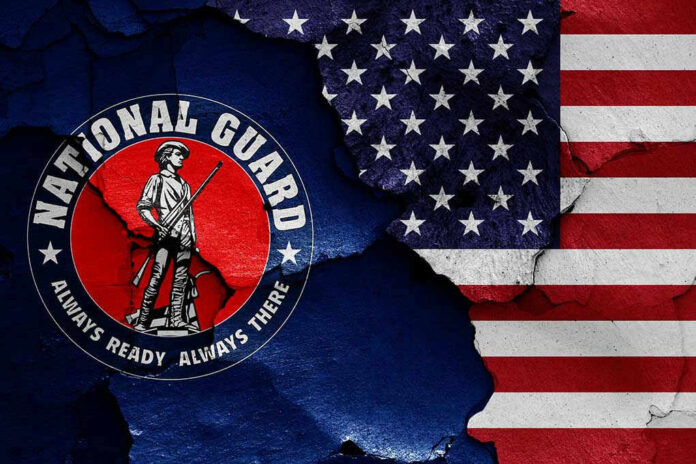
America’s National Guard, once the fire brigade summoned for rare disaster, is being refashioned into a standing domestic force poised to deploy within a day’s notice—raising the question: how close is the U.S. to a permanent federal police presence?
Story Snapshot
- The Pentagon has mandated every state and territory to assemble “quick reaction forces” (QRFs) for rapid domestic deployment.
- By April 2026, up to 23,500 National Guard soldiers will be trained and ready for riot control, disaster response, and crowd management.
- Federal authority is now overriding traditional state control over Guard units, igniting debates over the balance of power and civil liberties.
- This marks the most coordinated and expansive domestic military readiness in modern U.S. history.
Pentagon’s Directive: From Disaster Aid to Domestic Deterrence
The October 2025 leak of an internal Pentagon memo set off political shockwaves: every state, from Maine to Hawaii, must stand up specialized QRFs trained for rapid deployment in response to domestic unrest, emergencies, or potential threats to public order. Each state is to contribute a minimum of 200 troops by the start of 2026, with the nationwide force swelling to 23,500 by April. This is not disaster relief as usual—these units will drill in riot control tactics, nonlethal weapons, and rapid crowd suppression, all under direct federal guidance. The memo’s language strips away ambiguity: the federal government, not state governors, will call the shots when the stakes are high.
For decades, the National Guard’s role in domestic affairs was reactive and rare. Governors called out the Guard for hurricanes, wildfires, or—less commonly—civil unrest. Federalization was a last resort, invoked only for extraordinary events like the 1960s civil rights clashes or the 2005 chaos after Hurricane Katrina. Now, the Pentagon’s directive signals a shift: readiness for domestic deployment is becoming a core, standing mission. Every state’s QRF must be ready to move within 24 hours, support law enforcement, and quell unrest, whether sparked by disaster, politics, or protest.
Who’s in Charge? The Federal-State Power Struggle
Traditionally, state governors have commanded their own National Guard units, deploying them at their discretion. The new federal directive upends that balance. Pentagon leadership, with the National Guard Bureau coordinating, will oversee the QRFs, training them in standardized riot control and nonlethal tactics. Governors may chafe at losing direct control, especially in states where local priorities diverge from federal aims. Law enforcement agencies, meanwhile, see an influx of resources for crowd control, but civil liberties groups warn of blurred lines between military and police roles. The Trump Administration’s reported revisions to Guard policy underscore the stakes: expanded federal authority in the name of national order.
Behind the scenes, senior Pentagon officials and White House policymakers drive the strategy, betting that a visible, unified show of force can deter violence before it starts. State leaders, especially in politically divided regions, now face a dilemma—embrace federal support or resist the loss of autonomy. The implications for American federalism are profound: is this enhanced security, or a step toward centralized control?
Riot Shields and Riot Warnings: Training for a New Era of Unrest
National Guard soldiers slated for QRF duty are receiving intensive training in riot control, rapid deployment, and—crucially—the use of nonlethal weapons. The urgency is real: initial contingents specializing in chemical and nuclear disaster response will be operational by New Year’s Day. By April, a full 23,500-strong force will be on alert across the country, prepared to roll out within a day’s notice. This level of mobilization echoes only the most turbulent chapters of U.S. history, yet it is being normalized as routine readiness, not emergency exception.
The directive lands amid heightened political tensions and fears of post-election unrest. The echoes of the 2020 protests and the January 6 Capitol riot linger in the Pentagon’s planning, as do warnings from law enforcement about the potential for violent demonstrations. The scale and speed of the QRF buildup suggest a government bracing not just for natural disasters, but for manmade crises—protests, riots, even insurrection. The operational tempo is relentless: by late 2025, training and mobilization will be in full swing, with the first wave of troops on standby as the country enters an uncertain new year.
America’s Future: Security or Overreach?
Short-term, the QRF initiative promises a deterrent effect—faster, more robust responses to civil unrest and emergencies, and a visible commitment to order. Long-term, critics fear the transformation of the National Guard into a permanent, federally controlled domestic police force, eroding the guardrails of state autonomy and civilian oversight. The specter of militarized law enforcement looms, drawing comparisons to the domestic armies of less free societies. Legal scholars and civil liberties advocates warn of the dangers in blurring the distinction between military and police missions. Supporters counter that national security and public safety demand nothing less than constant readiness for the unknown.
The Pentagon’s move reverberates beyond politics, touching every corner of American society: protesters wary of suppression, state officials anxious about autonomy, defense contractors eyeing new business in training and equipment, and ordinary citizens left to ponder the meaning of security in a nation on edge. The directive’s implementation will test not just the Guard’s readiness, but the country’s commitment to its founding principles of federalism and freedom.
Sources:
Reason – Trump’s National Guard Plan Edges the U.S. Closer to a Permanent Federal Police Force