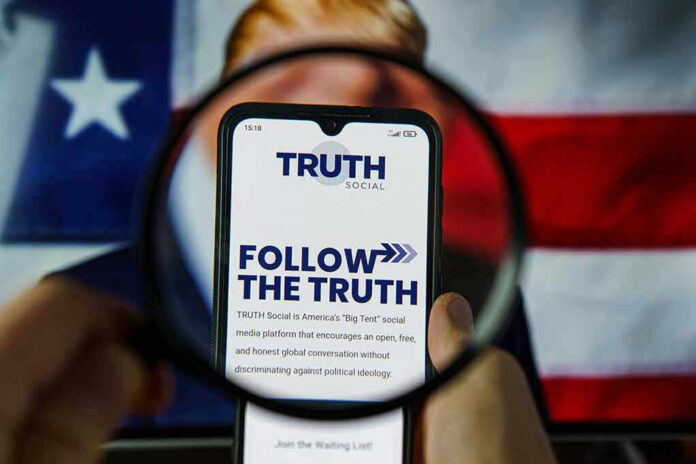
Progressive activists are hauling Trump’s Truth Social posts into court to override policy and score wins a ballot box couldn’t deliver.
Story Highlights
- Federal judges have cited Trump’s Truth Social posts as evidence when weighing policy disputes, including SNAP funding.
- Litigants argue presidential social posts equal formal policy, testing limits of executive communications and separation of powers.
- Agencies face preservation demands for posts, inviting lawfare that can sidestep Congress and the rulemaking process.
- Traditional evidence rules are applied piecemeal to social media, creating uncertainty and incentives for forum-shopping.
Courts Weigh Social Posts Against Actual Policy Actions
U.S. District Chief Judge John J. McConnell Jr. in Rhode Island cited a Truth Social post attributed to President Trump about SNAP benefits when ordering full funding. The White House later clarified the administration intended to pay half of November benefits, highlighting a gap between a social media statement and the implementation plan. The ruling demonstrates how litigants leverage posts as contemporaneous “admissions,” while courts wrestle with whether off-the-cuff online comments reflect binding executive policy or political speech.
The evidentiary move builds on a broader pattern since 2016: trial courts have treated social media as admissible if authenticated and relevant. Without social-specific amendments to the Federal Rules of Evidence, judges adapt traditional standards to tweets and posts. That patchwork invites tactical filings by advocacy groups eager to freeze or redirect executive action through preliminary orders. Conservatives see a risk: a president’s informal remarks can be weaponized to override duly delegated agency discretion and the constitutional roles of the branches.
Activist Strategy: Convert Posts Into Policy Commitments
Legal challengers increasingly argue presidential posts are authoritative statements of intent from “official” channels. They then press courts to treat the posts as controlling, even when agency guidance or budget instructions say otherwise. This tactic reframes political communication as binding policy, allowing plaintiffs to bypass the Administrative Procedure Act’s notice-and-comment process. It also pressures staff to react to headlines rather than planned implementation, undermining orderly governance and inviting injunctions based on rhetoric rather than promulgated rules.
Preservation demands amplify the strategy. Watchdog groups have urged the White House and the National Archives to preserve and prevent deletion of Truth Social posts as presidential records. That posture treats every online utterance as a document of state, expanding discovery exposure and creating litigation hooks. While transparency matters, blanket treatment of social posts as formal records invites gotcha lawfare, turning rapid-fire commentary into a minefield that opponents can trigger to halt programs or manufacture contradictions with agency actions.
Rule-of-Law Implications for Separation of Powers
Trial-level reliance on social posts risks elevating expressive speech above the formal instruments that govern policy: statutes, regulations, executive orders, and budget apportionments. When judges privilege social media over official directives, the judiciary informally rewrites the hierarchy of authority. That dynamic encourages forum-shopping and emergency motions that chase viral statements. Conservatives should insist that courts give primary weight to the written record of agency actions and legal texts, not to fleeting posts that lack the deliberation Congress and the APA require.
Applying traditional evidence rules case by case, without appellate guidance, leaves agencies uncertain and chilling presidential communication. Presidents must be free to speak candidly to the public while policy is developed through proper channels. Treating posts as per se policy blurs lines between advocacy and administration, inviting endless injunction cycles. A sound approach would allow posts as context while requiring plaintiffs to prove concrete, final agency action or clear legal directives before courts substitute judgment or compel spending.
Practical Guidance for the Administration and Readers
The administration can narrow litigation exposure by aligning posts with published directives and promptly clarifying when commentary is not self-executing policy. Clear labels distinguishing opinion, intent, and operative guidance would reduce ambiguity. Agencies should anchor decisions in the Federal Register, apportionments, and formal memos, ensuring courts see an authoritative record. Congress can reinforce this by reaffirming that social media statements do not constitute final agency action absent accompanying lawful instruments.
For readers, this fight is about constitutional guardrails and common sense. Activists prefer courtrooms to elections, using posts to force outcomes that belong to legislatures and accountable agency processes. The response is not silence; it is discipline. Demand that policy be made where the Constitution places it, insist on transparent rulemaking over viral screenshots, and support reforms that keep speech free while keeping law grounded in statutes, orders, and duly issued regulations—not in the latest post.
Sources:
Trump, Twitter, and truth judgments: The effects of “disputed” tags …
White House, NARA must ensure Trump’s deleted Truth Social posts …
Judge Cites Trump’s Own Truth Social Post in Order to Fully Fund …