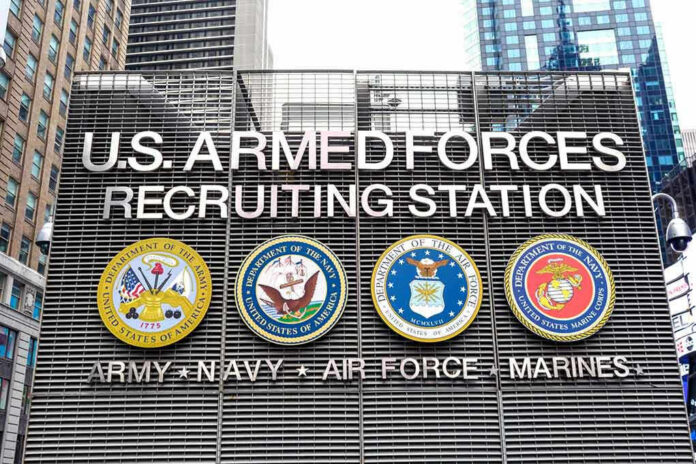
A new push in Congress would let cannabis-failed recruits into the Air Force and Marine Corps, raising hard questions about standards, readiness, and the future of our military.
Story Snapshot
- The Army and Navy already use waivers for recruits who test positive for THC, and now one lawmaker wants the Air Force and Marine Corps to follow.
- Supporters say past marijuana use should not block willing volunteers when the services face a major recruiting crisis.
- Critics warn that waivers chip away at the military’s long-standing zero-tolerance drug policy and could erode discipline.
- Federal law still bans marijuana nationwide, even where states have legalized it, keeping service members under strict rules.
What This New Waiver Push Would Do
One Republican lawmaker is pushing to let recruits who fail cannabis tests get waivers in the Air Force and Marine Corps, just as the Army and Navy already do.[1] His amendment builds on earlier efforts by Representative Dave Joyce of Ohio, who pressed to expand marijuana waivers for recruits who test positive for tetrahydrocannabinol, the main compound in cannabis.[1] The goal is simple on paper: open the door for otherwise qualified young Americans who used marijuana before enlistment but say they are ready to live by strict military rules.
Representative Matt Gaetz of Florida adds another layer, backing language in the defense bill that would stop the services from even testing new recruits for marijuana as a condition of joining.[3][5] He argues the country faces a recruitment and retention crisis “unlike any other time in American history” and that prior cannabis use should not automatically keep people from serving.[1][3] Supporters believe this could make the pool of eligible recruits larger at a time when fewer young people want, or are able, to meet entry standards.[5]
How The Army And Navy Already Handle Cannabis
The Army has quietly eased some rules on past marijuana offenses as recruiting has grown harder.[15] Recent regulation changes mean recruits with a single conviction for cannabis or drug paraphernalia no longer need a special misconduct waiver from the Pentagon to enlist.[15] Instead, Army Recruiting Command can handle these cases, and there is no longer a required two-year wait as there once was.[15] Army officials have said the change “accounts for changes in society,” while still drawing a hard line on repeated offenses and current drug use.[15]
The Navy has gone even further on failed drug tests at boot camp.[6] Rear Admiral James Waters explained that recruits who arrive at Great Lakes, Illinois, and test positive for THC no longer get kicked out automatically.[2][6] Instead, the Navy expanded waiver authority so those recruits can be evaluated and possibly kept, if they admit their past use and commit to a drug-free career.[2][6] Waters said the Navy wants to be “reflective of where legislation is in society,” noting that many states have legalized marijuana, but he also stressed, “We don’t do drugs in the military.”[2][6]
Air Force, Space Force, And The Emerging Waiver Model
The Air Force and Space Force are already testing a softer approach for new applicants who pop positive for THC at entry processing.[5][4] A two-year pilot program announced in 2022 allows some otherwise high-performing candidates to wait 90 days and retest after an initial positive result.[4] If they pass the second test, they can enlist, but they must then follow the Uniform Code of Military Justice and Department of the Air Force rules, which still ban drug use for active-duty service members.[4] Senior leaders have said this could become permanent policy if the pilot proves helpful.[4]
As of 2026, guidance for recruits shows the Navy and Air Force allowing waivers or re-testing for pre-service cannabis use, treating it as a social reality rather than a moral failure.[7] At the same time, active-duty members remain under strict “no cannabis, no hemp” rules, and even “accidental” ingestion of legal hemp products can still trigger a career-ending positive test.[7][8] That tension sits at the center of this debate: the system is slowly forgiving what people did before they wore the uniform, while keeping a tight grip once they are in.
The Constitutional And Readiness Concerns
Many conservatives worry that these waiver moves could chip away at discipline and the military’s clear moral standards. Under Article 112a of the Uniform Code of Military Justice, marijuana use, possession, or distribution is illegal for service members, no matter what state law says.[8][9] Department of Defense policy and drug programs still enforce a zero-tolerance stance.[8] Critics argue that a military that starts bending its own rules to match “woke” state policies risks weakening the clear lines that keep our forces focused, ready, and above the culture wars raging outside the gate.
There is also a legal clash that bothers many who value the rule of law. States have legalized marijuana for recreation, but federal law still classifies it as a Schedule I drug, and the Justice Department and Department of Defense treat it as illegal in all settings.[8][9] Navy guidance to personnel in states with legal cannabis warns that marijuana remains banned on bases for service members, families, and civilians alike, and that even off-duty federal employees can face consequences for use.[9] That means waivers live in a narrow space: they forgive past behavior but do not change the law or the standards once a recruit signs up.
What We Still Don’t Know
Both sides of the debate lack solid numbers on how cannabis waivers affect readiness, discipline, or long-term drug use. Supporters can point to the Navy granting more than a thousand waivers in recent years and the Air Force tripling the marijuana waivers it expected after changing its policy, but detailed performance data on those recruits is not yet public.[7][16] Opponents warn that any softening of standards could send the wrong signal, yet they also do not offer hard evidence that waiver recruits perform worse than others.[7]
Legal scholars note that the military likely has the authority to keep its cannabis ban even if Congress someday changes national law, because courts give wide leeway to commanders to protect order and discipline.[7][14] At the same time, those scholars warn that strict bans could hurt recruiting and retention in a country where marijuana use has become common.[14] For constitutional conservatives, the core question is whether easing entry rules for past cannabis use is a smart, targeted fix to a real recruiting crisis—or the first step on a slippery slope that blurs the line between civilian vice and military virtue.
Sources:
[1] Web – Lawmaker Wants to Let Cannabis-Failed Recruits Into Air Force & …
[2] Web – Congressional Amendment Would Expand Marijuana Waivers For …
[3] YouTube – U.S. Navy Expands Marijuana Waiver Authority To …
[4] Web – Recruits Wouldn’t Be Tested for Marijuana Under Proposed Defense …
[5] Web – Matt Gaetz Proposes Ending Cannabis Testing for Military Members
[6] Web – Air Force, Space Force may let in applicants who test positive for THC
[7] Web – [PDF] Recruits not tested for pot under new bill – Stripes Lite
[8] Web – Can You Smoke Weed in the Military? 2026 Policy and Waiver Guide
[9] Web – Rep. Matt Gaetz has proposed an amendment to a must-pass …
[14] Web – Marijuana Testing for Recruits Could End Under House’s Must-Pass …
[15] Web – GOP Pushes to Eliminate Cannabis Testing Ban for Military Recruits …
[16] Web – GOP Pushes to Eliminate Cannabis Testing Ban for Military Recruits in …
© patriotpostnews.com 2026. All rights reserved.